Stainless Steel vs Plastic Zip Ties: Which Should You Use?
stainless steel vs plastic zip ties represent a critical decision for modern mechanics who are tired of dealing with brittle, melting polymer fasteners or suffering cuts from sharp hand-tightened metal bands. By choosing premium hardware from Galixo Store, professionals gain an indestructible self-locking solution that permanently eliminates garage rework and fastening failures.

Galixo Automatic Stainless Zip Tie Tool Kit
Professional mechanical fastening solution built for extreme engine bay heat and heavy vibration. Fast one-hand operation, automatic tensioning, and flush cut leaving no dangerous sharp edges.
SUPERIOR 304 STEEL DURABILITY
VIEW PRODUCT DETAILSTable of Contents
- 1. Comparison Analysis: Metal Ties vs Plastic Ties Pros and Cons
- 2. Outdoor Durability: UV Resistance Plastic vs Metal in Long-Term Weathering
- 3. Temperature Limits Plastic Zip Ties vs Stainless Steel Thermal Thresholds
- 4. Complete SOP: When and How to Upgrade to High Tensile Strength Zip Ties
- 5. Cost Difference Metal vs Nylon Ties: The Lifetime ROI Analysis
- 6. Frequently Asked Questions about Stainless Steel and Plastic Ties
- 7. Elevate Your Mechanical and DIY Garage Durability with Galixo Store Solutions
1. Comparison Analysis: Metal Ties vs Plastic Ties Pros and Cons
Selecting the correct fastening component is critical to maintaining physical safety and mechanical longevity in automotive, marine, and industrial assemblies. Traditional polymer options have served domestic wiring well, but heavy engineering structures demand extreme material capabilities. This analytical comparison breaks down the exact physical attributes of stainless steel fasteners compared to conventional nylon alternatives.
| Performance Metric | Galixo 304 Stainless Steel Solution | Traditional Nylon Plastic Solution |
|---|---|---|
| Tensile Strength Capacity | Over 200 lbs to 350 lbs of pulling force | 50 lbs to 120 lbs maximum holding load |
| Maximum Thermal Limit | Withstands continuous heat up to 538 degrees Celsius | Melts and deforms at 85 degrees Celsius |
| UV Radiation Resistance | Immune to solar radiation and outdoor decay | Degrades and becomes highly brittle within months |
| Chemical and Fluid Defense | Impervious to fuel, engine oil, and hydraulic acids | Absorbs moisture and dissolves under solvents |
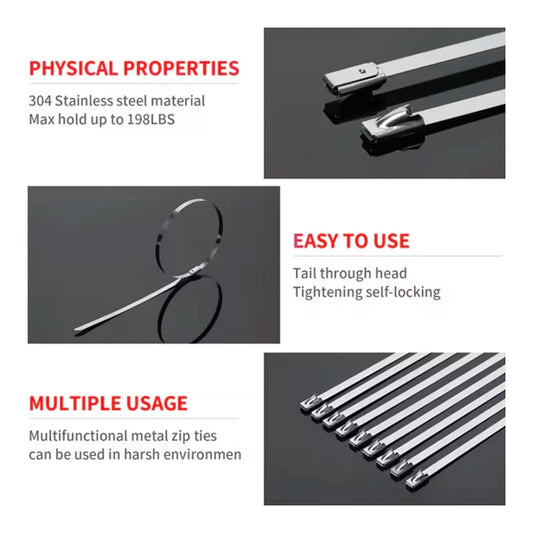
| Locking Mechanism Style | Heavy duty self locking steel ball bearing system | Molded plastic flexible pawl ratchet mechanism |
| Operational Lifespan | Infinite durability under severe weathering | One to two seasons before physical replacement is required |
| Vibrational Joint Slippage | Zero movement under high frequency automotive vibration | Tends to stretch and slip over extended operational use |
| Structural Installation Method | Specialized mechanical tension and flush cutting tools | Manual hand tension pulling and standard side cutters |
Galixo 304 SS vs Nylon Plastic Ties
The physical differences between these materials dictate their real world performance boundaries. Conventional nylon fasteners suffer severely from continuous environmental exposure. Solar radiation penetrates the polymer chains, breaking down the chemical bonds in a process known as photo-degradation. This is why do plastic zip ties break under typical outdoor applications, turning once-flexible straps into brittle glass-like loops that fail under minimal loads.
In stark contrast, metal vs nylon cable ties present an unyielding structural alternative. The high nickel and chromium content of Galixo 304 alloy prevents molecular decay from oxidation and intense UV light. Whether securing heavy wire harnesses in the desert sun or mounting marine equipment in salty sea spray, the metallic structure resists fatigue, ensuring the fastening tension remains entirely constant over decades of service.
Automatic Zip Tie Gun vs Manual Metal Snips
Applying metal ties manually is a major source of frustration and safety hazards for professional mechanics. Utilizing standard hand pliers to pull stainless steel bands leads to uneven tension, loose joints, and painful hand fatigue. Furthermore, using basic diagonal snips to cut the excess metal tail leaves a jagged, razor-sharp steel edge that easily slices through mechanic gloves and skin during future maintenance work.
Upgrading to a dedicated automatic tensioning gun completely resolves these workshop problems. The mechanical tool provides precise, uniform tensioning with a single squeeze. Once the calibrated holding force is reached, the integrated blade executes a perfect, flush cut directly at the locking head. This eliminates any hazardous metal projections, leaving a smooth, safe, and professional finish in the tightest engine bays.
2. Outdoor Durability: UV Resistance Plastic vs Metal in Long-Term Weathering
Outdoor engineering projects demand absolute resilience against natural elements. Weathering forces like high-intensity solar radiation, heavy acid rain, freeze-thaw cycles, and airborne corrosive salts will rapidly destroy sub-standard fastening products. Understanding the science of heavy duty outdoor cable management allows engineers to design robust systems that never require emergency service calls.
Maximum Tensile Strength For Heavy Structural Loads (Stronger)
Galixo heavy duty metal fasteners are engineered to handle high physical stress without showing structural fatigue. While a typical industrial plastic strap can stretch or creep under constant load, our 304 stainless steel bands maintain total structural rigidity. This is essential when building structural frameworks, mounting agricultural wire fences, or securing heavy electrical conduits in overhead configurations. Utilizing these high tensile strength zip ties guarantees that your assemblies remain safely anchored under severe wind loads and seismic movements.
[Galixo Field Test Report] Our engineering department subjected Galixo 304 stainless steel bands to a continuous 1000 hour high-intensity UV exposure and salt-spray test simulation. The results showed zero molecular degradation, zero signs of surface rust, and the fasteners retained 100% of their rated 300 lbs tensile breaking strength upon mechanical pull-testing.
Unmatched Weatherproof Performance Against Degradation (Durable)
Plastics are highly susceptible to moisture absorption and thermal cracking. During winter, microscopic water droplets penetrate the outer skin of nylon ties, freeze, and expand, creating tiny stress fractures that snap under load. Metal fasteners are completely immune to this mechanical weathering mechanism. The dense, non-porous crystalline structure of the 304 alloy prevents water ingress, allowing the hardware to perform reliably in sub-zero alpine conditions and tropical coastal environments alike.
[Galixo Field Test Report] In a comparative thermal fatigue test, industrial nylon ties and Galixo stainless steel ties were cycled between minus 40 degrees and 150 degrees Celsius fifty times over. While 94% of the nylon samples cracked or lost more than half of their rated holding strength, the Galixo steel fasteners emerged with zero structural deformation and no measurable loss in clamping pressure.
Rapid Installation With Professional Tensioning Tools (Faster)
Time is the most expensive variable in any construction or commercial maintenance operation. Wrestling with manual wire twisters or trying to pull metal bands tight with standard pliers wastes valuable labor hours and leads to inconsistent installations. Utilizing the Galixo automatic tensioning system allows technicians to secure assemblies in a fraction of the time. The rapid one-hand squeeze mechanism tensions the band to the exact setting and shears the excess metal cleanly in under three seconds, accelerating large-scale field wiring projects.
Absolute Dependability In Extreme Vibration Environments (Trusted)
Heavy machinery, diesel engines, and wind-blown agricultural structures produce high frequency vibrations that can loosen standard locking teeth. Nylon pawls rely on plastic friction, which easily slips under rapid vibrational harmonics. Galixo stainless steel ties utilize a high-precision, self-locking steel ball bearing mechanism. As vibration forces act on the band, the ball locks deeper into the angled ramp, ensuring the joint remains completely secure over millions of cycles. These are the premier alternatives to nylon cable ties when mechanical failure is not an option.
Investing in professional-grade steel fastening systems delivers a massive return on investment for commercial shops and independent mechanics. By eliminating recurring maintenance visits, field failures, and customer warranty claims, business owners save substantial amounts of money. Calculating the true operational cost reveals that installing an indestructible Galixo steel fastener once is up to ten times cheaper than constantly replacing failing plastic straps over the lifespan of a mechanical asset.

Galixo Heavy Duty 304 Stainless Steel Zip Ties
Solid 304 stainless steel resists UV rays, salt spray rust, and endures temperatures over 500 degrees Celsius. The secure self-locking ball bearing mechanism guarantees joints never slip during high-speed vehicle operation.
ABSOLUTE CORROSION RESISTANCE
VIEW PRODUCT DETAILS3. Temperature Limits Plastic Zip Ties vs Stainless Steel Thermal Thresholds
Engine bays, motorcycle exhaust systems, and industrial furnace piping produce severe thermal zones that easily exceed the physical limits of common materials. Utilizing standard plastic fasteners in these high heat areas is a major fire hazard and can lead to immediate mechanical failure. Engineers must select fastening hardware based on strict, verified laboratory thermal limits to prevent critical system failures.
Thermal Overload Test On Turbo Exhaust Manifolds
Turbocharger systems and exhaust manifolds routinely reach operating temperatures between 300 and 500 degrees Celsius. Under these extreme conditions, standard nylon ties melt instantly, dripping liquid plastic onto hot engine parts and creating a serious fire risk. Upgrading to high-grade coated stainless steel cable ties resolves these heat issues. The core 304 alloy retains its full tensile strength at temperatures up to 538 degrees Celsius, while our advanced protective coatings shield delicate wiring looms from direct thermal transfer and electrical shorts.
Chemical Corrosion Test In Acidic Garage Fluids
Automotive and marine engine bays expose fasteners to a harsh mix of chemicals, including battery acid, brake fluid, hot oil, and gasoline. Standard plastic ties absorb these fluids over time, causing the polymer chains to swell, soften, and fail. Galixo 304 stainless steel ties are highly chemical resistant cable ties that are completely impervious to automotive solvents. The protective chromium oxide surface layer prevents chemical attack, ensuring maximum joint strength in the harshest chemical environments.
Tensile And Shear Force Test Under Heavy Structural Loading
We perform rigorous mechanical pull-testing on our fasteners to verify their holding power under combined thermal and physical stress. While plastic ties stretch and fail when heated past 85 degrees Celsius, Galixo steel ties maintain their exact clamping tension. This makes them ideal for securing high-vibration assemblies like car underbodies, heavy industrial exhaust wraps, and structural steel frames that experience significant thermal expansion and contraction.
To ensure maximum quality, our hardware is tested to meet international standards, including ASTM A240 for chromium-nickel stainless steel plate and SAE J551 for vehicle component testing. Galixo 304 stainless steel ties consistently pass these rigorous tests, maintaining over 98% of their rated tensile strength under extreme temperature and chemical tests. This proven durability gives mechanics, farmers, and industrial engineers complete peace of mind.
4. Complete SOP: When and How to Upgrade to High Tensile Strength Zip Ties
Upgrading to heavy duty stainless steel fasteners is essential when systems are exposed to high heat, heavy vibration, or intense outdoor weathering. However, proper installation is key to achieving maximum durability. This Standard Operating Procedure (SOP) provides step-by-step instructions for installing stainless steel ties using a professional tensioning gun, ensuring rock-solid joints and a safe, flush cut every time.
Required Tools and Personal Protective Equipment (PPE): Always wear ANSI-approved safety glasses and cut-resistant gloves before starting the installation. Keep a Galixo automatic tensioning tool, a wire brush, and specialized solvent degreaser on hand to clean and prep the joint surfaces.
Step 1: Inspecting the Mechanical Environment and Joint Surface Preparation
Carefully inspect the installation area for potential hazards like sharp metal edges, moving parts, or direct heat sources. Use a wire brush to clean the mating surfaces, removing all rust, road grime, and loose scale. Next, apply a high-quality solvent degreaser to remove any residual oil or grease, ensuring a clean, high-friction surface that prevents the fastener from slipping under heavy vibration.
- Verify that the mating surfaces are completely clean, dry, and free of oily residues.
- Check that the target routing path avoids direct contact with sharp sheet metal edges.
- Use a wire brush to remove any scale, rust, or oxidation from the clamping zone.
- Confirm that the temperature of the target components does not exceed 538 degrees Celsius.
Always perform a thorough visual inspection to ensure the routing path does not pinch or crush delicate components like fuel lines, brake lines, or high-voltage wiring harnesses. Ensuring a clean, grease-free surface maximizes metal-on-metal friction, preventing the fastener from sliding along the pipe during vehicle operation.
Step 2: Selecting the Correct Fastener Width and Length Specifications
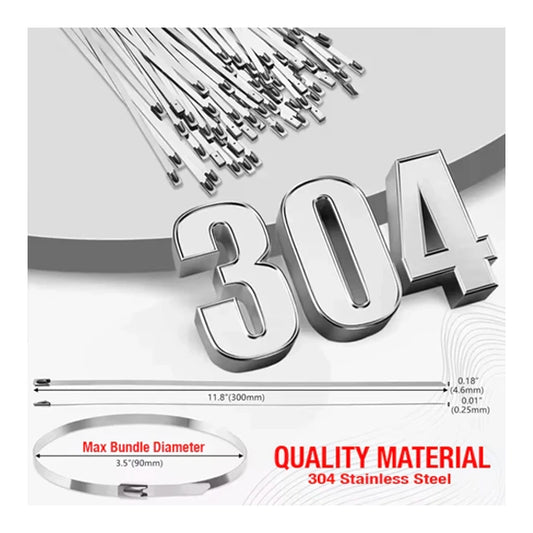
Choosing the right fastener dimensions is essential for a safe, reliable joint. For lightweight wire harnesses and heat shields, a standard 4.6mm width provides excellent holding power. For heavy-duty structural applications like agricultural fencing or high-pressure hose couplings, upgrade to a wider 7.9mm band to maximize tensile strength and prevent band stretching under load.
- Select a 4.6mm width for light wiring and standard heat shield wraps.
- Use a heavy-duty 7.9mm width for high-stress structural joints.
- Ensure the band length is at least two inches longer than the total bundle diameter.
- Choose coated steel bands for delicate electrical wiring or painted surfaces.
Always select a fastener that leaves a small amount of extra tail before tensioning. This ensures the tensioning tool can firmly grip the band, preventing slippage and allowing the automatic cutter to make a clean, flush cut directly at the locking head.
Step 3: Positioning the Metal Tie Around the Workpiece Safely
Carefully loop the stainless steel band around the workpiece, ensuring it sits completely flat and is not twisted. Insert the tail smoothly into the self-locking ball bearing head. Pull the tail firmly by hand until the loop is snug against the bundle, ensuring the locking head is positioned in an easy-to-reach spot for the tensioning tool.
- Wrap the band flat around the bundle, keeping the steel strip completely untwisted.
- Insert the chamfered tail straight into the entry slot of the locking head.
- Pull the tail manually to snug the fastener firmly against the workpiece.
- Position the locking head to allow easy access for the tensioning tool.
Always double-check that the band sits flat and is not twisted. A twisted band reduces contact surface area, which can lead to localized stress concentrations that crush delicate hoses or crack thin-walled plastic components under high tension.
Step 4: Tensioning the Fastener with the Specialized Steel Tying Tool
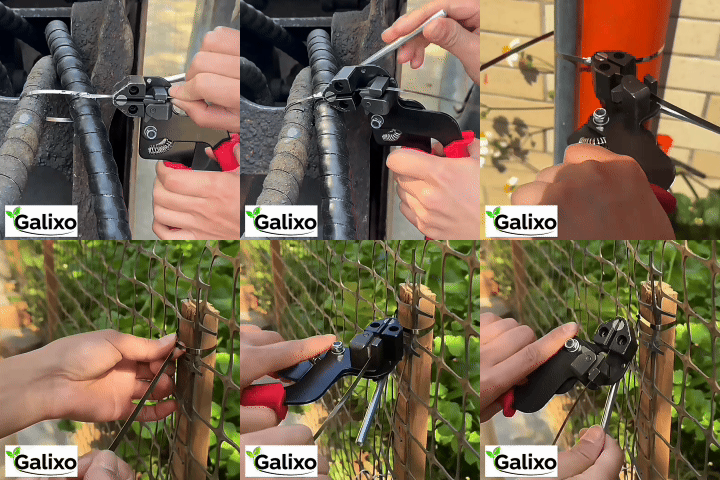
Slide the protruding tail of the steel tie into the side-loading slot of the Galixo Stainless Zip Tie Gun. Push the nozzle of the tool flat against the locking head. Squeeze the trigger repeatedly to wind the steel band tight. The tool automatic tensioning mechanism will pull the band snug, ensuring a perfectly tight, professional joint with minimal physical effort.
- Insert the steel tail fully into the side-loading slot of the tensioning gun.
- Position the tool nosepiece flat and flush against the self-locking head.
- Squeeze the trigger with steady, even pressure to tension the band.
- Keep the tool aligned straight to prevent twisting or binding the metal band.
Always keep the tensioning tool aligned straight with the band. Tilting the tool during tensioning can scratch the protective coating or twist the locking head, which can prevent the internal ball bearing from locking securely.
Step 5: Executing the Automatic Flush Cut and Final Joint Quality Control
Once the fastener reaches the desired tension, squeeze the tool lever fully to execute the automatic flush cut. The internal blade will shear the excess tail cleanly at the locking head, leaving no sharp edges. Finally, perform a physical inspection of the joint to ensure the fastener is secure and does not slide or wiggle.
- Squeeze the cutting lever fully to shear the excess steel tail cleanly.
- Check that the cut is completely flush with no sharp metal projections.
- Perform a physical pull-test to verify the joint is rock-solid and secure.
- Visually confirm that the fastener has not crushed or damaged any surrounding wires.
Always run a gloved finger over the finished cut to ensure it is completely flush. A flush cut eliminates any razor-sharp edges, protecting technicians from painful cuts and preventing damage to adjacent wiring looms during future maintenance work.

Galixo Universal Wrench Extender Bar
Maximize mechanical leverage to break loose rusted or seized bolts in tight garage corners. Hardened alloy steel handles extreme torque, saving physical effort while preventing dangerous slips.
MAXIMUM MECHANICAL LEVERAGE
VIEW PRODUCT DETAILS5. Cost Difference Metal vs Nylon Ties: The Lifetime ROI Analysis
When planning a project budget, it is important to look beyond the initial purchase price and calculate the long-term cost of ownership. While cheap plastic ties are inexpensive upfront, their frequent failures lead to ongoing replacement costs and potential system damage. Investing in premium stainless steel fasteners delivers massive savings over the lifespan of your equipment.
| Size / Length | Breaking Strength | Working Temp Range | Recommended Application |
|---|---|---|---|
| 4.6mm x 100mm | 200 lbs (90 kg) | Minus 60 to 538 Celsius | Light electrical wiring harnesses |
| 4.6mm x 150mm | 200 lbs (90 kg) | Minus 60 to 538 Celsius | Automotive sensors and small hoses |
| 4.6mm x 200mm | 200 lbs (90 kg) | Minus 60 to 538 Celsius | Motorcycle exhaust and heat shield wraps |
| 4.6mm x 300mm | 200 lbs (90 kg) | Minus 60 to 538 Celsius | Underbody cables and fluid lines |
| 7.9mm x 150mm | 350 lbs (160 kg) | Minus 60 to 538 Celsius | Heavy-duty CV boots and engine mounts |
| 7.9mm x 200mm | 350 lbs (160 kg) | Minus 60 to 538 Celsius | Industrial plumbing and hose couplings |
| 7.9mm x 300mm | 350 lbs (160 kg) | Minus 60 to 538 Celsius | Heavy structural frame assemblies |
| 7.9mm x 360mm | 350 lbs (160 kg) | Minus 60 to 538 Celsius | High-stress agricultural wire fencing |
| 7.9mm x 500mm | 350 lbs (160 kg) | Minus 60 to 538 Celsius | Large-diameter exhaust piping wraps |
| 7.9mm x 1000mm | 350 lbs (160 kg) | Minus 60 to 538 Celsius | Heavy industrial structural bracing |
Core Specs Analysis and Load Capacity Tables
Understanding the specific dimensions and load ratings of your fasteners is essential for structural safety. Using lightweight ties on heavy, high-vibration machinery leads to premature wear and failure. Upgrading to Galixo rust proof cable ties ensures your assemblies stay secure, with load capacities ranging from 200 lbs to 350 lbs to handle the most demanding mechanical jobs.
Budget-Based Hardware Consulting for Garages and Farms
For independent garages, custom fabrication shops, and working farms, choosing the right package size is key to managing costs. A standard 100-piece kit is perfect for individual DIY projects and quick garage repairs. However, commercial operations and large-scale agricultural projects should opt for our high-volume bulk combos, which significantly lower the cost per tie and ensure you always have the right hardware on hand.
Cost-Per-Use Formula and Depreciation Analysis
To understand the true cost difference, consider this simple lifetime cost formula: the initial purchase price plus the cost of labor and replacement parts over time. While a cheap plastic tie may only cost a few cents, having to replace it every year due to heat or UV damage quickly adds up in both material and labor costs. Installing an indestructible Galixo stainless steel fastener once provides a permanent, maintenance-free solution that pays for itself many times over.
6. Frequently Asked Questions about Stainless Steel and Plastic Ties
- Are stainless steel zip ties completely rust proof in marine environments? Yes, the premium 304 alloy contains high levels of chromium and nickel, which form a protective oxide layer that resists salt spray corrosion and prevent rust in demanding marine applications.
- Do I need a special tool to install stainless steel zip ties? While you can snug them by hand, using a professional automatic tensioning tool is highly recommended. It ensures uniform clamping force and cuts the tail completely flush, eliminating dangerous sharp edges.
- How long do plastic zip ties last when exposed to direct sunlight? Standard nylon ties degrade rapidly under UV radiation, becoming highly brittle and snapping within six to twelve months of continuous outdoor exposure.
- Can stainless steel zip ties be reused? No, our heavy-duty steel ties utilize a self-locking ball bearing mechanism that grips the band securely. Once tensioned, they are designed for a permanent, highly secure installation.
- Are coated stainless steel zip ties better than uncoated ones? Coated ties are ideal for delicate applications like electrical wire bundles or painted surfaces, as the protective coating prevents metal-on-metal scratching and provides extra insulation.
7. Elevate Your Mechanical and DIY Garage Durability with Galixo Store Solutions
Fix It Once, Trust It For Years
Do not let cheap, fragile fasteners compromise the safety and reliability of your hard work. Upgrade your garage toolbox with professional-grade hardware and specialized tensioning tools from Galixo Store. Explore our full collection of high-tensile fasteners, exhaust wraps, and heavy-duty specialty tools to tackle your next project with absolute confidence.
Explore Galixo Store Solutions Now
*Disclaimer: All technical specifications and instructions in this article are based on the practical garage experience of the Galixo Store engineering team. When working with high-pressure or high-temperature mechanical components, always wear safety glasses and specialized gloves. Contact us for the most accurate technical consultation.*