Chemical Resistant Cable Ties for Harsh Industrial Environments
chemical resistant cable ties from Galixo Store deliver maximum tensile strength in highly corrosive industrial environments, eliminating the frequent failures of standard plastic fasteners that melt under harsh chemical exposure. Engineered for long-term reliability in severe processing environments, these premium metal ties guarantee uncompromised support for industrial cable assemblies and chemical piping systems.

Galixo Automatic Stainless Zip Tie Tool Kit
Professional mechanical fastening solution built for extreme engine bay heat and heavy vibration. Fast one-hand operation, automatic tensioning, and flush cut leaving no dangerous sharp edges.
SUPERIOR 304 STEEL DURABILITY
VIEW PRODUCT DETAILSTable of Contents
- Understanding the Chemistry of Chemical Resistant Cable Ties in Acidic Environments
- Comparing Marine Grade 316 Stainless Steel and Fluoropolymer Zip Ties
- Selection Criteria and Engineering Specifications for Harsh Environments
- Industrial Case Studies: Refinery, Plating, and Wastewater Solutions
- Step-by-Step Practical SOP for Installing Chemical Resistant Cable Ties
- Frequently Asked Questions about chemical resistant cable ties (FAQs)
- Elevate Your Mechanical & DIY Garage Durability with Galixo Store Solutions
To thoroughly address industrial requirements, this engineering guide evaluates five critical sub-intents:
- Technical Mechanisms: Chemical degradation mechanics and metallurgical compositions of alloys.
- Material Comparison: Deep chemical resistance analysis of 316 stainless steel versus high-performance polymers.
- Selection Criteria: Sizing, tension metrics, and physical limits for severe pipeline environments.
- Industrial Applications: Case studies in refining, electroplating baths, and wastewater facilities.
- Installation Protocol: Precise step-by-step Standard Operating Procedures for professional assembly.
Understanding the Chemistry of Chemical Resistant Cable Ties in Acidic Environments
High-performance chemical resistant fasteners rely on advanced metallurgical composition to resist corrosive elements like sulfuric acid and sodium hydroxide. Unlike standard nylon ties that hydrolyze and shatter, these heavy-duty fasteners maintain structural integrity by forming a continuous passive oxide layer that prevents molecular degradation in harsh chemical plant environments.
Material Origin and Nature
The chemical resistance of high-grade metal fasteners stems directly from their atomic structure. Under global manufacturing guidelines like the ASTM A240 standards, high-grade alloys contain chromium, nickel, and molybdenum. Chromium reacts naturally with ambient oxygen to form an invisible, self-healing chromium oxide film. This passive layer blockades acids and aggressive ions from reaching the underlying steel core. To protect critical electrical wire runs from acidic fluids, plant engineers often conduct an acid spot test for stainless ties. This test verifies the metallurgical grade, confirming the absence of cheap structural fillers that compromise resistance under exposure to hydrochloric or nitric acids.
Anatomy Breakdown of Industrial Fasteners
To survive in a processing plant, a heavy-duty fastener must possess a robust, failure-proof design. The internal mechanical architecture consists of four distinct engineered components:
- Precision Ball Bearing Lock: A hardened stainless steel ball housed in a tapered chamber that wedges against the band, guaranteeing a slip-free mechanical lock.
- Chamfered Edge Profile: Smoothly rounded band edges that prevent sharp metal from slicing through wire jackets or pipe insulation during high-vibration operations.
- High-Tensile Band Body: A solid, unperforated metal strip designed to withstand extreme radial force without stretching.
- Tapered Self-Threading Tail: An angled tip that allows effortless insertion into the locking head, streamlining rapid one-handed installation.
The Self-Locking Operating Principle
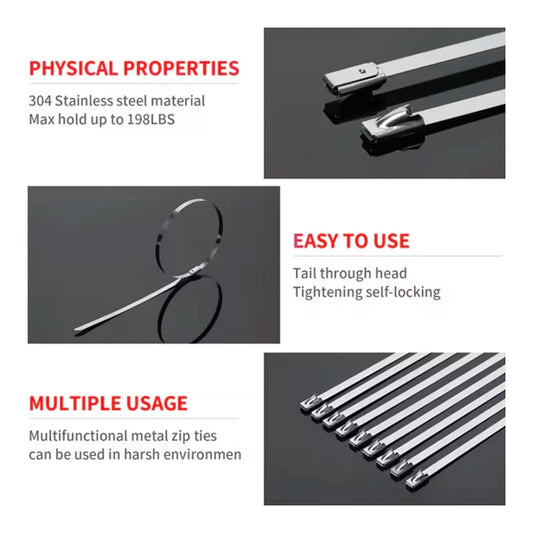
The physics of the self-locking mechanism is simple yet highly efficient. When the metal band is threaded through the locking chamber, the internal steel ball moves freely along a ramped ceiling. As tension is applied and the tail is pulled, the ball rolls back down the ramp, wedging itself tightly against the band. Any outward radial force from the bundled cables pushes the ball deeper into the wedge, increasing the locking force. This ensures that even under severe pipe vibrations and thermal fluctuations, the connection remains absolutely rigid, eliminating the danger of loose cables falling into industrial machinery baths.
Comparing Marine Grade 316 Stainless Steel and Fluoropolymer Zip Ties
Selecting the correct fastener material requires a direct comparison of physical properties, thermal thresholds, and resistance ratings against industrial agents. The table below details the performance of premium metal fasteners versus traditional plastic tying options.
| Performance Criteria | Galixo 316 Stainless Steel Solution | Traditional Nylon / Plastic Solution |
|---|---|---|
| Sulfuric Acid Resistance | Excellent - No structural decay | Poor - Rapid polymer chain hydrolysis |
| Hydrochloric Acid Exposure | High - Strong resistance to pitting | Very Poor - Embrittles within hours |
| Maximum Temp Limit | Up to 538 degrees Celsius (1000 degrees Fahrenheit) | Up to 85 degrees Celsius (185 degrees Fahrenheit) |
| Minimum Temp Limit | Down to -80 degrees Celsius | Down to -40 degrees Celsius (becomes brittle) |
| UV & Sunlight Durability | Infinite - No UV degradation | Very Limited - Photo-oxidation cracking |
| Tensile Strength Capacity | Over 200 lbs to 350 lbs | 50 lbs to 120 lbs maximum |
| Moisture Absorption | 0.00% - Totally non-hygroscopic | Up to 2.50% - Swells and weakens |
| Expected Lifespan | Decades of continuous service | 1 to 2 years before replacement |
Galixo 304 and 316 SS vs Nylon Plastic Ties
Standard nylon fasteners suffer from polymer degradation when exposed to automotive oils, industrial acids, or UV radiation. Over time, chemical molecules break down the internal polymer bonds, causing the plastic to swell, turn brittle, and snap under tension. Upgrading to marine grade 316 stainless steel zip ties solves this issue completely. The inclusion of molybdenum in the 316 alloy provides superior resistance to chloride-induced pitting, making it far more reliable than standard polymers in highly acidic environments.
Automatic Zip Tie Gun vs Manual Metal Snips
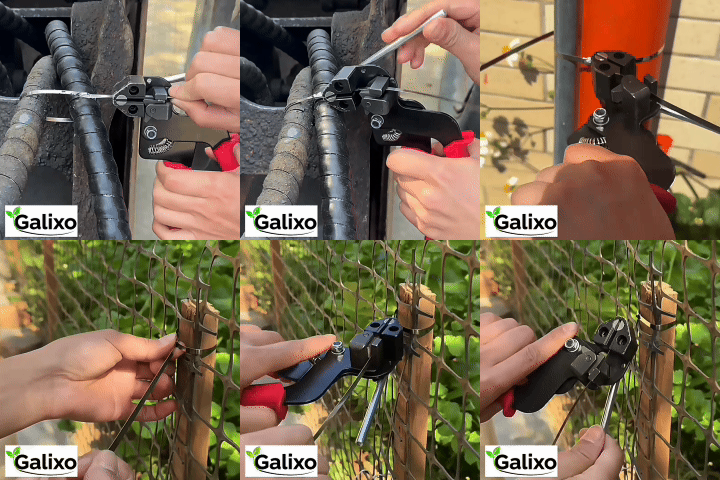
Manual installation of metal fasteners using pliers and wire snips is slow, inconsistent, and physically demanding. It frequently leaves jagged tails that can cut workers during maintenance. Utilizing a professional tensioning tool allows for smooth, one-handed operation. The tool tensions the metal band to an exact preset force and executes a perfectly clean, flush cut. This speeds up assembly, ensures consistent tension across all bundles, and eliminates dangerous metal burrs, making the work environment much safer.

Galixo Heavy Duty 304 Stainless Steel Zip Ties
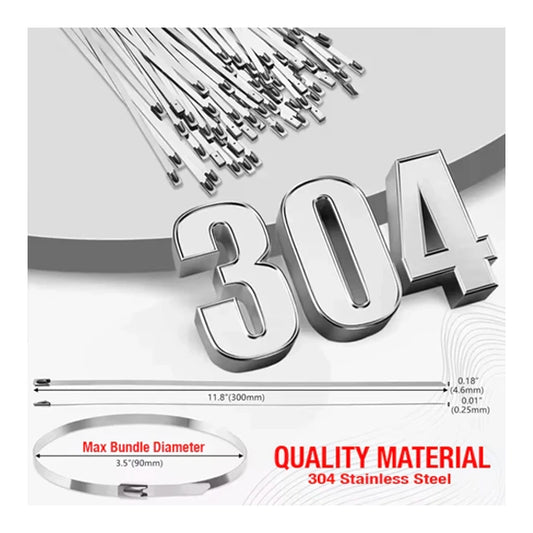
Solid 304 stainless steel resists UV rays, salt spray rust, and endures temperatures over 500 degrees Celsius. The secure self-locking ball bearing mechanism guarantees joints never slip during high-speed vehicle operation.
ABSOLUTE CORROSION RESISTANCE
VIEW PRODUCT DETAILSSelection Criteria and Engineering Specifications for Harsh Environments
Choosing the right fastener involves matching the diameter of your piping or cable bundles with the physical width, thickness, and load limits of the tie. Standardized dimensions must be observed to prevent structural failures under heavy loads or extreme pressures.
| Size & Length (mm) | Width & Thickness (mm) | Tensile Strength (lbs / kg) | Recommended Application |
|---|---|---|---|
| 4.6 x 100 mm | 4.6 x 0.25 mm | 200 lbs / 90 kg | Small sensor wire routing, tight engine bay areas |
| 4.6 x 150 mm | 4.6 x 0.25 mm | 200 lbs / 90 kg | Light harness bundling, motorcycle exhaust wraps |
| 4.6 x 200 mm | 4.6 x 0.25 mm | 200 lbs / 90 kg | General automotive harness routing, bracket mounts |
| 4.6 x 300 mm | 4.6 x 0.25 mm | 200 lbs / 90 kg | Standard pipe heat shielding, chemical duct fastening |
| 7.9 x 200 mm | 7.9 x 0.25 mm | 350 lbs / 160 kg | Heavy hydraulic hoses, structural joint reinforcing |
| 7.9 x 300 mm | 7.9 x 0.25 mm | 350 lbs / 160 kg | Industrial pipeline mounting, heavy chemical conduits |
| 7.9 x 360 mm | 7.9 x 0.25 mm | 350 lbs / 160 kg | Medium diameter exhaust runs, agricultural main fences |
| 7.9 x 500 mm | 7.9 x 0.25 mm | 350 lbs / 160 kg | Large industrial pipes, structural scaffolding joints |
| 12.0 x 300 mm | 12.0 x 0.35 mm | 450 lbs / 200 kg | Extra heavy-duty shipping cables, high-pressure pipes |
| 12.0 x 500 mm | 12.0 x 0.35 mm | 450 lbs / 200 kg | High-load wastewater piping, offshore energy cables |
Core Specifications Analysis
Understanding the mechanical limits of your fastening hardware is vital to avoiding failures on the factory floor. Heavy-duty pipes require wider bands (such as 7.9mm or 12.0mm options) to distribute structural loads and prevent crushing insulated sleeves. Using certified rohs compliant stainless cable ties guarantees that your fastening hardware is free of dangerous heavy metals like lead or cadmium, preventing contamination in food processing or chemical manufacturing lines.
Budget-Based Sourcing and Combos
Purchasing separate tools and fasteners often leads to compatibility issues and higher costs. For standard garage setups, a starter bundle with an automatic tension tool and 100 metal ties is highly cost-effective. Industrial manufacturing plants benefit most from purchasing large-scale bulk combos (such as 1000 pieces), which significantly lowers the cost per unit and ensures installers always have matching high-grade hardware available.
Cost-Per-Use and Long-Term ROI Formula
While nylon ties have a cheap upfront cost, their frequent failures make them expensive over time. Standard plastic ties degrade rapidly in chemical environments, requiring replacement every six months. This results in recurring material costs and expensive maintenance downtime. Premium metal fasteners last for decades without degrading. Investing in durable stainless steel solutions reduces long-term maintenance costs and boosts overall operating efficiency.
Industrial Case Studies: Refinery, Plating, and Wastewater Solutions
Industrial facilities rely on high-grade metal fasteners to maintain secure cable routing in demanding processing zones. The following field cases illustrate how premium stainless steel hardware stands up to severe chemical exposure.
Petrochemical Refineries and Refinery Cable Management
Refineries present extremely harsh conditions for cable management systems. Fasteners in crude distillation towers face exposure to sulfurous compounds, continuous vibration up to 8000 RPM, and temperatures reaching 400 degrees Celsius. Using standard ties near steam vents can result in cracking and failure. Installing heavy-duty stress corrosion cracking ties prevents metal fatigue in high-vibration areas, ensuring refinery cables remain safely secured.
Electroplating Plants and Acidic Bath Fastening
Electroplating operations generate aggressive mists from chromic acid and zinc chloride baths. Standard nylon ties disintegrate within weeks under these conditions. Upgrading to coated stainless steel cable ties protects the core metal from corrosive vapors. The protective polymer coating acts as a chemical barrier and insulates cables against electrical current leakage and galvanic corrosion.
Municipal Wastewater Treatment Facilities
Wastewater plants expose equipment to highly corrosive hydrogen sulfide gas, chlorine sanitizers, and high humidity. In these conditions, standard carbon steel and plastics degrade rapidly. Installing heavy-duty dnv approved marine cable ties ensures long-term safety and structural integrity, resisting rust in humid environments and keeping critical lines securely fastened.
Semiconductor Cleanroom Cable Management
Cleanroom environments require fasteners that do not release microscopic particles or chemicals. Standard plastic ties can outgas polymer compounds, which ruins delicate silicon wafers. Using premium metal ties is the ideal solution. Practicing the proper steps for selecting stainless ties for cleanrooms ensures cleanroom assemblies remain contaminant-free while resisting chemical sterilization washes.
Step-by-Step Practical SOP for Installing Chemical Resistant Cable Ties
Before beginning installation, ensure all safety protocols are observed. Wear safety glasses and cut-resistant gloves to protect your hands from metal edges. De-energize all nearby electrical lines to prevent shocks.
Step 1: Selecting and Aligning the Correct Metal Fastener
Measure the diameter of your cable or pipe bundle. Choose a metal fastener with a length at least 50mm longer than the bundle circumference. Wrap the band smoothly around the bundle, keeping the metal band straight and untwisted. Insert the tapered tail into the locking head until the self-locking ball bearing engages the band.
Step 2: Inserting the Metal Band into the Tensioning Tool
Slide the free tail of the metal band into the side slot of your automatic tensioning tool. Push the tool nozzle forward until it rests flat against the locking head. Keep the tool aligned perpendicularly to the band to ensure a straight cut and clean installation.
Step 3: Adjusting Tension and Squeezing the Trigger
Adjust the tension dial on your tool to match the load requirements of your bundle. For general wiring, a moderate tension setting is ideal to avoid crushing the insulation. Squeeze the tool trigger repeatedly to pull the metal band through the locking head and secure the bundle.
Step 4: Activating the Cutting Lever for a Flush Finish
Once the preset tension is reached, squeeze the cutting lever on the tool. The internal blade cuts the excess metal tail perfectly flush with the locking head. This flush cut eliminates sharp metal edges, keeping the installation safe for future maintenance work.
Step 5: Conducting the Hand Tension Inspection
Visually inspect the completed locking head to ensure the metal cut is flush and smooth. Grab the cable bundle and apply firm physical pressure to confirm it is held securely in place. Ensure the tie does not slide along the pipe or allow individual wires to pull loose under load.

Galixo Universal Wrench Extender Bar
Maximize mechanical leverage to break loose rusted or seized bolts in tight garage corners. Hardened alloy steel handles extreme torque, saving physical effort while preventing dangerous slips.
MAXIMUM MECHANICAL LEVERAGE
VIEW PRODUCT DETAILSFrequently Asked Questions about chemical resistant cable ties (FAQs)
- How does 316 stainless steel compare to 304 in chemical resistance? - Alloy 316 contains added molybdenum which significantly increases resistance to pitting and crevice corrosion from chloride environments and industrial acids, making it superior to 304 in coastal or chemical processing plants.
- Can chemical resistant plastic zip ties withstand direct engine bay exhaust heat? - No, standard chemical resistant plastics degrade and lose structural strength at temperatures above 150 degrees Celsius, whereas premium stainless steel ties operate reliably at temperatures up to 538 degrees Celsius.
- Are these industrial metal fasteners safe to use in cleanrooms? - Yes, high-grade stainless steel fasteners do not outgas chemicals or shed microscopic particles, making them the ideal choice for cleanroom cable management and pharmaceutical production areas.
- Do these metal ties require a specialized tool for installation? - While you can tension them manually, using an automatic zip tie tension gun ensures consistent tensioning and cuts the excess metal tail perfectly flush, eliminating sharp edges.
- Do coated stainless steel ties offer better chemical protection than bare steel ties? - Yes, coated ties provide extra resistance to galvanic corrosion and chemical vapors while protecting delicate wire jackets from metal-on-metal wear.
Elevate Your Mechanical & DIY Garage Durability with Galixo Store Solutions
Upgrade to Professional-Grade Hardware Built for Tough Environments
Stop wasting time with cheap plastic ties that break and melt under tough conditions. Galixo Store provides high-performance metal fasteners and specialized tools built for extreme temperatures, high vibration, and chemical exposure. Secure your exhaust wraps, wire harnesses, and industrial piping with hardware you can trust to last for years.
Explore our full collection of heavy-duty fastening solutions at Galixo Store today!
*Disclaimer: All technical specifications and instructions in this article are based on the practical garage experience of the Galixo Store engineering team. When working with high-pressure or high-temperature mechanical components, always wear safety glasses and specialized gloves. Contact us for the most accurate technical consultation.