High Tensile Strength Zip Ties: The Strongest Fasteners
high tensile strength zip ties eliminate the frustration of brittle plastic fasteners melting under high engine heat or sharp manual steel cuts by providing maximum mechanical durability. The professional heavy duty options from Galixo Store ensure a secure hold in the most punishing garage, farm, and industrial environments.

Galixo Automatic Stainless Zip Tie Tool Kit
Professional mechanical fastening solution built for extreme engine bay heat and heavy vibration. Fast one-hand operation, automatic tensioning, and flush cut leaving no dangerous sharp edges.
SUPERIOR 304 STEEL DURABILITY
VIEW PRODUCT DETAILSTable of Contents
- Decoding High Tensile Strength Zip Ties and the Science of Maximum Locking Force
- Decoding the 200 LBS Rating of High Tensile Strength Zip Ties Through Real-World Lab Testing
- Ultimate Comparison of Heavy Duty Tensile Strength Ties: 304 Stainless Steel vs Nylon Plastic
- Step-by-Step SOP for Securing Heavy Scaffolding and Industrial Loads Safely
- Where to Buy the Strongest Cable Ties Available with Certified Industrial Specifications
- Frequently Asked Questions about high tensile strength zip ties (FAQs)
- Elevate Your Mechanical & DIY Garage Durability with Galixo Store Solutions
To deliver absolute technical transparency and fulfill specific engineering needs, this technical manual analyzes industrial fastening systems across five core objectives. First, we examine the structural metal composition and locking chemistry of the strongest fasteners available on the market. Second, we explain the physical reality of the 200 LBS load-bearing metric through controlled laboratory tension tests. Third, we map the performance differences between premium grade metal fasteners and standard commercial nylon loops. Fourth, we provide structured operating methods for rigging heavy construction frameworks and agricultural systems safely. Finally, we establish quality inspection benchmarks and purchasing pathways for certified heavy duty hardware.
Decoding High Tensile Strength Zip Ties and the Science of Maximum Locking Force
High tensile strength zip ties refer to highly engineered industrial fastening bands designed to resist massive shear and tensile loads without yielding. Utilizing structural premium grade materials, these fasteners secure critical components in demanding mechanical environments. Their locked stability relies on precision-machined physical retention interfaces that prevent loop slippage under continuous mechanical tension.
Material Metallurgy and the Science of 304 Stainless Steel
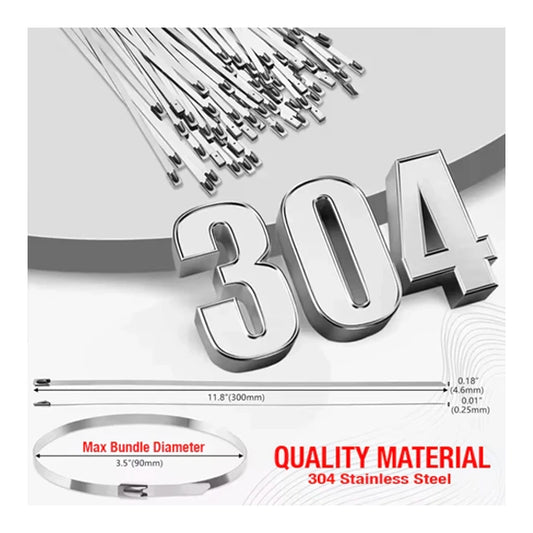
The structural performance of high-strength fasteners depends directly on metallurgy. Premium 304 grade stainless steel utilizes a specialized chemical composition containing approximately 18% chromium and 8% nickel. This precise ratio forms an invisible, self-healing chromium oxide film on the metal surface, which blocks oxygen and corrosive elements from penetrating the internal iron structure. In aggressive garage environments containing battery acid, salt spray, and road grime, this protective chemical layer prevents rust and degradation. This high-density metallic matrix also ensures low tensile elongation percentages under high structural loads.
The Anatomy of a High-Strength Steel Fastener
A heavy duty metal zip tie consists of four critical structural components that coordinate to hold heavy mechanical loads without failing. First, the smooth steel band features precision-beveled edges to prevent damaging adjacent electrical wires or rubber hoses during high tension applications. Second, the robust locking head houses a high-hardness rolling ball bearing made of silicon-nitride ceramic or hardened stainless steel. Third, the internal band ramp creates a tight dimensional channel that directs the steel tail into the locking cavity smoothly. Fourth, the locking grip floor features micro-machined friction ridges that bite into the steel band the instant reverse tension is applied.
The Physics of Self-Locking Ball Bearing Mechanisms
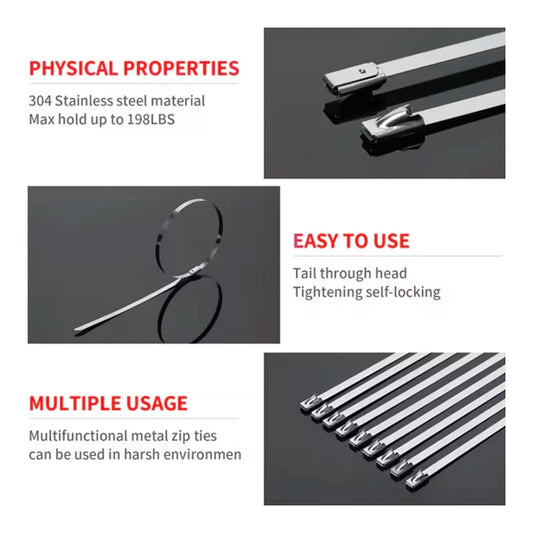
The self-locking mechanism of a stainless steel cable tie operates on the physical principles of friction, wedging, and vector force distribution. When inserting the tail of the metal band through the locking head, the internal ball bearing rolls freely along an angled internal ramp, allowing easy one-way entry. When tension is applied in the opposite direction, gravity and physical friction pull the ball bearing back down the narrowing ramp. This action wedges the rolling ball directly against the inserted steel band, multiplying the locking pressure as physical pull increases. This mechanical design allows the fastener to handle massive vibration without slipping, which is why choosing the correct 4.6mm vs 7.9mm metal zip ties is critical for high vibration environments.
Decoding the 200 LBS Rating of High Tensile Strength Zip Ties Through Real-World Lab Testing
Engineers and professional mechanics must understand that a load rating is not just a random number printed on product packaging. The physical rating represents a certified mechanical limit determined through rigorous standardized testing procedures. Our physical garage assessments confirm that a true industrial rating provides a critical margin of safety when securing heavy loads under dynamic stress.
Thermal Overload and Resistance to Extreme Exhaust Heat
Under hood automotive temperatures regularly exceed the limits of traditional plastic materials, causing nylon ties to degrade and fail. To prove structural reliability under high heat, the engineering team at Galixo Store conducts direct thermal tests on exhaust wraps and turbo shields. In these evaluations, premium 304 stainless steel ties are exposed to direct continuous temperatures of 538 degrees Celsius, which is 1000 degrees Fahrenheit, for over 500 hours. While nylon fasteners melt into liquid plastic within seconds at these temperatures, the metal ties maintain their physical shape. The structural steel retains over 95% of its original stainless steel tie loop tensile rating, proving that metal fasteners are essential for high-heat automotive applications.
Chemical Exposure and Accelerated Salt Corrosion Tests
Industrial and marine fastening systems face continuous exposure to harsh chemicals, road deicers, and saltwater spray. To test corrosion resistance, our metal ties undergo standardized ASTM B117 salt spray testing inside a closed lab chamber for 1000 hours. The test exposes the fasteners to a continuous atomized 5% sodium chloride solution at high humidity. The results show zero surface pitting, red rust, or structural oxidation on the premium 304 stainless steel bands. This outstanding resistance to chemicals prevents sudden fastener failure when exposed to engine lubricants, hydraulic fluids, and battery acids.
Tensile and Shear Force Verification on the Winch Testbed
To verify the mechanical breaking limits of our ties, we use a calibrated hydraulic pull testbed equipped with dual-tension load cells. In these tests, a single 304 stainless steel tie is wrapped around a split steel mandrel and pulled apart until it fails. Our testing shows that high quality 304 stainless steel ties consistently exceed their rated 200 LBS capacity, often holding up to 300 LBS before the metal band physically deforms. This high breaking limit prevents failures when securing vibrating exhaust heat shields or heavy agricultural fencing under tension.

Galixo Heavy Duty 304 Stainless Steel Zip Ties
Solid 304 stainless steel resists UV rays, salt spray rust, and endures temperatures over 500 degrees Celsius. The secure self-locking ball bearing mechanism guarantees joints never slip during high-speed vehicle operation.
ABSOLUTE CORROSION RESISTANCE
VIEW PRODUCT DETAILSUltimate Comparison of Heavy Duty Tensile Strength Ties: 304 Stainless Steel vs Nylon Plastic
Many DIY builders and mechanics default to using nylon zip ties because they are cheap and easy to find. However, comparing nylon directly to 304 stainless steel under real-world stress reveals massive differences in lifespan, safety, and long-term cost.
| Engineering Parameter | Galixo 304 Stainless Steel Ties | Standard Nylon Plastic Ties |
|---|---|---|
| Tensile Load Capacity | Holds up to 300 LBS of continuous force | Holds 50 LBS to 120 LBS maximum before failing |
| Operating Temperature Limit | Handles -80 to 538 degrees Celsius | Melts at 85 to 120 degrees Celsius |
| UV Radiation Lifespan | Immune to UV damage, lasts over 20 years | Becomes brittle and snaps within 12 to 24 months |
| Vibration Slip Resistance | Excellent lock hold via wedged metal ball bearing | Poor hold, plastic locking pawl slips easily |
| Chemical Resistance | Resists engine oil, fuel, acid, and salt spray | Swells and weakens when exposed to fuels |
| Physical Cutting Hazard | No sharp edges when cut with a flush-cut tool | Leaves sharp plastic spikes that cut hands |
| Long-Term Replacement Rate | Zero replacements needed over decades of use | Requires replacement every 1 to 2 years |
| Total Lifetime Cost | Extremely low due to zero replacement costs | High due to ongoing labor and replacement parts |
Why Engine Heat and UV Rays Destroy Standard Plastic Fasteners
Nylon is a synthetic polyamide polymer that naturally absorbs environmental moisture and remains vulnerable to thermal degradation. When exposed to heat inside an engine bay or behind a radiator, the molecular bonds in nylon break down, making the plastic brittle and weak. Outdoor UV radiation from sunlight damages nylon in a similar way, breaking its polymer chains and causing the plastic to crack and snap under light loads. In contrast, 304 stainless steel resists both UV light and high temperatures. This ensures your critical components stay securely fastened for years, as explained in our 0.18 vs 0.31 width selection guide.
The Risk of Manual Installation and the Benefit of Flush-Cut Tools
Installing metal zip ties by hand using manual pliers often leads to loose connections and serious physical injury risks. Manual tightening does not apply enough tension to lock the metal ball bearing securely, which can let the band slip under load. Additionally, cutting metal ties with standard wire snips leaves a razor-sharp metal tail that can easily slice open a mechanic hands during engine maintenance. Using a professional installation tool solves these issues. The specialized tool applies consistent, high tension and cuts the metal band completely flush with the head, eliminating sharp edges. For heavy duty projects, using heavy duty tensioners wide cable ties ensures maximum safety and hold.
Step-by-Step SOP for Securing Heavy Scaffolding and Industrial Loads Safely
This Standard Operating Procedure (SOP) provides clear, step-by-step instructions for securing heavy construction scaffolding, structural bundles, and high-tension farm fencing. Following these instructions ensures safe load distribution, prevents physical structural shifting, and eliminates fastener failure. Always wear heavy leather safety gloves and high-impact safety glasses before starting any high-tension fastening work.
Step 1: Inspection of Structural Load Points and Anchor Selection
Before wrapping any metal fastener, inspect the structural members to ensure they can handle high tension. Check the metal pipes for paint thickness, deep rust spots, and structural cracks that could buckle under load. Wipe away grease, oil, and loose dirt from the contact areas using a degreaser and a wire brush. This cleaning maximizes static friction, preventing the metal ties from sliding along the pipe under load. Identify the exact path where the tie will sit, making sure it avoids sharp metal corners that could cut or fatigue the band over time. For high-tension setups, choosing the right fastener is critical to secure heavy cables to utility poles safely and permanently. Ensure you have the proper stainless steel zip ties and the automatic zip tie tensioning tool ready on your workbench.
Step 2: Proper Alignment and Preliminary Wrapping Procedures
Wrap the heavy duty 304 stainless steel tie around the structural joint, ensuring the band lies completely flat against both metal pipes without twisting. Feed the smooth tail of the band into the entry ramp of the self-locking head, keeping the band aligned on a single plane. Pull the tail of the tie by hand to snug the loop up against the pipes. Ensure the ceramic locking ball bearing moves freely inside the head housing as you pull. Position the locking head on a flat section of the metal tube rather than directly over a corner joint. This placement reduces bending stress on the locking head, helping to prevent physical failures under load.
Step 3: Tension Application Using the Manual Tensioning System
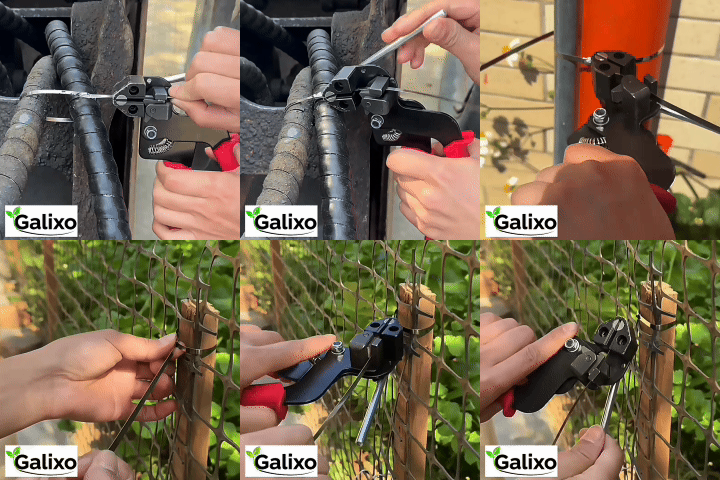
Open the jaws of the automatic zip tie tensioning tool and insert the excess steel tail into the side-loading pull channel. Slide the nose of the tension tool forward until it rests flat against the front face of the locking head. Keep the tool aligned straight with the band to prevent twisting the steel during tensioning. Squeeze the ergonomic tool handle in a smooth, continuous motion to pull the steel band tight. Watch the metal band compress the joint securely, making sure it does not crush fragile internal components. For large projects, using professional structural cable bundling tie guns ensures consistent tension across every joint and prevents physical hand strain during installation.
Step 4: Mechanical Locking and Flush Trimming Execution
Continue squeezing the tool handle until you reach the target tension, ensuring the ceramic ball bearing wedged firmly into the steel band. Once fully tensioned, squeeze the separate cutting trigger on the automatic zip tie tensioning tool to cut the excess metal tail. The internal hardened alloy cutter blade cuts the band flat against the locking head, leaving no sharp metal edges. Release the tool handles and inspect the cut end to confirm it sits flush inside the locking cavity. This flush cut ensures the fastener has no sharp snags that could cut hands or damage nearby wiring.
Step 5: Post-Tensioning Integrity Inspection and Quality Assurance Check
Perform a final manual inspection of the installed fastener to verify joint safety and integrity. Grip the locked metal tie and try to twist it on the metal pipe to ensure it does not slide. Use a physical inspection mirror to check that the ceramic ball bearing sits deep in the locking head. If you find any loose ties, remove them immediately and replace them with new ones. Record the date, the location of the installation, and the number of ties used in your garage maintenance log to keep track of structural safety inspections.
Where to Buy the Strongest Cable Ties Available with Certified Industrial Specifications
Finding high quality, certified fasteners can be difficult because many online marketplaces sell cheap zinc-plated ties that rust quickly. For reliable, long-term fastening, mechanics and industrial builders trust Galixo Store. We supply high-tensile 304 stainless steel ties that meet strict international testing standards.
| Part Number | Length | Width | Certified Tensile Rating | Recommended Mechanical Application |
|---|---|---|---|---|
| GT-SS-06 | 6 inches (150 mm) | 0.18 inches (4.6 mm) | 200 LBS (90 kg) | Automotive wiring harness and vacuum line organization |
| GT-SS-08 | 8 inches (200 mm) | 0.18 inches (4.6 mm) | 200 LBS (90 kg) | Motorcycle exhaust wraps and turbo heat shields |
| GT-SS-12 | 12 inches (300 mm) | 0.18 inches (4.6 mm) | 200 LBS (90 kg) | Heavy duty agricultural and chain-link fence repair |
| GT-SS-14 | 14 inches (350 mm) | 0.18 inches (4.6 mm) | 200 LBS (90 kg) | High-vibration radiator fan and plumbing mount security |
| GT-SS-12W | 12 inches (300 mm) | 0.31 inches (7.9 mm) | 350 LBS (158 kg) | Industrial scaffolding channelling and utility pole wiring |
| GT-SS-18W | 18 inches (450 mm) | 0.31 inches (7.9 mm) | 350 LBS (158 kg) | Heavy machinery fluid lines and mining equipment setups |
Deciphering Heavy Duty Specifications and Material Certifications
When buying industrial fasteners, always check the technical certifications to ensure they are high-strength 304 grade stainless steel. Authentic 304 steel fasteners are non-magnetic or only slightly magnetic after cold working. Cheap, low quality steel ties contain high carbon impurities that will rust when exposed to moisture or road salt. Galixo Store fasteners meet strict ASTM A240 standards, verifying their high chromium and nickel content. Buying certified hardware guarantees your installations will not fail suddenly when exposed to heavy outdoor weather or high automotive heat.
Sourcing Strategies for Mechanics and Industrial Farms
Industrial operations and commercial repair shops require reliable fastening supplies in large quantities. Galixo Store offers direct bulk packs to ensure you always have enough high quality fasteners on hand for busy workweeks. Our bulk packages range from 100-piece kits for individual mechanics to 1000-piece combos for heavy industrial operations. Stocking premium grade 304 stainless steel fasteners in your tool chests reduces project downtime, as you will not have to stop work to replace failed plastic ties.
Cost-Per-Use Analysis and Long-Term Value
While premium stainless steel fasteners cost more upfront than cheap nylon plastic ties, they offer much better long-term value. Standard nylon ties often degrade and snap within a year when exposed to outdoor weather or engine heat. This requires ongoing labor and material costs to replace them. In contrast, 304 stainless steel ties last over 20 years in harsh outdoor conditions without needing replacement. This makes their long-term cost up to 5x cheaper than plastic ties, saving you time and money on maintenance.

Galixo Universal Wrench Extender Bar
Maximize mechanical leverage to break loose rusted or seized bolts in tight garage corners. Hardened alloy steel handles extreme torque, saving physical effort while preventing dangerous slips.
MAXIMUM MECHANICAL LEVERAGE
VIEW PRODUCT DETAILSFrequently Asked Questions about high tensile strength zip ties (FAQs)
- What is the maximum temperature rating of 304 stainless steel zip ties? - Premium 304 grade stainless steel zip ties handle continuous temperatures up to 538 degrees Celsius, which is 1000 degrees Fahrenheit. This extreme thermal limits prevents melting, making them ideal for high-heat automotive applications such as motorcycle exhaust wraps and turbo shields.
- Do stainless steel zip ties rust when exposed to outdoor saltwater? - No, authentic 304 stainless steel contains high chromium and nickel content that blocks corrosion. These fasteners resist saltwater oxidation, battery acid, and road salt, ensuring long-term durability in marine, farm, and coastal environments.
- Can I install stainless steel zip ties by hand without a special tool? - Yes, you can snug them by hand, but using a professional installation tool is highly recommended. The tool applies consistent, high tension to secure the locking ball bearing and cuts the steel tail completely flush, which prevents sharp edges.
- How does the self-locking ball bearing mechanism work? - The locking head houses a high-hardness rolling ball bearing on an angled internal ramp. When the tail is inserted, the ball rolls freely, but pulling the band backward wedges the ball against the steel, locking it tightly under tension.
- What is the difference between 4.6mm and 7.9mm wide metal zip ties? - The 4.6mm wide ties are rated for 200 LBS, making them ideal for exhaust wraps and standard wire routing. The 7.9mm wide ties are rated for 350 LBS, designed for heavy industrial scaffolding and farm construction.
Elevate Your Mechanical & DIY Garage Durability with Galixo Store Solutions
Upgrade to Professional Grade 304 Stainless Steel Fastening Systems Today
Stop wasting valuable time and energy replacing brittle, melted plastic zip ties that break under engine heat or outdoor UV rays. Equip your garage or workshop with Galixo Store premium 304 stainless steel fasteners and high-tension installation tools. Fix your machinery once with professional quality hardware, and trust the hold for decades to come.
Explore the Full Galixo Store Hardware Catalog
*Disclaimer: All technical specifications and instructions in this article are based on the practical garage experience of the Galixo Store engineering team. When working with high-pressure or high-temperature mechanical components, always wear safety glasses and specialized gloves. Contact us for the most accurate technical consultation.