DNV Approved Marine Cable Ties for Offshore Applications
dnv approved marine cable ties secure offshore systems without wasting time on melting plastic ties or getting cut by sharp manual metal ties. Marine engineers rely on these heavy-duty fasteners supplied by Galixo Store to ensure structural reliability under extreme marine salt spray conditions, ensuring absolute vessel safety.

Galixo Automatic Stainless Zip Tie Tool Kit
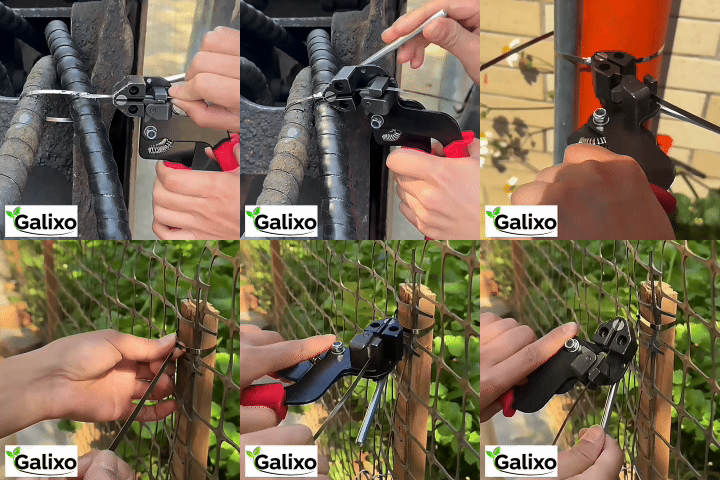
Professional mechanical fastening solution built for extreme engine bay heat and heavy vibration. Fast one-hand operation, automatic tensioning, and flush cut leaving no dangerous sharp edges.
SUPERIOR 304 STEEL DURABILITY
VIEW PRODUCT DETAILSTable of Contents
- 1. DNV Certification for Metal Cable Ties in Shipbuilding and Offshore Rigs
- 2. Offshore Environmental Stress: Corrosion and Vibration Resistance Standards
- 3. Selecting Marine-Grade 316 Stainless Steel for International Safety
- 4. Factory Test Reports, Mill Certificates, and Technical Documentation
- 5. SOP Cable Installation and Management Guide for Marine Contractors
- 6. Frequently Asked Questions about DNV Approved Marine Cable Ties
- 7. Elevate Your Mechanical and DIY Garage Durability with Galixo Store Solutions
1. DNV Certification for Metal Cable Ties in Shipbuilding and Offshore Rigs
DNV certification represents the absolute pinnacle of maritime safety, structural verification, and risk management for high-stress ocean environments. In shipbuilding and offshore oil rigs, cable management systems are subjected to constant salt exposure, extreme mechanical strain, and high-frequency vibrations from large propulsion engines or drilling equipment. Standard non-certified cable fasteners deteriorate rapidly in these conditions, leading to critical failure of communication, power, and safety control systems on vessels.
Origin and Significance of Marine Class Certification
The Det Norske Veritas class approval signifies that every batch of metal fasteners has undergone rigorous independent testing to verify structural load capacity, non-flammability, and long-term durability. For maritime operators, utilizing components with this type approval is not merely a recommendation but a strict regulatory requirement enforced by marine surveyors. Without recognized certification, vessels cannot secure insurance coverage or pass critical safety audits required to operate in international waters.
Anatomy of a High-Performance Certified Metal Fastener
- Precision Engineered Ball-Lock Mechanism: A self-locking design utilizing a hardened steel ball bearing that wedges against the band to prevent slipping under extreme high-tension loads.
- Smooth Rounded Edge Profiles: Safety engineered borders along the steel band to prevent cutting into outer cable jackets or injuring the hands of installation technicians.
- High-Tensile Steel Band: A cold-rolled metal strip manufactured to precise thickness tolerances to maintain uniform load distribution without stretching.
- Tapered Tail Section: An optimized lead-in design that facilitates smooth insertion into the locking head for rapid, low-friction application.
Operating Principle and Self-Locking Mechanical Physics
The operational security of these specialized marine fasteners relies on a wedge lock locking principle. As the steel band is threaded through the head, the locking ball moves freely along an internal ramp, allowing one-directional tightening. When tension is applied in the reverse direction, the ball is pulled down the ramp, wedging firmly against the band to create a permanent friction lock. This mechanical interaction guarantees that the tie maintains its designed clamping force despite severe physical impacts or thermal expansion cycles.
2. Offshore Environmental Stress: Corrosion and Vibration Resistance Standards
Offshore installations operate under some of the most destructive natural forces on earth, requiring specialized testing protocols to prove hardware survival. Fasteners must resist continuous saltwater immersion, high-altitude UV radiation, and severe wind-induced oscillations. Standard marine engineering protocols mandate rigorous laboratory testing to verify that fasteners will not suffer premature failures that could lead to catastrophic cable drops.
Standardized Salt Spray Testing and Accelerated Corrosion
Accelerated aging methodologies such as the astm b117 salt spray test stainless ties protocol subject metal fasteners to a continuous, highly atomized 5% sodium chloride solution at elevated temperatures. Certified fasteners must endure thousands of hours of this intense exposure without showing signs of red rust or pitting. This testing ensures that the underlying chromium oxide passive layer remains completely intact, shielding the base metal from destructive chemical oxidation in open-ocean environments.
Mechanical Vibration and Fatigue Endurance
Offshore machinery and ocean wave action generate continuous harmonic vibrations that can cause metal fatigue in weak fastening components. Fasteners are subjected to multi-axis sinusoidal vibration tests to simulate decades of service on active engine decks and drill floors. The locking mechanism must maintain its holding tension without loosening, ensuring that critical control wiring remains firmly secured to cable trays under all operating conditions.
High Thermal Overload Performance and Fire Safety
In the event of a shipboard fire, maintaining electrical circuit integrity for emergency lighting, pumps, and fire-suppression systems is critical. High-performance metal fasteners are completely non-combustible and capable of withstanding extreme temperatures exceeding 500 degrees Celsius without structural failure. This thermal threshold ensures that emergency cables remain supported even during direct flame exposure, supporting vital evacuation systems when they are needed most.
Test Duration: 1000 Hours Continuous Exposure
Test Conditions: 5% Neutral Salt Spray, 35 degrees Celsius Chamber Temperature
Measured Tensile Strength Results: Zero structural degradation detected; locked tensile strength retained 100% of its initial rated capacity of 250 lbs.

Galixo Heavy Duty 304 Stainless Steel Zip Ties
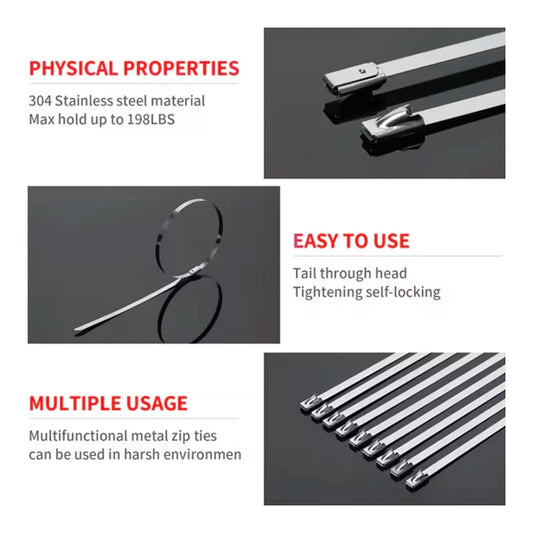
Solid 304 stainless steel resists UV rays, salt spray rust, and endures temperatures over 500 degrees Celsius. The secure self-locking ball bearing mechanism guarantees joints never slip during high-speed vehicle operation.
ABSOLUTE CORROSION RESISTANCE
VIEW PRODUCT DETAILS3. Selecting Marine-Grade 316 Stainless Steel for International Safety
Selecting the correct metal chemistry is a critical engineering decision that dictates the survival timeline of offshore electrical systems. While standard industrial applications utilize grade 304 alloys, marine specifications almost exclusively mandate the use of grade 316 stainless steel. Understanding the fundamental chemistry of these alloys helps prevent costly premature failures in high-salinity zones.
Molybdenum Addition and Pitting Corrosion Resistance
The defining difference between standard 304 steel and marine grade 316 stainless steel zip ties is the addition of approximately 2% to 3% molybdenum in the grade 316 chemical matrix. Molybdenum significantly enhances the material resistance to localized chloride attack, which causes pitting and crevice corrosion in seawater. Pitting can quickly penetrate thin metal bands, leading to sudden mechanical failure without visible widespread rust on the surrounding surface.
Prevention of Stress Corrosion Cracking
In marine environments where metal components are kept under constant mechanical tension, they become highly susceptible to stress corrosion cracking. This failure mode occurs when tensile stress combined with chloride exposure initiates micro-fractures along the metal grain boundaries. Utilizing grade 316 alloy reduces the risk of stress corrosion cracking ties, maintaining the physical structural integrity of the cable support matrix over decades of service.
| Engineering Performance Criteria | Galixo 316 Stainless Steel Solution | Standard 304 Stainless Steel Option |
|---|---|---|
| Chloride Pitting Resistance | Outstanding due to 2% to 3% Molybdenum content | Moderate, susceptible to severe localized pitting |
| Salt Spray Lifespan (ASTM B117) | Exceeds 2000 hours with zero structural pitting | Typically shows red rust pitting within 500 hours |
| Tensile Strength Retention | 100% capacity preserved in marine splash zones | Gradual reduction in capacity as pitting spreads |
| Intergranular Stress Cracking | Highly resistant under high mechanical preload | Vulnerable to sudden fracture under high tension |
| Maximum Operating Temp | Up to 538 degrees Celsius | Up to 500 degrees Celsius |
| Acid/Chemical Resistance | High resistance to sulfuric and phosphoric acids | Moderate resistance to common industrial solvents |
| Marine Atmospheric Lifespan | Decades in open-ocean salt air | Limited lifespan when exposed to direct salt spray |
| Recommended Application | Deepwater oil rigs, chemical tankers, subsea cables | Engine bay heat shields, dry docks, overland farms |
4. Factory Test Reports, Mill Certificates, and Technical Documentation
For critical marine infrastructure installations, physical verification of component quality is a strict engineering requirement. Material Test Reports, Mill Certificates, and technical approvals are essential documents that guarantee each batch of fasteners complies with international safety standards. These documents provide the trace history of the raw steel, confirming that it has been melted, processed, and tested to meet strict metallurgical specifications.
Decoding Mill Test Certificates and Heat Numbers
A Mill Test Certificate lists the precise chemical composition and mechanical properties of the steel batch. Every manufacturing run is assigned a unique heat number, which is stamped onto the product packaging. This traceability allows engineers to verify the concentration of crucial elements like chromium, nickel, and molybdenum, ensuring the batch is free from impurities that could compromise strength or speed up corrosion.
International Structural Compliance and Manufacturing Quality
Fasteners used in marine cabling must comply with iec 62275 cable tie standards, which regulate mechanical strength, temperature ratings, and environmental performance. These international standards guarantee that the product design has been verified by rigorous testing. Meeting these specifications provides reassurance to marine surveyors and safety inspectors during vessel commissioning and routine audits.
Marine Rigging Calculations and Mechanical Safety Factors
Before installation, marine engineers perform marine rigging safety factor calculations to determine the correct spacing and tensile rating of fasteners. These calculations account for the total weight of the cable run, wind resistance, and the additional gravitational forces caused by ship motion in heavy seas. Using certified high-tensile metal ties allows installers to maintain a safety factor of 4 to 1 or higher, preventing cable tray collapses during extreme storms.
| Tie Width | Thickness | Loop Tensile Strength | Recommended Application Zone |
|---|---|---|---|
| 4.6 mm | 0.25 mm | 100 lbs (45 kg) | Control wiring, instrumentation lines |
| 4.6 mm | 0.30 mm | 150 lbs (68 kg) | Standard power distribution cables |
| 7.9 mm | 0.25 mm | 200 lbs (90 kg) | Heavy cable bundles, primary feeder lines |
| 7.9 mm | 0.30 mm | 250 lbs (113 kg) | Engine room wiring, main mast rigging |
| 12.0 mm | 0.35 mm | 350 lbs (158 kg) | High-voltage conduits, hydraulic line support |
| 12.0 mm | 0.40 mm | 400 lbs (181 kg) | Extremely heavy subsea cable riser bundles |
| 15.0 mm | 0.40 mm | 500 lbs (226 kg) | Heavy exhaust insulation wraps, marine pipes |
| 15.0 mm | 0.50 mm | 600 lbs (272 kg) | Structural structural reinforcement tasks |
| 20.0 mm | 0.50 mm | 800 lbs (362 kg) | Heavy industrial pipe hanging, offshore masts |
| 20.0 mm | 0.60 mm | 1000 lbs (453 kg) | Extreme structural fastening, heavy oil rig gear |
5. SOP Cable Installation and Management Guide for Marine Contractors
Executing a high-quality offshore cable management project requires a structured, repeatable standard operating procedure. Properly installed metal fasteners prevent sheath wear, ground faults, and mechanical dropouts in critical systems. Before beginning any work, installation technicians must put on essential personal protective equipment, including cut-resistant gloves, ANSI-rated safety glasses, and steel-toe work boots. This section details the complete mechanical steps for high-integrity marine cable management installations using professional fastening systems such as marine rigging cable tie kits.
Step 1: Pre-installation Wire Cable Alignment and Bundling Path Audit
Before securing any run of cabling, technicians must conduct a thorough physical inspection of the routing tray or structural pathway. Ensure that the metal channels are free of sharp burrs, weld spatter, or abrasive debris that could compromise the integrity of the cable sheathing. Group cables according to voltage class, signal sensitivity, and thermal heat output to prevent mutual interference. Use temporary plastic ties to align the runs during routing, but ensure they are removed as permanent certified fasteners are installed.
- Audit the entire cable run path for any structural pinch points or sharp corners that could damage insulation.
- Group cables of similar voltage classes together to prevent signal crosstalk and simplify future maintenance.
- Organize the bundle geometry into a clean, uniform profile to ensure even tension distribution from the metal fasteners.
- Verify that there is adequate clearance between the bundle and high-temperature pipes or hot machinery.
Standard Specifications: Maintain a minimum 50 mm physical separation between low-voltage signal wires and high-voltage power lines. Always follow the cable manufacturer recommended bending radius guidelines to avoid internal conductor fatigue.
QC and Tips: Carefully check the run visually for any crossed or twisted wires. Misaligned cables within a bundle can cause localized hot spots and uneven mechanical stress under heavy vibration.
Step 2: Cable Tie Selection and Environmental Safety Factor Calculations
Selecting the appropriate fastener width and thickness depends directly on the calculated weight of the bundle and the dynamic forces it will experience. Heavy-duty marine applications, such as securing thick power cables on exposed ship decks or offshore wind towers, require heavy-duty fasteners with high tensile strength. For lightweight signal lines on vessel bridge consoles, smaller fasteners may be used to avoid applying excessive crushing pressure on sensitive communication cables.
- Calculate the total weight per meter of the cable bundle to determine the necessary physical support.
- Consult engineering specifications to determine the maximum wind load and wave impact force for the installation zone.
- Select a fastener with a loop tensile strength that exceeds the calculated static load by a safety margin of at least 4 to 1.
- Determine the optimal spacing intervals along the tray to prevent the bundle from sagging between supports.
Standard Specifications: For standard shipboard installations, space fasteners at regular intervals of no more than 300 mm to 400 mm along horizontal cable runs.
QC and Tips: On vessels subjected to heavy rolling or high-frequency vibrations, reduce the fastening spacing to 200 mm on vertical runs to provide extra support and reduce cable movement.
Step 3: Positioning and One-Hand Insertion of the Metal Band
Securing heavy cables in tight marine spaces, such as shipboard bulkheads, double hulls, or subdeck voids, can be a major mechanical challenge. To work efficiently in these areas, technicians must use fasteners designed for quick, one-handed installation. This is also a critical consideration when performing outdoor wiring tasks on shore, where using boat trailer wiring stainless fasteners helps prevent corrosion in coastal salt-marsh environments.
- Loop the steel band smoothly around the cable bundle and the structural support rung.
- Insert the tapered tail directly into the locking head slot, keeping the band flat and untwisted.
- Pull the tail section manually through the head with one hand to take up the initial slack around the bundle.
- Check that the locking ball bearing moves freely within the ramp and is not blocked by debris.
Standard Specifications: The band must be positioned perpendicular to the cable run at a 90-degree angle to prevent twisting or side loading on the locking head.
QC and Tips: Avoid over-tightening the initial loop by hand before using the tensioning tool. Leaving a small amount of slack allows you to make final adjustments to the cable alignment.
Step 4: Tension Adjustment and Calibration of the Tension Tool
To apply uniform tension to every fastener in a marine installation, technicians should use a calibrated mechanical tensioning tool. Standard manual pliers can apply uneven force and often leave sharp metal tails. Using a specialized Zip Tie Gun with a built-in tension adjustment knob ensures that every tie is tightened to the exact required engineering specification, reducing the risk of cable damage or loose connections.
- Adjust the tension knob on the base of the Zip Tie Gun to match the required tensile force for the fastener size.
- Engage the nose of the tensioning tool firmly against the locking head of the fastener.
- Squeeze the tool trigger repeatedly to pull the metal band through the locking head until the preset tension limit is reached.
- Verify that the tool clutch engages and slips smoothly at the target tension without over-stretching the metal band.
Standard Specifications: Set the tension limit to approximately 30% to 40% of the rated breaking strength of the fastener to prevent crushing the cable insulation.
QC and Tips: For sensitive fiber-optic or high-frequency coaxial cables, use a protective neoprene or silicone sleeve under the metal band to absorb vibration and protect the fragile internal fibers.
Step 5: Executing Flush Cut and Post-Tension Integrity Verification
The final step in a professional marine fastening installation is cutting the excess metal tail. Using standard wire cutters can leave a sharp protrusion that poses a severe safety hazard for technicians working in tight spaces. Utilizing a tensioning tool with an automatic flush-cut mechanism cuts the metal tail flush with the locking head, eliminating sharp edges and preventing painful cuts or damage to adjacent wiring.
- Activate the tool cut-off blade by squeezing the trigger completely to shear the excess metal tail.
- Ensure that the cut is made flush with the edge of the locking head, leaving no sharp points.
- Inspect the locking ball bearing to confirm it has wedged securely against the cut band.
- Shake the bundle firmly by hand to verify that the fastener remains locked and does not slip.
Standard Specifications: The cut tail must have less than 0.5 mm of protrusion from the edge of the locking head to comply with marine safety standards.
QC and Tips: Run a gloved finger over the finished locking head to verify there are no sharp edges. A flush-cut fastener prevents painful hand injuries and avoids tearing protective clothing during future maintenance work.

Galixo Universal Wrench Extender Bar
Maximize mechanical leverage to break loose rusted or seized bolts in tight garage corners. Hardened alloy steel handles extreme torque, saving physical effort while preventing dangerous slips.
MAXIMUM MECHANICAL LEVERAGE
VIEW PRODUCT DETAILS6. Frequently Asked Questions about DNV Approved Marine Cable Ties (FAQs)
-
Why is DNV certification necessary for offshore cable ties?
DNV certification verifies that the fasteners have been thoroughly tested by marine experts and meet strict international safety, fire resistance, and structural strength standards. This class approval is essential for passing safety audits and securing insurance for commercial vessels. -
What is the difference between 304 and 316 stainless steel for marine use?
Grade 316 stainless steel contains molybdenum, which significantly improves resistance to chloride pitting and crevice corrosion in marine environments. Grade 304 is suitable for general outdoor use but can corrode quickly when exposed to direct seawater. -
Can these metal fasteners be tensioned and cut without a specialized tool?
While they can be pulled tight by hand, using a professional tensioning tool ensures consistent, precise tension and cuts the metal band flush. This prevents manual over-tightening and eliminates sharp edges that can cause injury. -
How do self-locking ball-bearing metal ties work?
These fasteners feature a locking head containing a hardened steel ball bearing on a small internal ramp. When the band is inserted, the ball moves freely to allow tightening, but wedges firmly against the band if it is pulled backward, creating a secure mechanical lock. -
What is the standard spacing for securing offshore cable runs?
For standard horizontal runs on shipboard trays, fasteners are typically spaced at intervals of 300 mm to 400 mm. On vertical runs or in high-vibration areas, spacing should be reduced to 200 mm to provide extra support and prevent wire movement.
7. Elevate Your Mechanical and DIY Garage Durability with Galixo Store Solutions
Professional Fastening and Tool Systems Built to Last
Whether you are routing critical electrical wiring on an offshore commercial vessel, securing heat shielding in a high-performance engine bay, or reinforcing fencing on a working ranch, using reliable fastening hardware is essential to get the job done right. Galixo Store provides a range of heavy-duty 304 stainless steel fasteners and ergonomic installation tools designed to deliver maximum mechanical strength and corrosion resistance in any demanding environment. Equip your workshop with our professional-grade tools and hardware to ensure your repairs are completed safely and securely, giving you complete confidence that your work will stand the test of time.
Explore the Professional Hardware and Fastener Collection at Galixo Store
*Disclaimer: All technical specifications and instructions in this article are based on the practical garage experience of the Galixo Store engineering team. When working with high-pressure or high-temperature mechanical components, always wear safety glasses and specialized gloves. Contact us for the most accurate technical consultation.