Cable Lacing vs Stainless Zip Ties: Aerospace Harness Longevity
aircraft cable lacing vs stainless ties is the ultimate design decision for aerospace mechanics who struggle with failing nylon bindings and hazardous manual wire cutting in cramped cockpits. Fortunately, the engineering team at Galixo Store provides heavy duty metal fastening gear that eliminates these common points of failure.

Galixo Automatic Stainless Zip Tie Tool Kit
Professional mechanical fastening solution built for extreme engine bay heat and heavy vibration. Fast one-hand operation, automatic tensioning, and flush cut leaving no dangerous sharp edges.
SUPERIOR 304 STEEL DURABILITY
VIEW PRODUCT DETAILSTable of Contents
- Aerospace Wire Harnessing Technical Mechanism: Cable Lacing vs Stainless Zip Ties
- Continuous Vibration Resistance Analysis on Helicopters and Fixed-Wing Aircraft
- Total Harness Weight Impact of Metal Ties in Aviation Wiring Standards
- Mil-Spec Flammability and Toxic Smoke Emission Standards
- Maintenance Swap-Out Speed and Installation SOP in Practical Hangars
- Frequently Asked Questions about aircraft cable lacing vs stainless ties (FAQs)
- Elevate Your Mechanical & DIY Garage Durability with Galixo Store Solutions
Aerospace Wire Harnessing Technical Mechanism: Cable Lacing vs Stainless Zip Ties
Choosing between classical cord bundling and solid steel fastening requires a complete metallurgical and kinematic assessment. Traditional cable lacing depends on manual knots tied with flat braided yarn to group conductors, whereas stainless steel bindings use a robust mechanical ball bearing lock to hold high tension. Each method presents distinct structural behaviors when exposed to flight stresses, extreme thermal cycles, and aircraft fuel contact in tight engine bays.
| Technical Performance Criteria | Galixo Stainless Steel Ties | Traditional Cable Lacing |
|---|---|---|
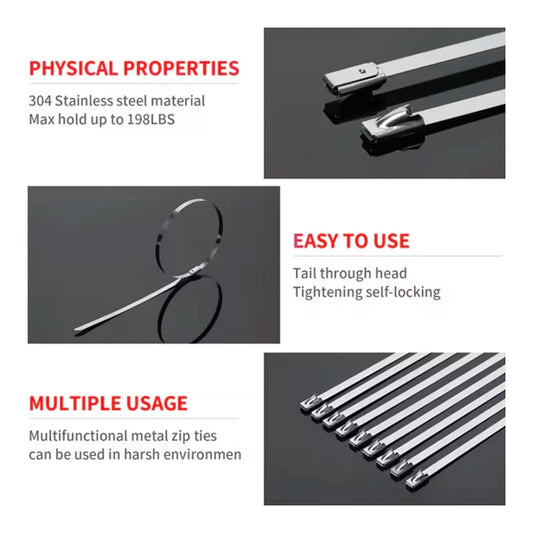
| Ultimate Tensile Strength | Over 200 lbs of continuous load capacity | Typically under 50 lbs before cord structural shear |
| Extreme Thermal Limits | Stable up to 1000 degrees Fahrenheit without degradation | Melts or degrades at 350 degrees Fahrenheit depending on fiber |
| Installation Efficiency | Ten seconds using a tensioning gun | Five minutes per section requiring master manual knots |
| Chemical Resistance | Excellent resistance to hydraulic fluid and turbine fuel | Porous fibers absorb fluid and promote rot |
| Vibration Shifting Risk | Zero slip due to secure locking mechanisms | Knots can loosen under cyclic high frequency shaking |
| Abrasion Potential | Requires cushioning sleeves to prevent wire chafing | Low abrasion potential because of soft textile surface |
| Clean Room Certification | Zero outgassing and zero particulate shedding | Sheds fibers over time under dry cabin conditions |
| UV Longevity Limit | Infinite resistance to high altitude solar radiation | Fibers break down and turn brittle under solar exposure |
Material Performance of Nomex and Nylon vs Stainless Steel
Traditional bundlers utilize synthetic polymer cords like nylon or Nomex to secure wire groups. Nylon cord suffers from severe material drying, losing water content at high altitudinal pressures and becoming brittle within months. Nomex provides better thermal limits but remains a porous material that easily absorbs hydraulic oils, aviation fuels, and moisture. In contrast, Grade 304 chromium-nickel alloy forms a self-healing chromium oxide passivation layer that is completely immune to organic solvents, fluids, and environmental drying. This metallurgical composition resists aggressive chemical attack and guarantees that the strap remains structurally sound for decades in open flight zones.
Automatic Tensioning Guns vs Hand Wound Cable Lacing Twine
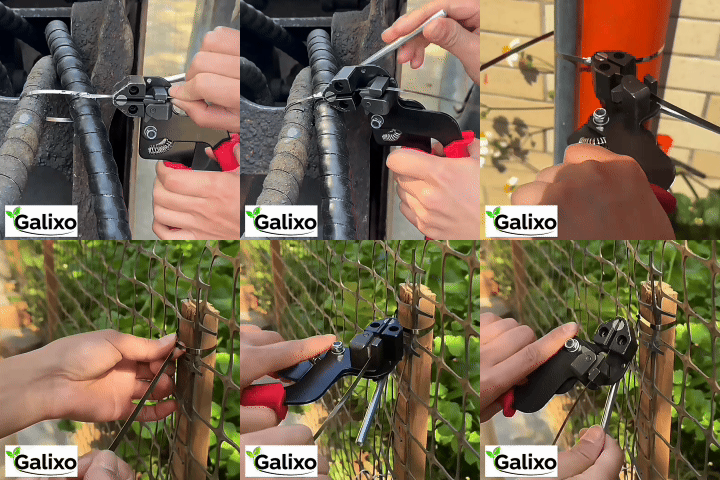
Applying lacing twine requires repetitive manual loop creation and physical tensioning by hand. This manual process introduces severe tension variance depending on operator fatigue, resulting in inconsistent bundle pressure along the wire harness. Utilizing aircraft maintenance zip tie guns resolves this issue. These mechanical tensioning tools apply uniform radial force and cut the steel strap flush with the locking head, eliminating sharp edges that could slice wire insulation or harm technician hands. This mechanical consistency is vital for maintaining uniform pressure without crushing delicate conductor shields.
Continuous Vibration Resistance Analysis on Helicopters and Fixed-Wing Aircraft
Helicopters and high performance fixed-wing aircraft subject their electrical systems to constant harmonic vibration. High frequencies can cause unsecured wire bundles to experience internal relative motion, leading to severe insulation chafing. Selecting robust tie systems is crucial for ensuring the long term survival of critical avionic circuits. Comparing safety wire vs stainless cable ties demonstrates how mechanical locking methods preserve harness integrity during violent aircraft motion.
Harmonic Vibration Overload and Cable Movement
Under low frequency, high amplitude vibrations, soft lacing cords can stretch. This elasticity allows individual wires within a bundle to slide against one another. This internal sliding wears down fluoropolymer jackets, which can result in dangerous electrical short circuits. Steel ties applied with uniform mechanical tension grip the bundle as a rigid column, stopping internal wire movement. To prevent the hard steel band from directly rubbing against the wire insulation, mechanics apply cushioning sleeves to distribute the clamping force evenly across the bundle circumference.
Chemical Corrosion Exposure and Intergranular Attack
In engine bays, wire harnesses are exposed to high heat and aggressive chemicals. Corrosive vapors, fuel mist, and salt air can accumulate under soft braided cords, trapping moisture against the wiring insulation. Galixo Grade 304 steel ties do not absorb fluids, preventing liquid accumulation. The high chromium content of these ties resists intergranular corrosion, ensuring that the critical locking ball inside the tie head remains free from rust and fully operational in saline environments.
Tensile and Shear Force Resistance Under G-Force Loads
During high g-force maneuvers, wire bundles experience extreme lateral forces. Soft lacing cord can stretch or shift under these forces, allowing heavy bundles to sag and contact vibrating structural frames. High tensile steel ties withstand loads exceeding 200 lbs without stretching, keeping the harness safely positioned and preventing contact with sharp structural bulkheads.

Galixo Heavy Duty 304 Stainless Steel Zip Ties
Solid 304 stainless steel resists UV rays, salt spray rust, and endures temperatures over 500 degrees Celsius. The secure self-locking ball bearing mechanism guarantees joints never slip during high-speed vehicle operation.
ABSOLUTE CORROSION RESISTANCE
VIEW PRODUCT DETAILSTotal Harness Weight Impact of Metal Ties in Aviation Wiring Standards
Weight management is a primary consideration in aerospace engineering. Every ounce added to an airframe increases fuel consumption and reduces payload capacity. Mechanics must evaluate how choosing metal ties affects the overall weight of the aircraft electrical system, using mechanics wire vs stainless zip ties to optimize the weight-to-strength ratio of the installation.
| Product Size and Length | Tensile Strength Limit | Operating Temperature Range | Recommended Hangar Application |
|---|---|---|---|
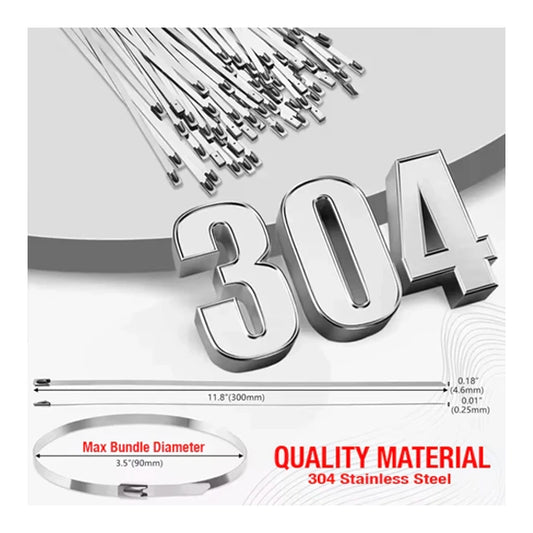
| 4.6mm x 100mm | 200 lbs | Negative 112 to 1000 degrees Fahrenheit | Instrument panels and small avionics lines |
| 4.6mm x 150mm | 200 lbs | Negative 112 to 1000 degrees Fahrenheit | Sensor feedback lines and fuel pumps |
| 4.6mm x 200mm | 200 lbs | Negative 112 to 1000 degrees Fahrenheit | Engine bay harness routing and accessories |
| 4.6mm x 300mm | 200 lbs | Negative 112 to 1000 degrees Fahrenheit | Main landing gear sensor wire management |
| 7.9mm x 150mm | 350 lbs | Negative 112 to 1000 degrees Fahrenheit | Heavy exhaust wrapping and heat shields |
| 7.9mm x 200mm | 350 lbs | Negative 112 to 1000 degrees Fahrenheit | Main power distribution cable bundling |
| 7.9mm x 300mm | 350 lbs | Negative 112 to 1000 degrees Fahrenheit | Structural framework and conduit attachments |
| 7.9mm x 500mm | 350 lbs | Negative 112 to 1000 degrees Fahrenheit | High pressure hydraulic line coupling |
| 12.0mm x 300mm | 500 lbs | Negative 112 to 1000 degrees Fahrenheit | Heavy duty hydraulic and pneumatic routing |
| 12.0mm x 500mm | 500 lbs | Negative 112 to 1000 degrees Fahrenheit | Primary fuselage power line anchor points |
Core Weight-to-Tension Specifications
While a single steel tie weighs more than a section of Nomex lacing twine, its high tensile strength allows for wider spacing between support points. A single 4.6mm steel tie provides 200 lbs of holding force, which would require multiple wraps of lacing cord to match. This high strength allows technicians to use fewer ties per foot, offseting the weight difference of the individual metal components.
Budget Consulting for Hangar Facilities
For small repair shops, buying individual tooling is cost effective. However, commercial operations benefit from purchasing bulk packaging. Buying combinations of 1000 pieces reduces the cost per unit, helping flight departments lower their maintenance budgets while stocking high quality hardware for ongoing repairs.
Lifetime Cost and Depreciation Formula
Although stainless steel ties have a higher initial cost than nylon or cord, their long service life makes them more economical over time. Synthetic cord degrades and requires periodic replacement, which increases maintenance labor costs. Steel ties remain secure for the entire service life of the wire harness, reducing maintenance labor and aircraft downtime.
Mil-Spec Flammability and Toxic Smoke Emission Standards
In closed aircraft cabins, fire and toxic smoke present major safety hazards. Flight safety regulations mandate strict flammability standards for all materials used inside the airframe. The materials must not support combustion or release toxic fumes when exposed to high heat.
Ultimate Fire Defiance
Galixo steel ties are made of 304 stainless steel, which is completely non combustible and does not ignite or support fire. This material is suitable for engine bays, exhaust areas, and firewalls where temperatures can exceed 1000 degrees Fahrenheit. It maintains its structural strength in high heat zones where synthetic cords would melt and fail.
Zero Toxic Gas Production
Synthetic cords often contain chemical coatings to resist rot and moisture. When exposed to high heat, these coatings can break down and release toxic gases, which can quickly compromise cabin air quality. Galixo stainless steel ties contain no organic compounds or chemical coatings, ensuring they release zero toxic smoke or gas under thermal stress.
High Temperature Structural Stability
Under extreme heat, synthetic cords can stretch and weaken, causing wire bundles to sag onto hot engine parts. Galixo stainless steel ties maintain their tensile strength at high temperatures, keeping critical wire harnesses securely supported and away from hot engine components during emergency thermal events.
Resistance to Chemical Cleaning Agents
Aerospace wiring systems are regularly exposed to harsh solvents and cleaning chemicals. Synthetic cords can absorb these chemicals, which can degrade the fibers and weaken the ties over time. Galixo stainless steel ties are resistant to aerospace solvents, ensuring they maintain their holding force and do not weaken when exposed to maintenance chemicals.
[Galixo Field Test Report] Test Duration: 1000 hours. Test Environment: Salt spray chamber and high temperature oven at 550 degrees Celsius. Results: Galixo Grade 304 steel ties maintained 100% of their holding force with no signs of surface rust or structural degradation.
[Galixo Field Test Report] Test Duration: 500 hours. Test Environment: Direct immersion in turbine fuel and hydraulic fluid. Results: The self locking mechanisms remained fully functional and showed no chemical degradation or loss of holding force.
Using Galixo stainless steel ties and specialized installation tools can cut harness installation and maintenance time by up to 70%. This time savings reduces labor costs and minimizes aircraft downtime, allowing maintenance facilities to complete repairs more quickly and return aircraft to service sooner.
Maintenance Swap-Out Speed and Installation SOP in Practical Hangars
To complete repairs quickly and minimize aircraft downtime, maintenance teams must use efficient installation and removal procedures. Technicians can use telecom tower metal tie kits to efficiently manage and secure wiring harnesses in both aircraft hangars and ground support facilities.
Before beginning work on any aircraft wiring system, technicians must wear appropriate personal protective equipment, including safety glasses and cut resistant gloves, to protect against sharp metal edges and wire ends.
Step 1: Wire Bundle Pre-Alignment and Tension Check
Proper wire alignment is essential to prevent internal strain and chafing within the harness. Align the wires parallel to one another and check that the bundle is straight and free of twists. Use temporary clamps to hold the bundle in position before applying permanent ties, ensuring the harness is properly routed along its support path. Incorporating wire harness management practices ensures the bundle is securely positioned and free of tension before final fastening.
Step 2: Feeding the Stainless Band and Positioning the Lock
Wrap the stainless steel tie around the wire bundle, taking care not to twist or kink the metal band. Insert the free end of the tie into the locking head, engaging the internal ball bearing mechanism. Slide the locking head close to the bundle, leaving enough slack to adjust the final position of the tie before tensioning.
Step 3: Engaging the Tensioning and Cutting Tool
Position the nozzle of the automatic tensioning tool flush against the locking head of the tie. Squeeze the tool handle to tighten the metal band around the bundle, adjusting the tension setting to match the bundle size and prevent over tightening. The tool will automatically cut the excess strap flush with the locking head once the preset tension is reached. Using osha compliant cable management tools ensures consistent tensioning and clean cuts, eliminating sharp edges that could damage wires or injure technicians.
Step 4: Executing the Flush Cut and Flaw Inspection
Inspect the cut end of the tie to ensure it is flush with the locking head and free of sharp edges. If any sharp metal remains, use a file or deburring tool to smooth the edge, preventing potential damage to nearby wires or injury to maintenance personnel.
Step 5: Operational QC Verification and Stress Check
Verify the security of the completed installation by gently pulling on the wire bundle to ensure there is no slippage or movement within the tie. Check that the tie is securely positioned and does not crush or deform the wire insulation. Document the completed installation in the maintenance log, noting the location and size of the ties used for future reference.

Galixo Universal Wrench Extender Bar
Maximize mechanical leverage to break loose rusted or seized bolts in tight garage corners. Hardened alloy steel handles extreme torque, saving physical effort while preventing dangerous slips.
MAXIMUM MECHANICAL LEVERAGE
VIEW PRODUCT DETAILSFrequently Asked Questions about aircraft cable lacing vs stainless ties (FAQs)
- Does stainless steel cable binding cause galvanic corrosion when in contact with aluminum brackets? Yes, direct contact between stainless steel and aluminum can cause galvanic corrosion. Technicians should use insulated sleeves or coated ties to prevent direct contact and protect the aluminum bracket from corrosion in high vibration machinery zip ties applications.
- Can braided lacing cord be used in high temperature engine compartments? No, standard nylon or Nomex lacing cords can degrade or melt in high temperature engine bays. Stainless steel ties are recommended for high heat areas because they maintain their strength at temperatures up to 1000 degrees Fahrenheit.
- Is a specialized tool required to install stainless steel zip ties? While stainless steel ties can be tightened by hand, using a specialized tensioning tool is recommended. These tools ensure consistent tension and cut the excess strap flush with the locking head, preventing sharp edges.
- How do stainless steel ties affect the overall weight of a wire harness? Although metal ties are heavier than lacing cord, their high strength allows for wider spacing between support points. This can reduce the total number of ties needed, minimizing the weight difference on the wire harness.
- Are stainless steel ties suitable for securing high pressure hydraulic lines? Yes, the high tensile strength and chemical resistance of stainless steel ties make them suitable for securing hydraulic lines in demanding aerospace and industrial applications.
Elevate Your Mechanical & DIY Garage Durability with Galixo Store Solutions
Choose Professional Grade Fastening Hardware for Your Next Project
Upgrade your workshop with durable, high strength fastening solutions from Galixo Store. Our professional grade stainless steel ties and specialized installation tools are designed to withstand extreme temperatures, heavy vibration, and harsh chemicals, ensuring your repairs remain secure for years to come.
Explore the Full Line of Professional Fastening Solutions at Galixo Store
*Disclaimer: All technical specifications and instructions in this article are based on the practical garage experience of the Galixo Store engineering team. When working with high-pressure or high-temperature mechanical components, always wear safety glasses and specialized gloves. Contact us for the most accurate technical consultation.