Weather Resistant Metal Cable Ties for Extreme Climates
weather resistant metal cable ties are the ultimate solution for industrial and automotive mechanics tired of watching cheap polymer fasteners crack under thermal stress. By switching to high-tensile hardware from the Galixo Store, heavy-duty outdoor installations gain lifetime durability against freezing temperatures and intense desert heat without sharp edges or slip risks.

Galixo Automatic Stainless Zip Tie Tool Kit
Professional mechanical fastening solution built for extreme engine bay heat and heavy vibration. Fast one-hand operation, automatic tensioning, and flush cut leaving no dangerous sharp edges.
SUPERIOR 304 STEEL DURABILITY
VIEW PRODUCT DETAILSTable of Contents
- Why Standard Polymers Fail in Extreme Weather
- The Metallurgy Behind Weather Resistant Metal Cable Ties
- Specifications and Cost-Benefit Matrix of Stainless Fasteners
- Extreme Environments and Real-World Industrial Deployments
- Ultimate Practical Installation Guide for Metal Cable Ties
- Frequently Asked Questions about weather resistant metal cable ties (FAQs)
- Elevate Your Mechanical & DIY Garage Durability with Galixo Store Solutions
Why Standard Polymers Fail in Extreme Weather
Outdoor structural projects require fastening hardware that maintains its chemical integrity under grueling atmospheric stress. Nylon and other polymer-based fasteners are highly susceptible to environmental degradation because outdoor elements break down their molecular structures. Ultraviolet radiation breaks the polymer chains, resulting in microscopic fractures that propagate quickly when physical stress is applied. Furthermore, extreme temperature fluctuations cause plasticizers to leach out, stripping the fastener of its flexibility and leaving it brittle.
Switching to Weather Resistant Metal Cable Ties Over Plastic
Standard plastic ties cannot endure sub zero temperature zip ties conditions because the extreme cold freezes the moisture absorbed in the nylon material. This molecular freezing prevents the locking pawl from flexing, causing the entire head of the tie to shatter upon the slightest vibration or load shift. In contrast, heavy duty outdoor cable management requires all weather metal zip ties that remain flexible, strong, and chemically stable whether exposed to winter frost or intense desert sun. Switching to metal eliminates the constant loop-failure risks associated with plastic straps in demanding outdoor applications.
Automatic Zip Tie Gun vs Manual Metal Snips
Using manual pliers and metal snips to tighten stainless steel ties often yields inconsistent tension and leaves hazardous, razor-sharp edges exposed in tight spaces. Utilizing a dedicated cable tie tool with a built-in tensioning and automatic cutting mechanism ensures that every single strap is locked to the exact tension required. The integrated blade cuts the excess metal band flush against the locking head, protecting hands and cables from painful cuts. This professional-grade mechanical leverage saves up to 70% of installation time while guaranteeing consistent safety across all joint locations.
| Performance Criteria | Galixo 304 Stainless Solution | Traditional Polymer Nylon Ties |
|---|---|---|
| Tensile Strength | Up to 350 lbs for heavy-duty ties | Typically 50 lbs to 120 lbs max |
| Working Temperature Range | -80 degrees Celsius to 538 degrees Celsius | -40 degrees Celsius to 85 degrees Celsius |
| UV Radiation Resistance | 100% impervious to UV degradation | Turns brittle and breaks within months |
| Chemical Resistance | Resists fuel, acids, oils, and salt spray | Swells, softens, and degrades in chemicals |
| Cold Embrittlement | Retains full mechanical strength in deep freeze | Shatters under light vibration or impact |
| Fire and Heat Safety | Non-flammable, oxygen-index independent | Melts easily, releases toxic gases |
| Expected Lifespan outdoors | Decades without structural degradation | Less than one year under direct sunlight |
| Installation Reliability | Consistent lock tightness via steel ball bearing | Slippage occurs under high constant tension |
The Metallurgy Behind Weather Resistant Metal Cable Ties
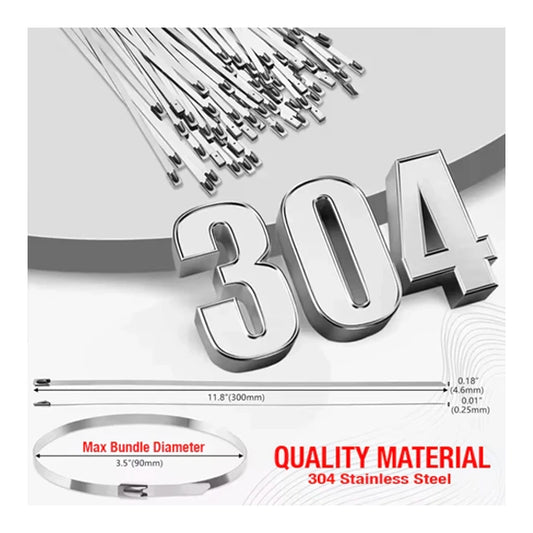
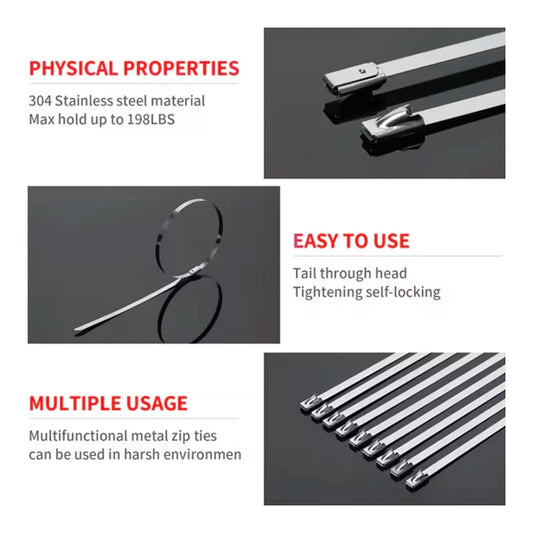
High-alloy 304 austenitic steel delivers superior structural stability across extreme temperature ranges. Utilizing an advanced self-locking ball bearing mechanism, these fasteners resist stress relaxation, thermal expansion, and atmospheric chemical degradation in industrial, automotive, and deep-freeze environments.
Material Origin and Nature of Austenitic Steel
The outstanding resilience of 304 stainless steel is due to its high chromium-nickel alloy content. This specific metallurgical composition forms a microscopic, self-healing passive chromium oxide layer on the metal surface when exposed to oxygen. This layer blocks water molecules and corrosive chlorides from oxidizing the iron underneath, ensuring the metal remains rust-proof. Running the rigorous astm b117 salt spray test stainless ties validates that this metallurgical structure handles years of saltwater fog without rust-proof cable ties degradation, providing reliable outdoor performance.
Anatomy Breakdown of Self-Locking Fasteners
To understand how these robust steel ties achieve extreme hold, one must examine their mechanical design features:
- High-Tensile Steel Band: A smooth-edged 304 stainless steel strap designed to glide easily without damaging surrounding insulated jackets.
- Self-Locking Ball Bearing Chamber: A tapered locking head containing an internal free-floating micro-ball made from super-hardened steel.
- Tapered Insertion Tip: A precision-cut, slightly curved tail that allows for fast, one-handed insertion through the locking chamber.
- Internal Locking Ramp: An engineered slope inside the head that wedges the steel ball tightly against the band when tension is applied.
Critical Ball Bearing Mechanics in Weather Resistant Metal Cable Ties
The locking mechanism operates on the physics of the wedge-lock principle. When the tail of the tie is threaded through the head and pulled tight, the internal steel ball moves freely along the wider section of the chamber, allowing the band to pass through smoothly. However, the instant the tension is released or external forces pull the band backward, the steel ball is drawn down a narrow wedge ramp. This wedging action locks the strap firmly in place, resisting over 200 lbs of tensile force and ensuring the fastener never slips under extreme load.

Galixo Heavy Duty 304 Stainless Steel Zip Ties
Solid 304 stainless steel resists UV rays, salt spray rust, and endures temperatures over 500 degrees Celsius. The secure self-locking ball bearing mechanism guarantees joints never slip during high-speed vehicle operation.
ABSOLUTE CORROSION RESISTANCE
VIEW PRODUCT DETAILSSpecifications and Cost-Benefit Matrix of Stainless Fasteners
Choosing the right industrial fastening hardware requires matching the exact engineering specifications of the project with the environmental conditions it will face. For heavy duty outdoor cable management, understanding the precise load capacity and thermal limit of each model ensures safety and structural durability. Using undersized ties in high-vibration engine bays or high-wind telecommunication towers can lead to premature joint failure, putting expensive equipment and safety at risk.
Core Specs Analysis: Sizing and Load Capacity
The tensile strength of a stainless tie is directly related to its width and band thickness. Standard 4.6mm wide ties are ideal for bundling lightweight wiring, motorcycle exhaust wraps, and flexible sensor lines, delivering a strong 100 lbs loop tensile rating. For larger industrial challenges like securing rigid heavy-duty cables, high-pressure pipes, or agricultural fences, the 7.9mm and 12mm wide ties provide up to 350 lbs of locking strength. Correctly matching width to the structural weight prevents material fatigue over years of outdoor exposure.
Budget-Based Consulting for DIY and Commercial Use
For home mechanics and DIY enthusiasts, a 100 Pcs or 200 Pcs variety pack is perfect for maintaining car projects, fixing heat shields, or tackling backyard fence repairs. Commercial fleets, solar installers, and industrial contractors are better served by the 500 Pcs or 1000 Pcs bulk packages. These bulk configurations reduce the cost per unit, ensuring professionals have plenty of reliable, rust and cold resistant fasteners on hand for large-scale outdoor projects.
Cost-Per-Use Formula and Lifetime Value
While polymer ties are cheap upfront, their quick degradation outdoors creates a costly cycle of constant replacement and maintenance labor. Consider this comparison: replacing brittle plastic ties every year on an outdoor solar array over ten years costs far more in materials and technician hours than installing a single Galixo 304 tie. Since steel ties last for decades, this one-time installation cuts long-term maintenance costs by over 80%, proving that investing in metal is the smartest choice for both your budget and your peace of mind.
| Product Model Size | Loop Tensile Strength | Max Thermal Threshold | Recommended Application |
|---|---|---|---|
| Galixo 4.6mm x 150mm | 100 lbs (45 kg) | 538 degrees Celsius | Motorcycle exhaust wrapping and sensor lines |
| Galixo 4.6mm x 200mm | 100 lbs (45 kg) | 538 degrees Celsius | Automotive underhood harness routing |
| Galixo 4.6mm x 300mm | 100 lbs (45 kg) | 538 degrees Celsius | Fuel filter heat shield clamping |
| Galixo 7.9mm x 200mm | 250 lbs (113 kg) | 538 degrees Celsius | Heavy vehicle undercarriage guard support |
| Galixo 7.9mm x 300mm | 250 lbs (113 kg) | 538 degrees Celsius | Solar panel rail cable management systems |
| Galixo 7.9mm x 360mm | 250 lbs (113 kg) | 538 degrees Celsius | Telecom tower transmission lines and masts |
| Galixo 7.9mm x 500mm | 250 lbs (113 kg) | 538 degrees Celsius | Agricultural barbed wire fence tensioning |
| Galixo 12mm x 300mm | 350 lbs (158 kg) | 538 degrees Celsius | High-pressure chemical pipe bundling |
| Galixo 12mm x 500mm | 350 lbs (158 kg) | 538 degrees Celsius | Saltwater marine cabling and dock lines |
| Galixo 12mm x 1000mm | 350 lbs (158 kg) | 538 degrees Celsius | Industrial HVAC ducting and extreme load support |
Extreme Environments and Real-World Industrial Deployments
Industrial networks must run smoothly without interruption, regardless of local weather. From sub-zero mountain ranges to blistering desert oil fields, heavy-duty components demand strong, reliable bundling systems to prevent system failures. Using premium weather resistant metal cable ties ensures that critical electrical feeds, mechanical lines, and monitoring structures remain securely fastened under the most challenging conditions on earth.
Telecom and Desert Solar Farm Applications
Solar farms face intense environmental challenges, including daily UV indexes exceeding level 11 and dry heat up to 50 degrees Celsius. In these settings, standard plastic ties quickly crack, causing heavy power lines to sag onto sharp metal edges, which can lead to electrical shorts. Using the best cable ties for solar panels ensures photovoltaic systems remain securely bound for over 25 years. Similarly, remote mountain telecom stations rely on extreme climate cable ties to keep heavy transmission cables safe during intense winter freezes and wind speeds over 120 km/h.
Automotive and Marine Deployments
Vehicle engine bays generate extreme ambient heat that easily exceeds 400 degrees Celsius, especially near exhaust manifolds and turbos. Securing heat wraps and shield components with outdoor rust proof cable ties prevents dangerous component rattles and holds tight during rapid heating and cooling cycles. For marine environments exposed to corrosive saltwater spray, choosing marine grade 316 stainless steel zip ties or coated stainless steel cable ties stops galvanic corrosion. These specialized metal fasteners provide reliable, rust-proof protection, ensuring that essential wiring bundles on boats and docks stay secure through years of wave impacts and marine elements.
Agricultural and Heavy Fencing Projects
Farms and ranches need tough fencing that stands up to weather, livestock pressure, and heavy machinery vibrations. Traditional fence ties often snap under impact, letting barbed wire loose and creating a escape risk for livestock. Heavy-duty 304 stainless steel ties hold fence lines securely against wooden or metal posts, resisting wind pressure and soil shifts. By utilizing rust proof cable ties, agricultural properties save hundreds of maintenance hours, keeping boundary lines solid year after year.
Extreme High-Altitude and Cold Climate Infrastructure
At high altitudes, freezing winds, heavy snow loads, and rapid freeze-thaw cycles place massive physical stress on external wiring. High-altitude structures require specialized sub zero temperature zip ties and freeze proof wire fasteners to prevent utility lines from snapping and causing power outages. The tough, non-elastic design of stainless steel ties prevents cold-temperature sagging, ensuring communication networks and power lines stay fully functional during winter blizzards and high-altitude storms.
Ultimate Practical Installation Guide for Metal Cable Ties
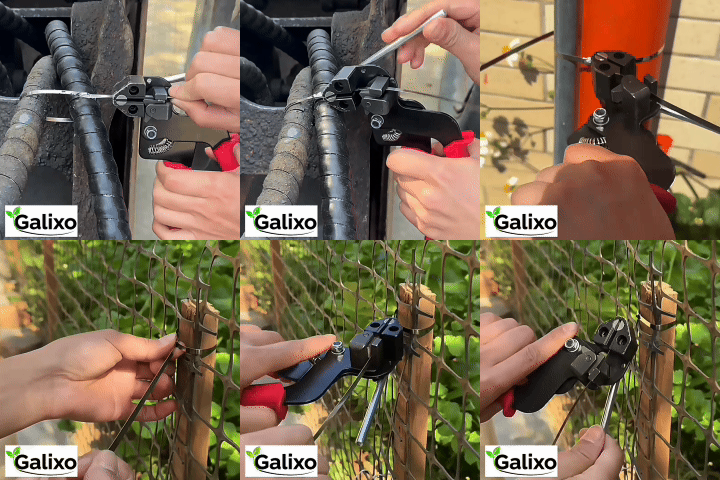
Properly installing stainless steel cable ties requires the right tools, careful setup, and precise tension. While plastic ties can be pulled tight by hand, securing metal ties requires a dedicated professional tensioning tool to get the tightest hold without damaging the band. Following a clear, step-by-step process ensures your installations are safe, tight, and completely flat, preventing slipping even under high-vibration and harsh weather conditions.
Before starting your project, gather your essential tools and safety gear. You will need a high-quality Galixo Stainless Zip Tie Gun, safety glasses to protect your eyes, and cut-resistant gloves to protect your hands from sharp metal edges. Make sure you also have a clean rag to wipe down the workspace, a ruler or tape measure for accurate placement, and your 304 stainless steel ties ready to go.
Step 1: Surface Preparation and Conduit Alignment
Begin by thoroughly wiping down the installation surface with a clean cloth to remove all dust, grease, moisture, and road debris. Dust and oil left on cables can cause the ties to slide around, especially when exposed to wind and vibration. Lay out your wires or hoses neatly, making sure there are no twists or sharp bends that could pinch the lines under tension. If you are attaching metal ties to raw steel posts, apply a protective rubber or vinyl sleeve around the bundle to prevent galvanic corrosion between different types of metal.
Step 2: Threading the Cable Tie and Ball Bearing Engagement
Loop the 304 stainless steel tie around your prepared bundle, then insert the tapered tail into the locking head. You will feel a slight mechanical click as the band passes the internal steel ball bearing, showing that the self-locking system is engaged. Pull the tail through by hand until the loop is snug against the bundle. Make sure the locking head is positioned in a convenient spot where your tensioning tool can easily reach it, keeping it away from moving parts or tight corners.
Step 3: Tool Calibration and Nozzle Positioning
Take your cable tie tool and adjust the tension adjust wheel at the base of the handle to match your project needs. For delicate wiring or sensor lines, choose a lower tension setting to avoid crushing the insulation. For heavy-duty projects like exhaust wraps or metal fences, dial in a higher setting to ensure an absolute lock. Slide the flat tip of the tie into the front nozzle of the gun, ensuring the tool is held at a flat 90-degree angle to the locking head to get a clean, even cut.
Step 4: Tension Application and Automatic Flush Cutting
Squeeze the trigger of your Galixo Stainless Zip Tie Gun in a smooth, steady motion. Each squeeze pulls the steel band tighter, wrapping it securely around the bundle. Keep squeezing until the tool reaches your pre-set tension level, where the built-in cutter will automatically clip the excess metal tail. This automatic cut leaves a perfectly flush edge on the head of the tie, eliminating dangerous sharp points and protecting both the technician and the surrounding wiring from damage.
Step 5: Post-Installation Joint Quality Control Inspection
Finish your installation with a careful visual and physical check of each locked tie. Try to twist the joint with your hand; a correctly tensioned tie will not slip or slide along the conduit. Visually confirm that the metal band is sitting flat and even against the bundle without pinching or crushing any cables. If a tie is too loose, replace it immediately to keep your system safe and reliable, ensuring your outdoor projects stand up to years of weather, wind, and heavy vibrations.

Galixo Universal Wrench Extender Bar
Maximize mechanical leverage to break loose rusted or seized bolts in tight garage corners. Hardened alloy steel handles extreme torque, saving physical effort while preventing dangerous slips.
MAXIMUM MECHANICAL LEVERAGE
VIEW PRODUCT DETAILSFrequently Asked Questions about weather resistant metal cable ties (FAQs)
- Are weather resistant metal cable ties reusable once they are locked in place? - Standard 304 stainless steel ball-locking ties are designed for permanent use and cannot be easily released without a specialized tool or cutting them off. This permanent lock ensures they stay perfectly secure and never slip, even under extreme vibration and heavy wind.
- Will these steel cable ties rust if used in saltwater marine environments? - Premium 304 stainless steel ties are highly rust-resistant and work beautifully in most outdoor areas. However, for projects exposed directly to harsh seawater or chemical baths, upgrading to marine-grade 316 stainless steel provides the absolute best protection against pitting and saltwater corrosion.
- Can I install these metal ties tightly without a specialized tensioning tool? - While you can pull them snug by hand, using a professional tensioning gun is highly recommended. The gun ensures every tie is pulled to the perfect tension and cuts the tail completely flush, eliminating dangerous sharp edges and preventing loose connections.
- Do stainless steel ties scratch or damage insulated electrical wires? - Uncoated stainless steel ties have smooth, rounded edges to protect wires, but they can still pinch if overtightened. For sensitive wiring bundles or high-vibration areas, choosing coated steel ties or using a protective rubber sleeve provides extra cushioning and keeps insulation safe.
- What is the maximum temperature limit for 304 stainless steel ties? - Premium 304 stainless steel ties can easily handle extreme temperatures ranging from -80 degrees Celsius up to 538 degrees Celsius. This massive thermal range makes them perfect for freezing winter weather as well as high-heat applications like car engine bays and exhaust systems.
Elevate Your Mechanical & DIY Garage Durability with Galixo Store Solutions
Upgrade Your Projects with Professional-Grade Hardware Solutions
Keep your critical assemblies, vehicle lines, and outdoor projects secure with professional-grade hardware designed for the toughest conditions. The Galixo Store provides high-tensile 304 stainless steel ties and specialized tensioning tools built to handle extreme heat, freezing winter temperatures, and heavy vibrations. Stop dealing with broken plastic ties and loose connections; explore our durable, rust-proof fastening kits and wrench extenders today to build reliable projects that are built to last.
Explore the Galixo Store Fastening Collection Now
*Disclaimer: All technical specifications and instructions in this article are based on the practical garage experience of the Galixo Store engineering team. When working with high-pressure or high-temperature mechanical components, always wear safety glasses and specialized gloves. Contact us for the most accurate technical consultation.