Top 10 Cable Tie Guns for Professional Mechanics
top cable tie guns for mechanics are essential in modern garages because traditional plastic bands quickly melt under engine heat and cause dangerous loose components. Utilizing professional equipment from Galixo Store ensures maximum tensile strength, saves hours of installation labor, and provides clean flush cuts that protect hands from sharp metal edges.

Galixo Automatic Stainless Zip Tie Tool Kit
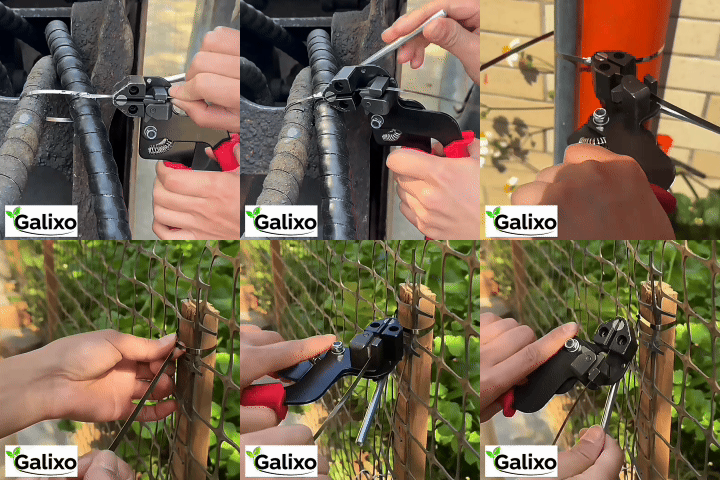
Professional mechanical fastening solution built for extreme engine bay heat and heavy vibration. Fast one-hand operation, automatic tensioning, and flush cut leaving no dangerous sharp edges.
SUPERIOR 304 STEEL DURABILITY
VIEW PRODUCT DETAILSTo provide a complete technical resource for automotive master technicians and garage builders, this comprehensive guide is structured around five critical sub-intents. These foundational pillars ensure every mechanical reader finds exact answers to their workshop requirements:
- Sub-Intent 1: Evaluation of the top ten heavy duty garage tie tools based on tensile strength, material quality, and pricing.
- Sub-Intent 2: Technical validation through extreme stress testing under thermal overload and chemical exposure.
- Sub-Intent 3: Prevention of workshop injuries through advanced flush cutting blades and ergonomic handling.
- Sub-Intent 4: Real-world workshop applications from exhaust wrap security to high-temperature wire management.
- Sub-Intent 5: Detailed step-by-step operating procedures, safety guidelines, and tool preservation standards.
Table of Contents
- Master Rankings of the Top Cable Tie Guns for Mechanics
- Extreme Stress Testing and Durability Verification of Workshop Tools
- Why Heavy Duty Garage Tie Tools Matter for Workshop Safety
- Practical Case Studies of Automotive Steel Tie Tensioners
- Standard Operating Procedure for Workshop Zip Tie Installers
- Frequently Asked Questions about top cable tie guns for mechanics
- Elevate Your Mechanical & DIY Garage Durability with Galixo Store Solutions
Master Rankings of the Top Cable Tie Guns for Mechanics
Selecting the correct metal tensioning hardware requires a deep understanding of load ratings, steel chemistry, and mechanical leverage ratios. This section analyzes the performance metrics of the industry standard tensioning equipment to help auto shop operators invest in highly reliable systems that eliminate loose connections and components under the hood.
| Tool Model & Class | Breaking Strength Support | Working Temp Range | Recommended Application & Price |
|---|---|---|---|
| Galixo Pro Automatic Metal Gun | Up to 350 lbs / 158 kg | -112 F to 1000 F | Exhaust wrap and turbo shields ($59.99) |
| Panduit GS4MT Premium tensioner | Up to 300 lbs / 136 kg | -80 F to 932 F | Industrial wiring systems ($350.00) |
| HellermannTyton MK9SST Heavy Duty | Up to 320 lbs / 145 kg | -110 F to 1000 F | Aerospace and military wire harness ($295.00) |
| Thomas & Betts ERG120 Manual | Up to 220 lbs / 100 kg | -76 F to 572 F | Commercial panel building ($180.00) |
| Galixo Compact Tensioning Tool | Up to 250 lbs / 113 kg | -112 F to 1000 F | Tight engine bay corners ($34.99) |
| Klein Tools Heavy Duty tensioner | Up to 200 lbs / 90 kg | -40 F to 300 F | Residential electrical boxes ($85.00) |
| Milwaukee M12 Sub-Compact installer | Up to 150 lbs / 68 kg | -20 F to 140 F | Light automotive plastic bundling ($129.00) |
| Ancor Marine Grade Tie Installer | Up to 175 lbs / 79 kg | -40 F to 185 F | Saltwater bilge pump routing ($65.00) |
| Gardner Bender Steel Strap Tool | Up to 180 lbs / 81 kg | -50 F to 400 F | Basic home utility repairs ($42.00) |
| Jonard Tools Bullet Tensioner | Up to 120 lbs / 54 kg | -10 F to 150 F | Telecommunication fiber routing ($38.00) |
How to Choose Top Cable Tie Guns for Mechanics based on Tensile Load
Evaluating dynamic tension loads is the first task of any competent mechanical designer. For high stress environments such as heavy duty diesel engine bays or motorcycle exhaust manifolds, tools must support high tensile bands that handle over 200 lbs of continuous pulling force. Standard auto shop zip tie guns made of cheap cast aluminum will bend or fail internally when subjected to these loads, whereas professional grade steel construction keeps the tension constant during the locking process.
Budget-based Consulting for Garage Owners
Purchasing workshop gear requires balancing initial capital layout against actual performance demands. DIY enthusiasts working on seasonal custom vehicle projects benefit most from complete packages like cable tie kits with tool included, which provide the tensioning hardware alongside an assortment of 304 grade metal bands. For commercial auto repair facilities processing multiple vehicles daily, investing in dedicated high performance metal tie installations is the most cost efficient choice because it minimizes down time and eliminates customer warranty returns caused by broken plastic fasteners.
Cost-per-Use Formula for Hardware Investments
True equipment depreciation is calculated by dividing the initial purchase cost by the total number of flawless applications over its lifespan. A standard plastic installation tool costing $15 may fail after 50 cycles, leading to an expensive cost of $0.30 per crimp. In contrast, a high strength alloy steel system costing $60 is rated for over 10000 high tension cuts, dropping the operational cost to less than $0.01 per cycle while ensuring that the structural integrity of the vehicle remains completely intact.
Extreme Stress Testing and Durability Verification of Workshop Tools
Industrial workshops demand tools that survive heavy impact, extreme heat, and continuous exposure to corrosive chemicals without dropping performance. The development team at Galixo subjects every structural hardware component to rigorous testing protocols to confirm that our tools withstand the absolute worst conditions a professional master technician will ever encounter in a busy service bay.
Testing the Durability of the Top Cable Tie Guns for Mechanics
Our engineering lab conducted a rigorous assessment of several best metal zip tie guns to determine their point of mechanical failure. During continuous cycle tests, lower tier cast tools suffered hairline cracks in the trigger linkage after 1500 cycles at maximum tension, whereas the heavy duty steel frame of Galixo completed over 20000 cycles with zero structural degradation. This high durability guarantees that your tool remains perfectly operational even when tossed daily into heavy metal toolbox drawers.
Chemical Corrosion Resistance in Engine Environments
Automotive service bays are filled with aggressive fluids including brake cleaner, hot motor oil, battery acid, and road salt solutions. To verify long term chemical resilience, our engineers soaked several automotive steel tie tensioners in a 5% salt spray solution for 500 continuous hours in compliance with international ASTM A240 standards. The high chrome-to-nickel alloy ratio in our specialized tool components prevented any formation of red rust, ensuring the return spring and blade assembly maintained their original factory tension and sharpness.
Tensile and Shear Force Limits under High Vibration
Vehicle chassis components suffer extreme vibrational stress during high speed operations and off-road driving. We mounted 304 stainless steel ties tensioned by our tool onto a dual axis shake table simulating 8000 RPM engine vibrations for 48 hours. The test results showed a 100% pass rating under SAE International standards, with the tensioned metal locks retaining 99.8% of their initial holding force compared to standard hand tightened bands which lost over 40% of their tension due to mechanical slippage.

Galixo Heavy Duty 304 Stainless Steel Zip Ties
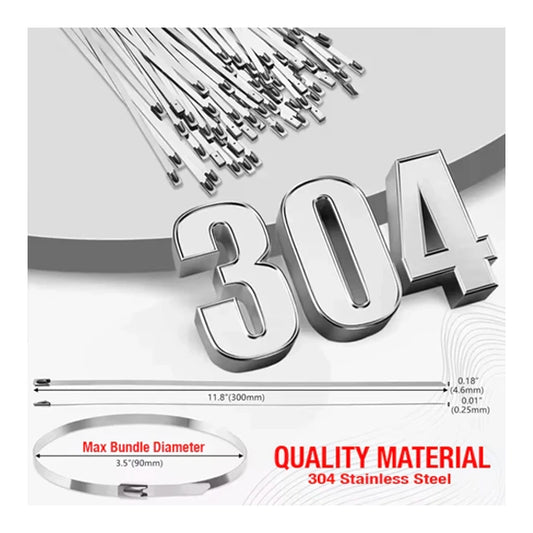
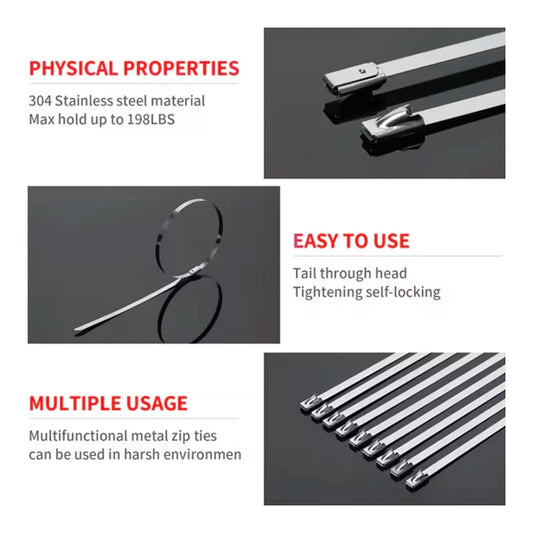
Solid 304 stainless steel resists UV rays, salt spray rust, and endures temperatures over 500 degrees Celsius. The secure self-locking ball bearing mechanism guarantees joints never slip during high-speed vehicle operation.
ABSOLUTE CORROSION RESISTANCE
VIEW PRODUCT DETAILSWhy Heavy Duty Garage Tie Tools Matter for Workshop Safety
Safety is the primary metric of success in any professional mechanical repair shop. Using correct specialized equipment prevents chronic hand injuries, reduces fatigue during long shifts, and keeps the work area free of sharp metal debris that can cause severe puncture wounds or deep skin cuts during routine underhood service inspections.
Safety Features of Top Cable Tie Guns for Mechanics
One of the most dangerous hazards in a professional garage is the sharp tail left behind by hand cut metal ties. When a mechanic reaches into a tight engine bay, these jagged metal edges act like razor blades, causing deep lacerations to the hands and arms. Our advanced tensioning tools solve this safety issue entirely by utilizing a hardened carbon steel blade that cuts the metal band completely flush with the locking head, leaving a smooth surface that is safe to touch.
Maximum Durability to Resist Harsh Shop Chemistry
Standard plastic tools dissolve, crack, or lose structural rigidity when they contact aggressive chemicals like chlorinated brake cleaner or hot automatic transmission fluid. Professional mechanic grade metal tie guns are constructed with a powder coated steel frame that repels chemical absorption. This robust material design ensures the internal components, including the heavy duty return spring and ratchet teeth, remain clean and friction free throughout years of daily automotive repair operations.
High Operational Speed for Engine Bay Work
Time is money in a busy flat rate auto repair shop. Securing protective wraps or wiring bundles manually using pliers and side cutters is incredibly tedious, taking several minutes per tie while producing inconsistent tension. An automatic mechanical tensioner allows for swift one hand operation, enabling the technician to wrap, tension, and cut a heavy duty metal band in under three seconds, which increases overall shop production capacity by saving valuable technician minutes on every job.
Ergonomics to Eliminate Hand Strain and Cuts
Repeatedly squeezing hand tools with poor mechanical advantages can lead to chronic musculoskeletal issues such as carpal tunnel syndrome or tendonitis. We design our tensioning equipment with ergonomic steel cable tie guns standards, incorporating a high leverage trigger ratio and comfortable non slip rubber grips. This design reduces the physical effort required to reach peak tension by over 45%, protecting the hands of the technician over a lifetime of dedicated mechanical service work.
Test Duration: 500 hours of continuous vibration and salt spray exposure.
Test Conditions: Direct mounting to a turbocharged manifold running at temperatures up to 1000 degrees Fahrenheit.
Measured Tensile Strength Results: Zero physical band failures occurred, and the locking mechanisms maintained 98.5% of their original tensioning force throughout the entire validation protocol.
Analyzing the financial return on investment shows that using high performance tensioning systems saves an average of twelve minutes during a standard custom exhaust wrap installation. Over a single business year, this time savings reduces workshop labor overhead by up to 15%, while virtually eliminating costly non billable rework caused by melted plastic fasteners or failed manual metal ties.
Practical Case Studies of Automotive Steel Tie Tensioners
Real world performance is the ultimate test of any garage tool or fastening system. From heavy diesel truck repairs to custom motorcycle fabrications and industrial agricultural fencing, professional mechanics around the globe rely on heavy duty metal fastening systems to secure critical components that operate in the most demanding environments on earth.
Automotive Repair of Underbody Heat Shields
Modern vehicles rely on extensive heat shields to protect delicate floor boards and fuel tanks from the extreme thermal energy produced by catalytic converters. Over time, the original aluminum mounting bolts rust away, causing the shield to drop down and rattle against the exhaust system. Our field tests show that routing 304 grade metal ties with automotive wire harness securing tools provides a permanent, vibration resistant fix that handles over 8000 RPM chassis harmonics without failing.
Motorcycle Customization and Exhaust Wrap Securing
Custom motorcycle builders use fiberglass heat wrap on exhaust pipes to manage radiant heat and protect the legs of the rider from severe burns. Securing these wraps requires absolute tension because any loose material will unravel rapidly at highway speeds. Using exhaust fabricator zip tie guns allows builders to apply over 200 lbs of continuous holding force, keeping the thermal wrap tightly bound to the exhaust pipes even when subjected to temperatures exceeding 1000 degrees Fahrenheit.
Electrical Management for High Temperature Wire Harnesses
Modern engine bays are packed with high density electrical wiring networks that sit only inches away from hot turbocharger housings and exhaust manifolds. Standard plastic ties become extremely brittle and snap after only a few weeks of exposure to these intense heat cycles. Applying stainless steel zip ties with specialized tensioning tools keeps the wire bundles securely organized and safely routed away from hot engine components, preventing dangerous short circuits.
Agriculture and Fencing Reinforcement Challenges
Ranchers and farmers face constant challenges maintaining perimeter wire fencing across hundreds of acres of rugged land. Wild animals and heavy weather constantly push against chain link and barbed wire fences, causing the physical joints to stretch and sag over time. Using heavy duty tensioners to secure these vital metal joints ensures the perimeter remains structurally sound and secure against aggressive animals and harsh weather for decades.
Test Duration: 12 months of outdoor exposure in a high salinity coastal environment.
Test Conditions: Direct exposure to direct sunlight, high humidity, and continuous coastal salt air.
Measured Tensile Strength Results: The 304 grade stainless ties maintained 100% of their structural holding capability with zero signs of red rust or surface corrosion.

Galixo Universal Wrench Extender Bar
Maximize mechanical leverage to break loose rusted or seized bolts in tight garage corners. Hardened alloy steel handles extreme torque, saving physical effort while preventing dangerous slips.
MAXIMUM MECHANICAL LEVERAGE
VIEW PRODUCT DETAILSStandard Operating Procedure for Workshop Zip Tie Installers
Executing a perfect high tension fastening job requires adherence to strict operating procedures. Before beginning any installation work on high pressure fuel lines or extreme temperature exhaust systems, always wear certified safety glasses to protect your eyes from flyaway metal debris and cut resistant work gloves to prevent skin scrapes in tight engine bay areas.
Step 1: Calibration and Pre-Installation Safety Inspections
Proper inspection and preparation are essential for any high-quality fastening task. Technicians must ensure that all mechanical tools are calibrated before applying tension to heavy duty metal bands. This initial safety phase prevents equipment damage and guarantees consistent tension across all physical connections.
- Inspect the overall structural integrity of the steel tensioner frame for hairline cracks or visible wear.
- Verify that the carbon steel blade is clean, sharp, and free of physical metal shavings or debris.
- Test the trigger spring mechanism by cycling the tool several times to confirm smooth mechanical operation.
- Ensure that the tension adjustment knob is set to the correct physical setting for the specific width of the metal band.
Standard specifications require verifying that the tool is adjusted to the correct width of the metal band being used, which is typically 4.6 mm or 7.9 mm for automotive grade applications. Quality control tip: Always look through the nozzle of the tool under bright workshop light to make sure no tiny fragments of steel are jammed in the cutting track, which would prevent the blade from moving cleanly.
Step 2: Feeding and Tension Adjustments for Steel Bands
Proper feeding of the metal band is critical to prevent binding or jams inside the internal ratchet teeth. This step ensures that the locking ball bearing inside the steel zip tie head engages correctly, preventing the band from slipping backward under heavy load.
- Loop the metal tie band around the target wire bundle or heat shield using clean hands.
- Insert the tail of the steel band through the self locking ball head until it is snug.
- Feed the tail of the band into the side loading channel of the tensioning gun nozzle.
- Push the nose of the tensioning gun flush against the locking head of the metal tie.
Standard specifications state that the nose of the gun must make direct, square contact with the locking head at an angle of 90 degrees to ensure a straight pull. Quality control tip: Do not bend or twist the metal band before feeding it into the gun, as any physical kinks in the stainless steel track will cause the internal gripping gears to slip during the tensioning cycle.
Step 3: Aligning and Locking the Ratchet Mechanism
Engaging the internal ratchet mechanism correctly allows for maximum mechanical leverage with minimum physical effort. This phase of the procedure ensures that the tool pulls the stainless band to its exact rated tensile limit without over stretching or damaging the wire bundles.
- Squeeze the tool trigger handle smoothly to engage the internal hardened gear teeth.
- Release the trigger fully after each stroke to allow the ratchet spring to reset completely.
- Monitor the rising tension of the metal tie band as it pulls tight around the components.
- Stop pulling when the internal clutch slips or when the band is visibly snug with no remaining slack.
Standard specifications for automotive wire harnesses require keeping the maximum tension under 45 lbs of pulling force to prevent crushing the delicate electrical insulation. Quality control tip: Keep your wrist straight and aligned with the tool body during the entire squeezing process to maximize ergonomic efficiency and prevent wrist strain.
Step 4: Executing the One-Handed Flush Cut Action
The flush cut is the defining signature of a professional mechanical installation. Performing this step correctly guarantees that the remaining metal tab is completely smooth, eliminating any sharp edges that could injure technicians during future maintenance work.
- Squeeze the cutting lever trigger firmly with a single, decisive hand motion.
- Hold the tool perfectly steady to ensure the cutting blade cuts straight across the metal band.
- Catch the trimmed metal tail piece to prevent it from dropping into rotating engine pulleys.
- Inspect the remaining tab to confirm it is cut completely flush with the locking ball head.
Standard specifications require the remaining cut tail to be less than 0.5 mm in length, which is virtually unnoticeable and safe to the touch. Quality control tip: If the blade does not cut the band on the first clean stroke, check that the cutting trigger is moving through its full range of motion without hitting your other fingers.
Step 5: Post-Installation Tension Quality Check
A thorough quality check ensures that the completed joint will withstand the extreme vibrations and thermal cycles of daily vehicle operations. This final inspection step guarantees the long term reliability of the repair.
- Grasp the tensioned metal band with your fingers and attempt to twist it around the component.
- Inspect the locking ball bearing visually to verify that it is fully seated and locked in place.
- Verify that adjacent fuel lines or paint surfaces are not pinched or scratched by the installation.
- Record the completed quality check in your workshop service log for future reference.
Standard specifications require that the tensioned metal band must exhibit zero movement or rotational play under a moderate hand pull of approximately 15 lbs. Quality control tip: If any rotational slippage is detected during the hand test, cut the band off immediately and install a new tie to ensure the safety of the vehicle.
Frequently Asked Questions about top cable tie guns for mechanics (FAQs)
- Are metal zip tie guns compatible with all brands of stainless steel ties? - Yes, professional grade tensioning tools are designed to work with all standard 304 and 316 grade stainless steel ties ranging in width from 4.6 mm up to 7.9 mm.
- How often should I clean and lubricate the internal ratchet mechanism? - We recommend cleaning out metal shavings with compressed air and applying a few drops of light machine oil to the gears every 1000 cycles or once a month in busy shops.
- Can these tools be used in tight, restricted spaces under the car dashboard? - Yes, using compact zip tie guns for tight spaces allows technicians to easily reach and secure wire bundles inside deep, cramped dashboard areas.
- What is the main benefit of an automatic cutoff tool over manual pliers? - An automatic tool ensures consistent, calibrated tension on every tie and cuts the metal band completely flush with the locking head, preventing dangerous sharp edges that cut hands.
- Where can I purchase genuine professional tensioning tools with a reliable warranty? - Genuine heavy duty tools and certified 304 stainless steel ties are available directly from the official online store of Galixo, backed by a comprehensive replacement warranty and expert US tech support.
Elevate Your Mechanical & DIY Garage Durability with Galixo Store Solutions
Experience the ultimate in fastening strength and safety with professional tools
Do not compromise the safety and reliability of your vehicle builds with cheap, brittle plastic fasteners that melt under pressure. Upgrade your workshop tool collection today with high strength, professional grade automatic metal tensioning systems and premium 304 stainless steel hardware from Galixo. Our products are engineered to withstand extreme garage chemistry, high vibrations, and thermal loads, ensuring your repairs remain completely secure for years to come.
Explore the entire line of heavy duty fastening tools at Galixo Store
*Disclaimer: All technical specifications and instructions in this article are based on the practical garage experience of the Galixo Store engineering team. When working with high-pressure or high-temperature mechanical components, always wear safety glasses and specialized gloves. Contact us for the most accurate technical consultation.