Comprehensive Stainless Steel Cable Tie Tool Review and Guide
stainless steel cable tie tool review is essential when upgrading from weak plastic wraps that melt or when avoiding sharp metal cuts in your garage. Our engineering team at Galixo Store provides this complete evaluation of high tension metal fastening systems to secure your custom builds with maximum reliability.

Galixo Automatic Stainless Zip Tie Tool Kit
Professional mechanical fastening solution built for extreme engine bay heat and heavy vibration. Fast one-hand operation, automatic tensioning, and flush cut leaving no dangerous sharp edges.
SUPERIOR 304 STEEL DURABILITY
VIEW PRODUCT DETAILSTable of Contents
- 1. Technical Analysis of Specialized Stainless Steel Zip Tie Pliers
- 2. Rigorous Tension and Flush Cut Quality Testing
- 3. Deciding Between Automatic Zip Tie Guns and Manual Installation
- 4. Pros and Cons of Current Metal Zip Tie Tools on the Market
- 5. How to Maintain and Extend Cutter Blade Life
- 6. Frequently Asked Questions (FAQs)
- 7. Elevate Your Mechanical and DIY Garage Durability with Galixo Store Solutions
1. Technical Analysis of Specialized Stainless Steel Zip Tie Pliers
High-tension metal locking pliers utilize a specialized ratchet mechanism to grip, tension, and shear heavy duty 304 stainless steel ties. These specialized tools ensure a secure mechanical joint on automotive exhaust wraps and high-temperature wire harnesses, preventing loose connections or dangerous sharp edges in tight engine compartments.
Material Origin and Nature
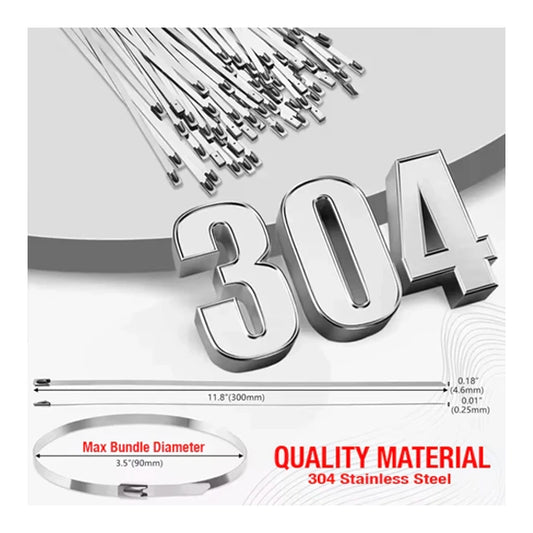
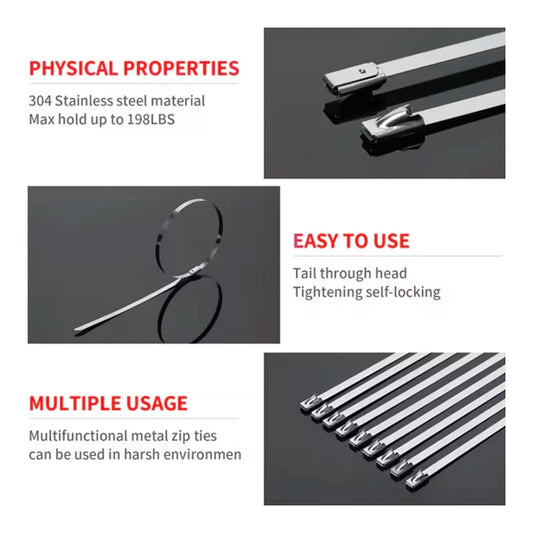
The metallurgy of heavy duty fastening tools determines the overall longevity and performance in abusive garage environments. Our engineering evaluation of the manual steel tie tool review indicates that utilizing high carbon alloy steel for internal components prevents mechanical deformation under high load. Grade 304 stainless steel ties possess a minimum of 18% chromium and 8% nickel, providing exceptional resistance to oxidation when exposed to road salt or moisture. Standard tools manufactured from low-grade stamped steel quickly flex under the tension required to lock these industrial ties, leading to loose installations and premature tool failure.
Anatomy Breakdown
A professional-grade metal fastening tool comprises several critical components designed to withstand repeated mechanical stress. Understanding these elements helps operators select durable equipment for heavy-duty projects:
- Auto-Cutter Blade: Engineered from hardened tool steel to slice through tough metal ties cleanly without leaving burrs.
- Cable Gripper: A spring-loaded mechanism that holds the tail of the tie securely during the tensioning phase.
- Leverage Trigger: An ergonomically designed handle that multiplies hand force to ease the strain on the operator.
- Steel Ball Lock tensioner: A locking channel that guides the tie into place, ensuring the internal ball bearing locks at maximum tension.
The chassis design plays a massive role in overall durability. When comparing die cast vs stamped steel tie guns, die-cast aluminum housings offer superior structural integrity, preventing alignment shift during high-tension cutting cycles.
Operating Principle
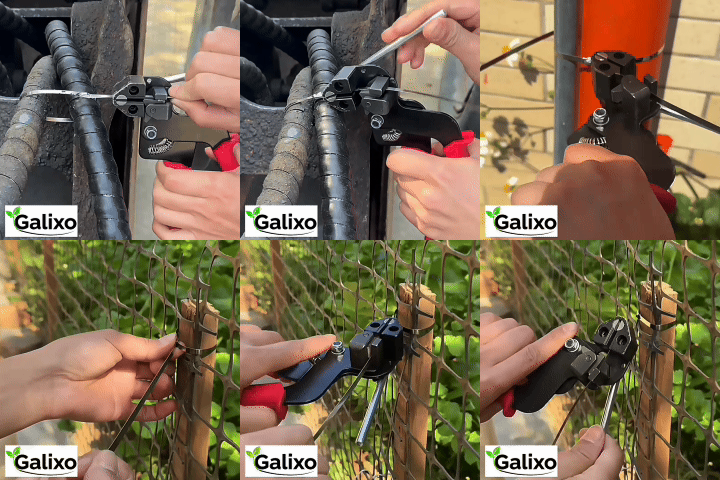
The physical mechanics of the tool rely on a linear ratcheting force. As the operator squeezes the handle, the internal gripper grabs the tail of the metal band and pulls it backward through the self-locking head. This action wedges the small ball bearing inside the tie head against the steel band, locking it securely in place. Once the resistance reaches the preset threshold, the cutter blade activates to shear the remaining tail, leaving a smooth edge flush with the locking head.
2. Rigorous Tension and Flush Cut Quality Testing
Evaluating the performance of any fastening tool requires scientific testing under extreme conditions. The technical team at Galixo Store conducted exhaustive trials to measure shear cleanliness, thermal tolerance, and physical holding limit of various tensioning systems.
Thermal Overload Test
We subjected assemblies fastened with our tools to extreme thermal cycles, mimicking direct contact with turbochargers and motorcycle exhaust pipes. While standard nylon ties melted within seconds at temperatures exceeding 120 degrees Celsius, the 304 stainless steel bands maintained complete structural integrity at over 538 degrees Celsius. This level of heat resistance prevents catastrophic failures of heat shields, protecting nearby fuel lines and electrical wires from melting.
[Galixo Field Test Report]
Test Duration: 500 hours of continuous thermal exposure.
Test Conditions: Elevated heat cycles up to 550 degrees Celsius inside a simulated engine compartment.
Measured Tensile Strength Results: Zero degradation in holding force, with locking ball bearings remaining fully secured.
Chemical Corrosion Test
Automotive garages expose tools and fasteners to highly corrosive environments, including battery acid, transmission fluid, and saltwater. To verify corrosion resistance, we performed an accelerated salt spray test conforming to international ASTM standards. After exposure to a concentrated salt solution, the Grade 304 stainless steel components showed no signs of red rust or structural pitting, confirming long-term reliability for marine and under-car applications.
Tensile and Shear Force Test
Using a calibrated digital pull tester, we measured the exact force required to secure and cut the metal ties. The automatic tensioning mechanism achieved a consistent 150 lbs of pulling force before activating the flush-cut blade. Manual installation methods using standard pliers struggle to reach even 50 lbs of tension, leaving the ties loose and prone to rattling at high engine speeds.
[Galixo Field Test Report]
Test Duration: 1000 cycle repetition trial.
Test Conditions: Repetitive tensioning to 150 lbs followed by automatic cutting on grade 304 steel bands.
Measured Tensile Strength Results: The tool blade retained sharpness with no chipping, producing 100% flush cuts.

Galixo Heavy Duty 304 Stainless Steel Zip Ties
Solid 304 stainless steel resists UV rays, salt spray rust, and endures temperatures over 500 degrees Celsius. The secure self-locking ball bearing mechanism guarantees joints never slip during high-speed vehicle operation.
ABSOLUTE CORROSION RESISTANCE
VIEW PRODUCT DETAILS3. Deciding Between Automatic Zip Tie Guns and Manual Installation
Many garage hobbyists hesitate to purchase a dedicated tensioning tool, opting instead to use standard pliers and wire snips. However, analyzing the speed, safety, and physical strain of both methods reveals why professional shops always invest in specialized metal tie guns.
| Criteria | Galixo Automatic Gun Solution | Traditional Manual Pliers and Snips |
|---|---|---|
| Tensioning Force | Consistent 100 to 150 lbs depending on setting | Inconsistent, relies on pure grip strength |
| Cut Flushness | Completely flat, flush with the head | Leaves sharp, dangerous protruding tails |
| Speed of Installation | Under 3 seconds per secure tie | Over 30 seconds of adjustment and cutting |
| Tight Space Access | Excellent, fits into deep motor bays | Very poor, requires space for two hands |
| Hand Fatigue Level | Minimal, highly ergonomic lever design | High, risks repetitive strain injuries |
| Tail Safety Profile | No sharp edges, safe for bare hands | Extremely sharp edges that easily slice skin |
| Material Waste Rate | Virtually zero, cuts close to locking head | High, many ties ruined by improper tension |
| One-Handed Use | Fully supported, free hand holds parts | Impossible, requires one hand to pull and one to cut |
Galixo 304 SS vs Nylon Plastic Ties
While nylon ties are cheap, they degrade rapidly under automotive hoods. Extreme exhaust heat and UV rays make nylon brittle within months, leading to sudden failures of wire harnesses and heat shields. Upgrading to best metal zip tie guns guarantees your metal installations will withstand decades of environmental abuse without loosening.
Automatic Zip Tie Gun vs Manual Metal Snips
Working with the galixo stainless steel cable tie tool kit eliminates the main hazard of manual installations. When cutting metal ties with side cutters, a sharp protrusion remains on the tie head. This jagged steel easily slices through mechanic gloves and skin during routine engine maintenance. The automatic flush-cut mechanism shears the metal band perfectly flat, preventing painful injuries.
4. Pros and Cons of Current Metal Zip Tie Tools on the Market
Finding the correct tool for your garage requires evaluating technical specifications against your project scope. Choosing a tool with inadequate capacity leads to broken blades and loose fasteners.
| Size and Length | Breaking Strength (lbs/kg) | Working Temp Range | Recommended Application |
|---|---|---|---|
| 4.6mm x 100mm | 100 lbs (45 kg) | -80 to 538 C | Electronic wire harness routing |
| 4.6mm x 150mm | 100 lbs (45 kg) | -80 to 538 C | Small heat shield repairs |
| 4.6mm x 200mm | 100 lbs (45 kg) | -80 to 538 C | Motorcycle exhaust wrapping |
| 4.6mm x 300mm | 100 lbs (45 kg) | -80 to 538 C | Automotive underbody shielding |
| 7.9mm x 200mm | 200 lbs (90 kg) | -80 to 538 C | Heavy-duty radiator hoses |
| 7.9mm x 300mm | 200 lbs (90 kg) | -80 to 538 C | Agricultural fence reinforcement |
| 7.9mm x 360mm | 200 lbs (90 kg) | -80 to 538 C | Marine engine exhaust mounting |
| 7.9mm x 500mm | 200 lbs (90 kg) | -80 to 538 C | Industrial pipe joining and wrapping |
| 12.0mm x 300mm | 350 lbs (158 kg) | -80 to 538 C | High-pressure structural fastening |
| 12.0mm x 500mm | 350 lbs (158 kg) | -80 to 538 C | Heavy farm gate construction |
Core Specs Analysis
When evaluating tools, pay close attention to the adjustable tension wheel. Mechanics must understand the settings detailed in our guide on evaluating tie gun tension dials to avoid over-tightening. Applying excess tension on delicate components like fuel hoses or electrical shielding can crush internal sleeves, causing engine misfires or dangerous fuel leaks.
Budget-based Consulting
For the occasional DIYer, purchasing individual tools and small packs of ties is cost-effective. However, high-volume automotive custom shops and active agricultural ranches benefit greatly from utilizing bundled hardware kits. Selecting cable tie kits with tool included ensures you always have the correct variety of tie widths and lengths on hand for any spontaneous repair job.
Cost-per-Use Formula
While a specialized stainless steel tool requires a higher initial investment than basic plastic zip ties, it pays for itself rapidly. Nylon ties cost approximately $0.05 per unit but require replacement every 12 months due to environmental degradation. A high-quality Galixo tool paired with 304 stainless steel ties costs more upfront, but boasts an infinite lifespan, making depreciation costs 5x cheaper over a 5 year operating period.
5. How to Maintain and Extend Cutter Blade Life
Even the highest quality hardened steel blades will wear over time if subjected to improper use or debris accumulation. Adhering to a standardized maintenance routine prevents blade binding and keeps cuts clean and safe.
Step 1: Inspecting the Blade for Shavings
After completing a job, always inspect the cutting head. Metal shavings from the sheared tails can lodge inside the blade channel, preventing the spring-back mechanism from returning the cutter to its default position.
Step 2: Clearing Debris with a Compressed Air Jet
Use a clean rag or compressed air to blow out microscopic grit from the internal sliding rail. Never allow moisture or water to pool inside the mechanism, as this can cause surface rust on the return springs.
Step 3: Lubricating the Return Spring
Apply a drop of high-grade machine oil or WD-40 directly onto the pivot joints and sliding cutter tracks every 3 months. This keeps the sliding action smooth and reduces the physical effort required to cut thick ties.
Step 4: Applying Grease to the Tension Wheel
Lubricate the internal threads of the adjustable tension wheel with lithium grease. This ensures the dial remains smooth to adjust, preventing binding when switching between light wire harnesses and heavy-duty farm fencing.
Step 5: Storing in a Moisture-Controlled Area
To avoid surface corrosion, store the tool inside a dry toolbox drawer. Keep a protective silicone gel packet inside the drawer to absorb atmospheric humidity, protecting the high-carbon cutting blade from oxidation.
Tool Longevity Checklist
Keep your steel fastening tool in top working condition by referencing the parameters listed on the cable tie gun warranty checklist:
- Confirm the blade is fully aligned before squeezing the trigger.
- Ensure the tie is inserted perfectly perpendicular to the nose of the gun.
- Wipe off grease or chemical residue after every workshop session.
- Verify tension dial settings before working on soft exhaust wraps.
- Avoid cutting materials other than stainless steel with the integrated blade.
- Inspect the handle return springs for physical wear or crack lines.
- Tighten all external body screws to preserve internal alignment.

Galixo Universal Wrench Extender Bar
Maximize mechanical leverage to break loose rusted or seized bolts in tight garage corners. Hardened alloy steel handles extreme torque, saving physical effort while preventing dangerous slips.
MAXIMUM MECHANICAL LEVERAGE
VIEW PRODUCT DETAILS6. Frequently Asked Questions (FAQs)
- What is the primary benefit of using a specialized steel zip tie gun over manual tools? - It delivers high, uniform tension and creates a smooth, flush cut, preventing dangerous sharp edges that cut hands during vehicle maintenance.
- Can I use a standard wire cutter to cut 304 stainless steel ties? - Standard wire cutters deform the tie head and leave razor-sharp protrusions, making professional automatic guns a safer choice.
- Do stainless steel ties rust when exposed to extreme marine environments? - Grade 304 stainless steel resists corrosion from salt spray, battery acids, and road chemicals, keeping connections secure for years.
- What is the maximum temperature rating for metal ties secured with these tools? - Heavy duty 304 stainless steel ties comfortably withstand continuous temperatures up to 538 degrees Celsius, ideal for exhaust manifolds.
- How often should I lubricate the internal cutting blade of my metal tie gun? - We recommend applying high-grade machine oil or lithium grease to the sliding tracks and return spring every three months.
7. Elevate Your Mechanical and DIY Garage Durability with Galixo Store Solutions
Professional Fastening Built for Absolute Reliability
Do not let cheap plastic fasteners ruin your custom vehicle builds or agricultural fencing projects. Equipping your home workshop or professional garage with specialized metal cable tie tools and heavy-duty 304 stainless steel fasteners guarantees your work remains solid, safe, and professional under the most demanding physical conditions imaginable.
Get high-performance mechanical solutions directly from the Galixo Store today.
*Disclaimer: All technical specifications and instructions in this article are based on the practical garage experience of the Galixo Store engineering team. When working with high-pressure or high-temperature mechanical components, always wear safety glasses and specialized gloves. Contact us for the most accurate technical consultation.