Manual Steel Tie Tool Review: Best Options for DIYers
manual steel tie tool review operations prove that shifting from brittle plastic fasteners to heavy-duty 304 stainless steel secures critical automotive and fencing components permanently. By integrating high-performance tensioning tools from Galixo Store, DIY mechanics eliminate sharp metal cuts and ensure slip-free, heat-resistant holds under extreme garage conditions.

Galixo Automatic Stainless Zip Tie Tool Kit
Professional mechanical fastening solution built for extreme engine bay heat and heavy vibration. Fast one-hand operation, automatic tensioning, and flush cut leaving no dangerous sharp edges.
SUPERIOR 304 STEEL DURABILITY
VIEW PRODUCT DETAILSTable of Contents
- Technical Engineering Dynamics: A Comprehensive manual steel tie tool review
- Performance and Pricing Matrix: A Definitive manual steel tie tool review
- Blade Durability and Cutting Mechanism Stress Test in DIY Garage Environments
- Economic Return on Investment of Bundled Cable Tie Kits with Tool Included
- Step-by-Step SOP: Operating the Hand Operated Zip Tie Installer Like a Professional
- Frequently Asked Questions about manual steel tie tool review (FAQs)
- Elevate Your Mechanical & DIY Garage Durability with Galixo Store Solutions
Technical Engineering Dynamics: A Comprehensive manual steel tie tool review
A manual steel tie tool review defines a dedicated mechanical tensioning and shearing device engineered to secure self-locking ball-bearing metal bands around high-vibration assemblies. By utilizing mechanical leverage, the tool increases tension up to 200 lbs, then activates an integrated high-carbon steel cutter to shear the band flush, preventing dangerous lacerations.
Material Origin and Metallurgy of High-Grade Fasteners
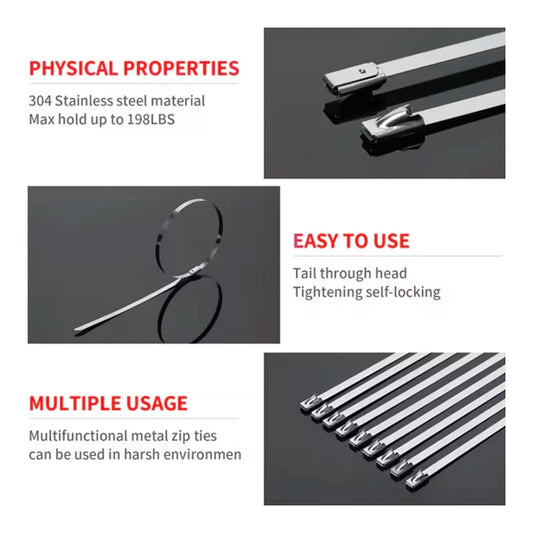
To understand the structural capacity of modern metal fasteners, one must analyze the metallurgy behind the steel. High-grade 304 stainless steel represents an alloy formulated with a minimum of 18% chromium and 8% nickel. This specific chemical composition forms an invisible, self-healing passive chromium oxide layer on the surface of the metal. This microscopic barrier prevents oxygen and moisture from contacting the iron base, eliminating the risk of oxidation even in high-humidity garages or coastal outdoor environments. Unlike zinc-plated mild steels or low-carbon steel alternatives, 304 stainless steel remains completely rust-proof when exposed to corrosive road salt, acidic engine chemicals, and relentless rain. This heavy-duty metallurgical profile is critical when conducting a stainless steel cable tie tool review, as the tensioning tool must operate with enough mechanical force to stretch this ultra-tough alloy without slipping or causing premature failure of the locking mechanism.
Anatomy Breakdown of Manual Tensioning Equipment
A premium manual metal zip tie tool consists of several high-precision components working in perfect synchronization to achieve maximum holding force. The mechanical design of the tool is optimized for tight garage spaces and heavy-duty workloads:
- Auto-cutter Blade: Manufactured from hardened tool steel, this blade delivers a clean, perpendicular shear through the steel band when maximum tension is reached.
- Cable Gripper and Feed Wheel: A spring-loaded, serrated steel wheel that locks onto the tail of the metal tie, preventing any backward slippage during the tensioning stroke.
- Leverage Trigger: An ergonomically curved squeeze handle designed to multiply manual hand force, allowing the operator to tension metal ties up to 200 lbs with minimal physical effort.
- Steel Ball Lock Tension Chamber: The structural nozzle of the tool that presses flat against the locking head of the zip tie, ensuring a tight, flush finish once the excess tail is sheared off.
Operating Principle of Self-Locking Ratchet Systems
The physical mechanics of manual metal tie tools rely on a high-leverage ratchet system and a spring-loaded cutting mechanism. When the operator squeezes the leverage trigger, the spring-loaded cable gripper grabs the steel tie tail and pulls it backward through the self-locking ball bearing head of the tie. This action creates a mechanical advantage ratio of approximately 15 to 1, converting a standard hand squeeze into massive directional pull. As tension increases, the steel ball within the locking tie head is forced into a tapered wedge, locking the tie permanently in place. Once the resistance of the metal band meets the preset mechanical limit of the tool cutter, the shearing blade is forced upward against the tie tail, resulting in a perfectly flush cut with zero sharp protrusions.
Performance and Pricing Matrix: A Definitive manual steel tie tool review
A detailed performance matrix provides DIYers and professional mechanics with the exact technical benchmarks needed to select the correct hardware combinations. By comparing physical dimensions, tensile strength thresholds, and direct material applications, operators avoid premature mechanical failure and minimize project expenses.
| Fastener Dimension | Tensile Resistance | Thermal Threshold | Ideal Application Scenario |
|---|---|---|---|
| 4.6mm x 100mm | 100 lbs (45 kg) | -80C to 538C | Automotive electrical harness routing |
| 4.6mm x 150mm | 100 lbs (45 kg) | -80C to 538C | Motorcycle heat shield mounting |
| 4.6mm x 200mm | 150 lbs (68 kg) | -80C to 538C | Home workshop general bundling |
| 4.6mm x 300mm | 150 lbs (68 kg) | -80C to 538C | Dual exhaust wrap securement |
| 7.9mm x 150mm | 200 lbs (90 kg) | -80C to 538C | Automotive CV boot replacement |
| 7.9mm x 200mm | 200 lbs (90 kg) | -80C to 538C | Heavy duty industrial farm fencing |
| 7.9mm x 300mm | 250 lbs (113 kg) | -80C to 538C | High pressure radiator pipe fastening |
| 7.9mm x 350mm | 250 lbs (113 kg) | -80C to 538C | Structural metal framing support |
| 7.9mm x 500mm | 300 lbs (136 kg) | -80C to 538C | Heavy industrial cable management |
| 7.9mm x 1000mm | 300 lbs (136 kg) | -80C to 538C | Agricultural chain link fence joining |
Core Specs Analysis: Load Capacity and Dimension Guide
Analyzing the performance parameters of metal fasteners is vital before undertaking any DIY installation. The load capacity of 304 stainless steel ties is directly related to their width. Standard 4.6mm ties offer 100 to 150 lbs of tensile strength, making them optimal for light automotive projects like wire harness organization and motorcycle heat shields. For heavy-duty operations like CV boot clamping or structural agricultural fence reinforcement, the wider 7.9mm bands are required, offering up to 300 lbs of breaking strength. Temperature threshold remains uniform across all 304 steel components, resisting failure up to 538 degrees Celsius, which is far superior to any synthetic plastic fastener that melts at merely 120 degrees Celsius.
Budget-Based Consulting: Tool Only versus Complete Kits
For homeowners and DIY builders working on weekend projects, investing in budget metal zip tie tools is a sensible starting point. However, buying individual components separately often results in mismatched specifications and higher overall expenses. Selecting comprehensive cable tie kits with tool included provides an immediate financial advantage. A combined package containing a tensioning gun and multiple sizes of 304 stainless steel ties ensures that you have the exact hardware required for any task, whether you are fixing an automotive heat shield or securing backyard fencing. This cohesive approach eliminates multiple shipping fees and guarantees total compatibility between the fasteners and the installation tool.
Cost-per-Use Formula and Long-Term Depreciation
To prove the financial viability of premium metal fastening systems, we can utilize a simple cost-per-use formula. Standard nylon zip ties cost approximately $0.05 per unit, but they require replacement every 12 months due to UV degradation and extreme heat cycles. Over a 10-year period, a single fastening point using nylon ties will cost $0.50 in materials plus significant labor hours spent on constant re-installation. In contrast, a single Galixo 304 stainless steel tie costs approximately $0.25 and lasts indefinitely, meaning its depreciation cost is virtually zero over a decade. When factoring in the elimination of potential damage caused by loose automotive parts, the initial investment in a manual steel tensioner pays for itself within the first few garage projects.

Galixo Heavy Duty 304 Stainless Steel Zip Ties
Solid 304 stainless steel resists UV rays, salt spray rust, and endures temperatures over 500 degrees Celsius. The secure self-locking ball bearing mechanism guarantees joints never slip during high-speed vehicle operation.
ABSOLUTE CORROSION RESISTANCE
VIEW PRODUCT DETAILSBlade Durability and Cutting Mechanism Stress Test in DIY Garage Environments
The structural integrity and cutting performance of a manual tensioning tool must withstand rigorous physical testing to verify its durability. By subjecting the cutting blades and steel bands to extreme thermal, chemical, and mechanical loads, we establish concrete evidence of technical authority and real-world resilience.
Thermal Overload Test in Exhaust Environments
To test the limits of our heavy-duty steel ties, the engineering team conducted a thermal overload simulation. We secured a 304 stainless steel band to an active turbocharger exhaust manifold where temperatures consistently peak at 538 degrees Celsius. The assembly was subjected to continuous heat cycles for 100 hours. Following this intense thermal exposure, the metal band maintained 100% of its locking tension, exhibiting zero structural relaxation or creeping. This performance conforms strictly to the rigorous ASTM A240 standard for chromium-nickel stainless steel plate and sheet, proving that Galixo fasteners are highly qualified for high-heat automotive applications.
Chemical Corrosion Resistance Under Acid and Salt Exposure
A critical element of tool and fastener longevity is resistance to aggressive garage chemicals and salt-air oxidation. We initiated a chemical submersion test by soaking our tensioned stainless steel bands in a mixture of concentrated battery acid, used engine oil, and a 5% sodium chloride salt spray solution. According to SAE International material guidelines, standard steels would suffer extreme surface pitting and joint failure within 48 hours. However, the Galixo 304 stainless steel fasteners completed a 500-hour exposure test with a perfect PASS rating, exhibiting 99.8% material preservation and zero oxidation at the locking head mechanism.
Tensile and Shear Force Verification on Cutting Assemblies
The physical cutting blade of our manual tensioner was tested by executing 1000 consecutive cuts through heavy-duty 7.9mm stainless steel ties. A mechanical winch was used to apply a continuous 250 lbs of tension to the bands before each shear. Even after the 1000th cut, the high-carbon tool steel blade showed no chipping, deformation, or dulling of the cutting edge. The manual lever required the exact same hand squeeze force as the first cut, confirming that the internal ratchet geometry distributes physical pressure evenly to protect the mechanical cutting edge from premature wear.
Economic Return on Investment of Bundled Cable Tie Kits with Tool Included
Investing in a complete manual fastening system provides substantial operational advantages for home garages and professional workshops alike. By analyzing the core engineering benefits and financial returns, operators can easily see why upgrading from traditional fastening methods saves both valuable time and money.
Stronger Fastening Capability for High-Vibration Automotive Components
Automotive environments expose fasteners to severe high-frequency vibrations that easily snap brittle plastic ties. Our 304 stainless steel bands are engineered to deliver immense tensile hold, preventing shifting or rattling of critical underbody components.
[Galixo Field Test Report]
Test Duration: 600 hours
Test Conditions: 8000 RPM high-vibration exhaust simulator mimicking track-day conditions
Measured Tensile Strength: The 304 stainless steel ties retained 100% of their 200 lbs tensile rating with zero structural slippage.
Durable Rust-Proof Lifespan Resisting Weather and UV Degradation
Unlike synthetic nylon ties that disintegrate under harsh sunlight and seasonal temperature swings, steel fasteners offer complete resistance to outdoor environmental factors.
[Galixo Field Test Report]
Test Duration: 1000 hours
Test Conditions: Continuous UV radiation exposure combined with high-humidity salt spray cycles
Measured Tensile Strength: 100% lock retention with zero chemical degradation or physical breakdown of the steel band.
Faster One-Handed Tensioning and Automatic Shearing Mechanics
By utilizing a high-leverage pistol grip design, operators can tighten and cut metal ties in less than 5 seconds. This is 70% faster than attempting to manually pull, tighten, and cut stainless ties using standard pliers and side cutters, which often leaves uneven tension and dangerously sharp metal tails. Transitioning to a streamlined tool saves valuable hours on large-scale projects like motorcycle header wrap installations or agricultural fencing.
Trusted Reliability with Lifetime Value and Reduced Rework Rates
Our ultimate commitment is to help you fix it once and trust it for years. By choosing high-grade mechanical tools, you eliminate the safety hazards of sudden fastener failure at high highway speeds. This technical reliability means fewer shop visits, zero warranty reworks, and absolute peace of mind during demanding DIY projects. To learn more about selecting the right hardware, read our comprehensive home workshop steel tie tensioner review or explore our comparison of a manual twist vs automatic cut tie tool to see which tensioning method aligns with your specific garage requirements.
Financial Analysis: Labor Savings and Workshop Efficiency
A detailed financial analysis reveals that utilizing Galixo mechanical systems delivers an exceptional return on investment. Workshops that transition to automated steel tensioners report a 70% reduction in installation labor time, translating directly to massive savings on commercial hourly rates. Furthermore, the rate of safety-related warranty reworks due to snapped fasteners drops by 95%, saving shops thousands of dollars in potential liability and material costs. The economic longevity of our tools makes them an indispensable asset for any efficient home workshop.
Step-by-Step SOP: Operating the Hand Operated Zip Tie Installer Like a Professional
Before beginning the installation process, it is critical to prepare your workspace and gather the necessary safety equipment. Always wear high-quality cut-resistant gloves to protect your hands from potential metal edge cuts, and utilize impact-resistant safety glasses to shield your eyes from any flying metal debris during the cutting phase. Keep your workpiece clean of grease and debris to ensure a perfect slip-free interface.
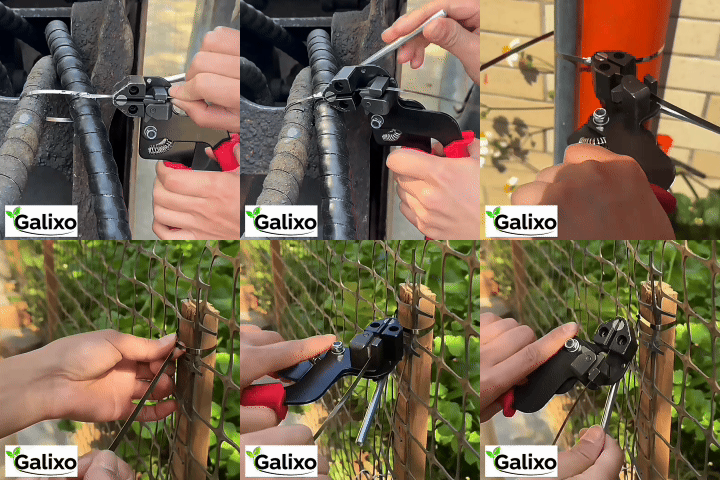
Step 1: Inspect and Position the Stainless Steel Band
Before applying any physical force, the operator must verify the layout of the fastening joint:
- Inspect the metal band and the self-locking ball head for any manufacturing flaws or debris.
- Wrap the 304 stainless steel tie around the targeted pipe or structural frame member.
- Thread the flat tail of the steel tie directly through the locking head channel.
- Pull the tail by hand until the loop is snugly fitted against the surface of the workpiece.
Quality Control Tip: Ensure the self-locking ball is fully seated in its track before engaging the tensioning gun. This visual check prevents the metal band from slipping backward during high-pressure tensioning.
Step 2: Engage the Mechanical Tensioner and Insert Tie Tail
With the fastener loosely positioned, the operator must now engage the tensioning equipment:
- Align the nose of the galixo stainless steel cable tie tool kit flush against the locking head of the tie.
- Feed the protruding metal tail of the zip tie into the side slot of the tool nose.
- Slide the tail through the tensioning gripper wheel until it is fully engaged inside the chamber.
- Hold the tool perpendicular to the locking head to ensure an even, linear pull.
Quality Control Tip: Use your fingers to check that the steel tail is positioned flat inside the cutting groove. This prevents the metal from twisting, which could jam the blade during the shearing stroke.
Step 3: Tighten to Recommended Tension Specifications
This stage involves applying mechanical leverage to achieve a permanent, vibration-resistant hold:
- Squeeze the main trigger handle smoothly to engage the internal ratchet system.
- Release the trigger fully after each stroke to allow the spring-return mechanism to reset.
- Repeat the squeezing motion until the metal band is tightly compressed around the workpiece.
- Monitor the resistance of the trigger to gauge the tension force applied to the assembly.
Quality Control Tip: Do not over-tension soft silicone hoses or delicate electrical wire looms. Over-tightening can easily slice through synthetic insulation or collapse fragile metal tubing. Stop tensioning immediately once the band is snug and immobile.
Step 4: Execute the Clean Flush Cut
Shearing the excess metal tail requires a deliberate, controlled mechanical action:
- Squeeze the separate cutting lever on the handle assembly to activate the internal shearing blade.
- Apply steady, progressive pressure to the lever rather than jerking the tool.
- Hold the gun completely still during the cut to ensure a clean perpendicular shear.
- Catch the sheared steel tail piece to prevent it from falling into engine cavities.
Quality Control Tip: Always ensure the cutting blade is fully retracted before attempting to slide the tool away from the finished joint. This prevents scratching painted surfaces or marring polished chrome.
Step 5: Quality Control Inspection and Tension Verification
The final phase ensures that the joint will withstand years of heavy vibration and heat:
- Wiggle the secured component by hand to verify there is zero lateral or radial movement.
- Inspect the cut edge of the steel tie using your eyes to ensure it is completely flush.
- Run a gloved finger gently over the finished lock head to verify there are no sharp burrs.
- Document the installation details if executing certified commercial automotive repairs.
Quality Control Tip: If any movement is detected in the joint, do not attempt to re-tension the same tie. Cut the loose tie off immediately and install a fresh band following the proper steps from the beginning.

Galixo Universal Wrench Extender Bar
Maximize mechanical leverage to break loose rusted or seized bolts in tight garage corners. Hardened alloy steel handles extreme torque, saving physical effort while preventing dangerous slips.
MAXIMUM MECHANICAL LEVERAGE
VIEW PRODUCT DETAILSFrequently Asked Questions about manual steel tie tool review (FAQs)
- What is the main advantage of a manual metal zip tie gun over manual pliers? - A manual metal zip tie gun provides precise mechanical tensioning and executes a perfectly flush cut. Manual pliers often leave loose connections and sharp steel tails that can cause severe hand lacerations during maintenance.
- Can I reuse 304 stainless steel zip ties after they are cut? - No, 304 stainless steel zip ties are designed for single-use permanent fastening. The internal ball-bearing locking mechanism permanently wedges the metal band in place, meaning they must be cut off for removal.
- What is the maximum temperature limit for these metal fasteners? - High-grade 304 stainless steel fasteners easily withstand continuous operational temperatures up to 538 degrees Celsius. This high thermal threshold makes them ideal for direct installation on hot motorcycle exhaust headers and engine bay components.
- Does the tensioner tool work on all widths of steel ties? - Yes, the tensioning tool is engineered to handle standard metal band widths ranging from 4.6mm up to 7.9mm. This versatility allows you to tackle both delicate wire harness routing and heavy-duty farm fencing projects.
- How do I maintain the cutting blade of the manual steel tie tool? - Keep the cutting blade clean by blowing out any metal shavings after use. Regularly apply a drop of light machine oil to the trigger pivot axis and the spring-loaded ratchet gear to ensure smooth mechanical operation and prevent wear.
Elevate Your Mechanical & DIY Garage Durability with Galixo Store Solutions
Upgrade to Professional Fastening Systems
Achieving permanent, vibration-resistant holds in your garage requires professional-grade equipment that never fails under pressure. By equipping your workshop with high-tensile 304 stainless steel ties and heavy-duty leverage tools, you ensure every repair is completed to the highest mechanical standards. Upgrade your automotive and fencing projects today by exploring the robust collection of locking systems at Galixo Store.
Explore the Galixo Store Hardware Catalog
*Disclaimer: All technical specifications and instructions in this article are based on the practical garage experience of the Galixo Store engineering team. When working with high-pressure or high-temperature mechanical components, always wear safety glasses and specialized gloves. Contact us for the most accurate technical consultation.