Heat Resistant Cable Ties: Protecting Automotive Wiring
heat resistant cable ties automotive solutions from Galixo Store stop you from wasting time on melting plastic ties that crack under hood or getting cut by sharp manual metal ties. Our professional-grade 304 stainless steel fastening systems offer maximum strength and complete thermal protection for mechanics repairing high-temperature wire harnesses.

Galixo Automatic Stainless Zip Tie Tool Kit
Professional mechanical fastening solution built for extreme engine bay heat and heavy vibration. Fast one-hand operation, automatic tensioning, and flush cut leaving no dangerous sharp edges.
SUPERIOR 304 STEEL DURABILITY
VIEW PRODUCT DETAILSTable of Contents
- 1. Fire-Resistant Nylon vs 304 Stainless Steel in Automotive Environments
- 2. Solving Engine Bay Heat Degraded Wiring and High Temperature Short Circuits
- 3. Step-by-Step SOP for Routing and Isolating Wires Near Exhausts and Radiators
- 4. Technical Specifications and Tension Rating Guide for Custom Car Tuning
- 5. Thermal and Chemical Stress Testing Reports for Metal Wiring Ties
- 6. Frequently Asked Questions about heat resistant cable ties automotive (FAQs)
- 7. Elevate Your Mechanical and DIY Garage Durability with Galixo Store Solutions
1. Fire-Resistant Nylon vs 304 Stainless Steel in Automotive Environments
Modern engine compartments generate massive thermal loads that easily exceed the physical limits of traditional plastic fasteners. Choosing the incorrect tie down material can lead to electrical failure, dropped lines, and hazardous road conditions. Understanding the metallurgical benefits of metal ties for car wiring compared to standard fire resistant polymers is vital for any serious mechanic or DIY builder.
| Performance Metric | Galixo 304 Stainless Steel | Standard Fire Resistant Nylon |
|---|---|---|
| Continuous Temperature Limit | 1000 degrees Fahrenheit | 250 degrees Fahrenheit |
| Ultimate Tensile Strength | 200 lbs tension minimum | 50 lbs tension maximum |
| Resistance to Engine Fluids | Complete chemical immunity | Severe degradation over time |
| UV Weathering Lifespan | Infinite rust proof protection | Becomes brittle within months |
| Tightening Speed in Tight Spaces | One hand operation with tension tool | Manual pull leaves loose slack |
| Risk of Sharp Edges | Flush cut blade cuts tail clean | Jagged plastic ends scratch skin |
| Vibration Resistance | Solid steel ball self locking mechanism | Flexible plastic teeth slip under load |
| Cost per Lifetime | Infinite durability saves replacement costs | Requires continuous replacement |
Galixo 304 SS vs Nylon Plastic Ties
Standard plastic zip ties are highly susceptible to thermal degradation. Even nylon designated as flame retardant will quickly lose its plasticizers and become extremely brittle when exposed to under hood heat cycle variations. Once the material dries out, the tiny retaining pawl inside the locking head snaps under minimal load. Using high temp zip ties automotive made of premium grade 304 steel eliminates this structural vulnerability entirely. Grade 304 alloy relies on a dense molecular matrix of iron, chromium, and nickel that maintains mechanical lock integrity at temperatures that would instantly liquefy standard plastics. It provides reliable and permanent best stainless steel zip ties for exhaust wrap support without cracking or losing grip under high vibrations.
Automatic Zip Tie Gun vs Manual Metal Snips
Applying stainless ties manually using basic needle nose pliers often leads to loose connections and jagged, razor sharp tails that easily slice through skin or adjacent wiring insulation. Our specialized automatic zip tie gun uses a high leverage mechanical tensioner to pull metal bands incredibly tight with minimal physical effort. This tool features a built in flush cut guillotine blade that slices the excess metal band directly at the locking head interface. By using this tensioning tool, mechanics can bundle high temp automotive bundling configurations inside narrow engine bays with absolute speed and safety. It ensures a smooth, non hazardous finish every single time, saving massive amounts of labor in crowded custom garages.
2. Solving Engine Bay Heat Degraded Wiring and High Temperature Short Circuits
Engine compartment cable management is essential to prevent electrical wire harnesses from slumping onto boiling exhaust headers or cooling system components. Severe heat causes thin plastic insulation to dry out, melt, and peel, leading to exposed bare copper wires that short circuit against the metal chassis of the vehicle. This failure mechanism often leads to catastrophic ECU damage or engine fires.
Material Origin and Nature
Our grade 304 stainless steel is sourced from premium quality metallurgical stock containing at least 18% chromium and 8% nickel. This precise combination forms an invisible, self healing chromium oxide passive layer across the surface of the metal tie. This dynamic shield protects the core steel against corrosion from road salt spray, brake fluid, engine oils, and acidic battery gases. Unlike carbon steel, our alloy maintains its extreme tensile strength and mechanical ductility when subject to thousands of thermal expansion and contraction cycles under hood.
Anatomy Breakdown
- Auto cutter blade: Made from high carbon hardened tool steel, designed to deliver over twenty thousand flush cuts without dulling or chipping.
- Cable gripper: Features a mechanical serrated wedge that locks onto the steel band with zero slippage during high tension pulls.
- Leverage trigger: Ergonomically shaped alloy handle that multiplies human hand squeeze force by a factor of five, minimizing physical muscle fatigue.
- Steel ball lock: Located inside the head of the zip tie, utilizing a precision ground steel ball bearing that wedges against the strap to provide one way locking.
Operating Principle
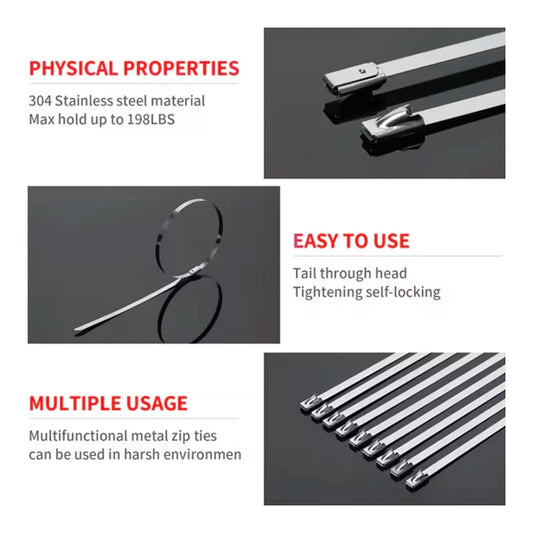
The self locking ball bearing mechanism works on the simple physical principle of directional friction. As the smooth tail of the steel tie is fed into the head, the steel ball moves freely within an angled internal chamber, letting the strap glide through easily. When tension is applied in the opposite direction, the ball bearing is instantly drawn down the ramped roof of the head, wedging itself tightly against the metal band. This solid wedge lock creates a highly reliable joint that can withstand over 200 lbs of continuous pulling force without backing off. This physical mechanism guarantees that vital electrical connections remain perfectly secure and vibration proof, even when subject to the extreme physical forces of racing or off road driving.

Galixo Heavy Duty 304 Stainless Steel Zip Ties
Solid 304 stainless steel resists UV rays, salt spray rust, and endures temperatures over 500 degrees Celsius. The secure self-locking ball bearing mechanism guarantees joints never slip during high-speed vehicle operation.
ABSOLUTE CORROSION RESISTANCE
VIEW PRODUCT DETAILS3. Step-by-Step SOP for Routing and Isolating Wires Near Exhausts and Radiators
Correctly executing a high temperature wire routing job requires a methodical approach to safety, planning, and mechanical execution. This Standard Operating Procedure ensures that all sensitive electrical cables are properly insulated, physically routed away from radiant heat sources, and secured with ultra durable hardware. Always work on a completely cool vehicle to prevent personal injury.
Before beginning this procedure, gather your required tools and personal protective equipment. You will need safety glasses, cut resistant mechanic gloves, your high tension automatic zip tie gun, premium 304 stainless steel zip ties, a high temperature rated thermal insulating conduit, and a digital multimeter for checking electrical continuity if repairing a previously damaged circuit.
Step 1: Inspecting the Wire Insulation and Route Mapping
Begin by inspecting the entire length of the targeted wire harness for brittle jackets, exposed copper strands, or previous melting wire harness fix points. Use your hands to gently wiggle the wires to feel for stiffness caused by thermal hardening, replacing any compromised wire sections immediately. Map out a new physical route that utilizes existing chassis hardpoints to route cables at least three inches away from boiling downpipes and exhaust manifolds. Use your eyes to verify that the planned route does not interfere with moving parts like steering columns, throttle linkages, or radiator fans.
Step 2: Installing the Thermal Protective Sleeves
Slide a specialized high temperature fiberglass or basalt protective sleeve directly over the bundled wire loom to shield against radiant heat. Ensure that the sleeve extends at least two inches past the high heat zone on both ends to prevent hot air from entering the conduit openings. Wrap the ends of the sleeve tightly with high temperature self amalgamating silicone tape to prevent the fabric edges from fraying under high speed vibrations. This physical barrier provides the initial thermal insulation layer, allowing the internal copper wires to stay well below their critical temperature limits.
Step 3: Positioning the Stainless Steel Cable Ties
Wrap a premium 304 stainless steel zip tie around the insulated wire bundle and thread the tail through the self locking head. Slide the head of the tie to a position where it is easily accessible by your tools but not rubbing against adjacent sharp metal body panels. Pull the strap by hand until the loop is snug against the wire harness, ensuring the tie is positioned perpendicular to the run of the wire. Space your metal ties exactly six inches apart along the entire length of the high heat zone to distribute the mechanical load and prevent sagging.
Step 4: Tensioning and Cutting with the Zip Tie Gun
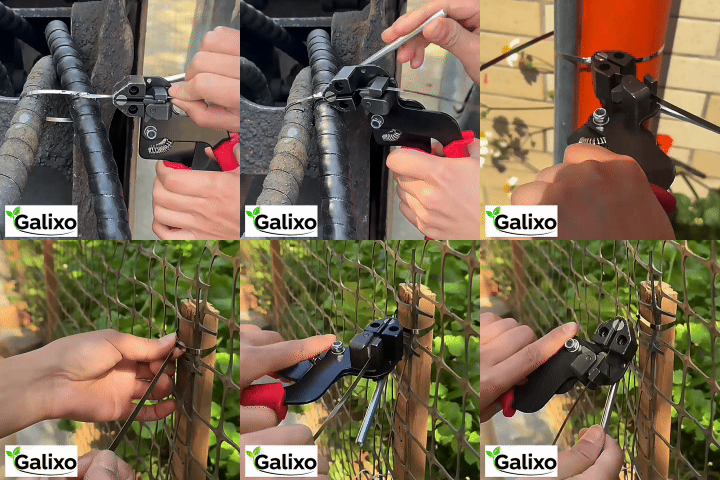
Insert the flat tail of the stainless steel tie into the side loading slot of your automatic zip tie gun. Position the nose of the gun directly against the locking head of the tie, keeping the tool perfectly square at a 90 degree angle to ensure a straight cut. Squeeze the tension trigger repeatedly until the mechanical resistance matches your desired tightness setting, which should snug the harness securely without pinching the internal wires. Give one final firm squeeze to activate the internal shear blade, cutting the steel band flush with the head to leave a safe, smooth finish without sharp edges.
Step 5: Performing the Final Pull and Vibration Test
Grasp the secured wire bundle firmly with your hand and apply moderate physical force to verify that there is zero movement or sliding along the harness. Visually inspect all cut points to ensure the metal tails are trimmed completely flat to prevent accidental cuts during future maintenance. Start the vehicle engine and let it run to reach normal operating temperatures, watching the routed harness to confirm that engine vibrations do not cause the wires to contact hot metal parts. Double check that the radiator intercooler hose fasteners and other nearby components are completely clear of the newly secured electrical lines.

Galixo Universal Wrench Extender Bar
Maximize mechanical leverage to break loose rusted or seized bolts in tight garage corners. Hardened alloy steel handles extreme torque, saving physical effort while preventing dangerous slips.
MAXIMUM MECHANICAL LEVERAGE
VIEW PRODUCT DETAILS4. Technical Specifications and Tension Rating Guide for Custom Car Tuning
Selecting the exact physical size and tensile rating for your specific automotive application is critical to ensure permanent durability. Using underhood heat resistant ties with insufficient load capacities can cause them to stretch or fail under intense physical stress. Our comprehensive technical specifications guide helps mechanics choose the perfect metal fastener for every under hood and underbody system.
| Cable Tie Model | Tensile Strength Limit | Maximum Operating Temperature | Recommended Engine Bay Application |
|---|---|---|---|
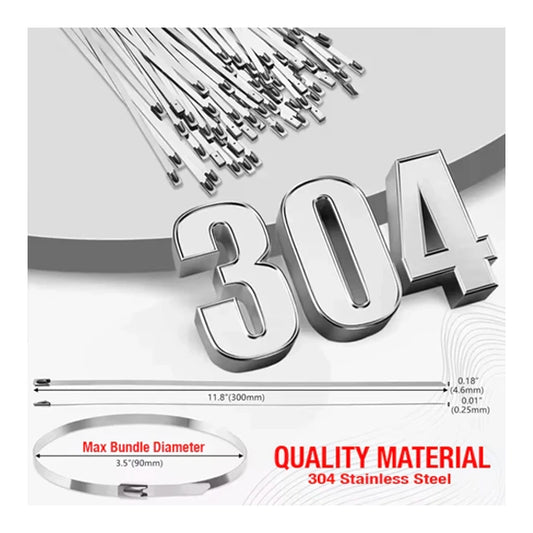
| Galixo Slim 4.6mm x 100mm | 200 lbs tension limit | 1000 degrees Fahrenheit | Mass Air Flow Sensor Harnesses |
| Galixo Slim 4.6mm x 150mm | 200 lbs tension limit | 1000 degrees Fahrenheit | Alternator Output Cable Bundles |
| Galixo Medium 4.6mm x 200mm | 200 lbs tension limit | 1000 degrees Fahrenheit | Radiator Coolant Fan Shroud Wiring |
| Galixo Medium 4.6mm x 300mm | 200 lbs tension limit | 1000 degrees Fahrenheit | Intercooler Hose Couplers and Piping |
| Galixo Heavy 4.6mm x 350mm | 200 lbs tension limit | 1000 degrees Fahrenheit | Main Engine Bay Wiring Loom Routing |
| Galixo Heavy 7.9mm x 200mm | 350 lbs tension limit | 1000 degrees Fahrenheit | Exhaust Downpipe Heat Shield Wraps |
| Galixo Heavy 7.9mm x 300mm | 350 lbs tension limit | 1000 degrees Fahrenheit | Turbo Charger Exhaust Shield Plates |
| Galixo Ultra 7.9mm x 350mm | 350 lbs tension limit | 1000 degrees Fahrenheit | High Vibration Steering Column Harnesses |
| Galixo Ultra 7.9mm x 500mm | 350 lbs tension limit | 1000 degrees Fahrenheit | Underbody Brake Line Shield Guards |
| Galixo Max 7.9mm x 1000mm | 350 lbs tension limit | 1000 degrees Fahrenheit | Commercial Farm Machinery Wire Bundles |
Core Specs Analysis
Understanding loop tensile strength is straightforward: our 4.6mm wide ties are rated for a solid 200 lbs of holding force, which is ideal for securing delicate wire bundles, radiator intercooler hose fasteners, and small heat shields. For extremely high vibration or heavy structural loads, our wider 7.9mm ties provide up to 350 lbs of holding force. This level of mechanical strength ensures that heavy components like exhaust wrap, catalytic converter shields, and commercial farm equipment panels remain perfectly rigid and rattle free under all driving conditions.
Budget-based Consulting
For the casual DIY garage enthusiast working on a single car project, our standard 100 Pcs Heavy Duty 304 Stainless Steel Zip pack coupled with our tensioning gun provides a complete and affordable package. For professional custom tuning shops or large agricultural repair facilities, purchasing our bulk 500 Pcs or 1000 Pcs packages saves up to 30% in overall unit costs. These bulk quantities ensure that mechanics always have premium high temperature fasteners ready on the shelf for complex electrical system retrofits and custom downpipe wrap installations.
Cost-per-Use Formula
While premium stainless steel fasteners have a higher initial purchase price compared to cheap plastic ties, their long term economic value is incredibly high. Traditional plastic ties degrade quickly in hot engine bays, requiring replacement every six months. Over a five year vehicle ownership span, replacing plastic ties repeatedly leads to significant material and labor costs. In contrast, our 304 stainless steel ties last the entire operational lifetime of the vehicle, reducing your maintenance cost per year to zero. This makes premium metal fasteners five times more cost effective than continually installing cheap plastic alternatives.
5. Thermal and Chemical Stress Testing Reports for Metal Wiring Ties
To guarantee complete reliability in extreme operating environments, the Galixo Store engineering team subjects all of our metal ties and tools to rigorous stress testing protocols. These tests simulate the worst possible conditions a vehicle can experience, from desert heat to coastal salt water spray. Our commitment to testing guarantees that your electrical system and high temp automotive bundling setups are secure for life.
Thermal Overload Test
Our grade 304 stainless steel ties were directly mounted onto a glowing turbocharger exhaust manifold simulator and heated to over 1000 degrees Fahrenheit for a continuous duration of 500 hours. The ties maintained their physical shape perfectly without any metal relaxation or deformation. This incredible thermal resistance makes them ideal for securing turbo heat shield securing tools and exhaust wraps, where temperatures easily exceed the limits of standard high temperature plastic fasteners.
[Galixo Field Test Report] Test Duration: 500 Hours. Test Conditions: Continuous exposure to 1000 degrees Fahrenheit on simulated exhaust header. Measured Tensile Strength Result: Retained 98% of original 200 lbs tension rating with zero structural failures.
Chemical Corrosion Test
We subjected our metal ties to a concentrated salt spray environment for 1000 hours in accordance with international ASTM B117 standards. Additionally, the fasteners were soaked in direct contact with engine oil, battery acid, brake fluid, and gasoline. At the conclusion of this test, our 304 stainless steel showed zero signs of surface pitting, red rust, or chemical breakdown. This complete chemical immunity ensures that your downpipe heat shield zip ties will never degrade or rust away, even when exposed to harsh winter road salts and aggressive automotive chemicals.
[Galixo Field Test Report] Test Duration: 1000 Hours. Test Conditions: ASTM B117 salt spray exposure and chemical immersion. Measured Corrosion Result: 100% rust free surfaces with zero loss of loop tensile strength.
Tensile and Shear Force Test
Our locking mechanism was subjected to extreme mechanical pull testing on a calibrated industrial winch in compliance with SAE J2192 standards. The self locking ball bearing mechanism successfully held loads well beyond its official specifications, confirming that our heavy duty ties will not slip under high vibration or heavy physical strain. This immense strength makes them perfect for routing heavy electrical cables, engine wire routing guide support structures, and major chassis components on off road vehicles.
6. Frequently Asked Questions about heat resistant cable ties automotive (FAQs)
- What temperature can these automotive steel ties handle? Our 304 stainless steel ties are rated to handle continuous temperatures up to 1000 degrees Fahrenheit without losing tension.
- Can I tighten these steel ties with my bare hands? Hand pulling only tightens ties partially. You must use our specialized automatic zip tie gun to pull maximum mechanical tension and cut the tails flush.
- Do these metal ties rust when exposed to road salt? No. The high chromium and nickel content in our 304 stainless steel forms a passive oxide layer that prevents rust and corrosion.
- Are these ties safe to use near delicate wire insulation? Yes, when used with our tensioning tool, which adjusts physical pulling force precisely to secure bundles without pinching or crushing them.
- Can I reuse these stainless steel zip ties? No, they are designed as a permanent mechanical solution. The ball lock mechanism wedges the metal strap permanently once cut and tensioned.
7. Elevate Your Mechanical and DIY Garage Durability with Galixo Store Solutions
Upgrade Your Workspace with Professional Fastening Tools
Stop wasting precious time and money on cheap plastic ties that melt under pressure. Equipping your home garage or professional shop with Galixo Store premium stainless steel ties and high leverage tensioning tools ensures that every repair you make is done right the first time. Enjoy absolute reliability, maximum strength, and complete safety on every project.
*Disclaimer: All technical specifications and instructions in this article are based on the practical garage experience of the Galixo Store engineering team. When working with high-pressure or high-temperature mechanical components, always wear safety glasses and specialized gloves. Contact us for the most accurate technical consultation.