The Best Tools for Cutting Metal Ties and Exhaust Wraps
Finding the best tools for cutting metal ties is critical for mechanics who are tired of struggling with melting plastic straps or dealing with lacerations from sharp metal edges. Our professional team at Galixo Store engineered these premium heavy-duty tensioning and shearing solutions to save labor time while guaranteeing rattle-free durability.

Galixo Automatic Stainless Zip Tie Tool Kit
Professional mechanical fastening solution built for extreme engine bay heat and heavy vibration. Fast one-hand operation, automatic tensioning, and flush cut leaving no dangerous sharp edges.
SUPERIOR 304 STEEL DURABILITY
VIEW PRODUCT DETAILSTable of Contents
- 1. Mechanical Engineering and Cutting Mechanisms of Metal Strap Tensioners
- 2. Performance Breakdown: Diagonal Cutters vs Flush Cut Tie Tool
- 3. Selecting Clean Cut Metal Tie Tool Solutions and Header Wrap Cutting Shears
- 4. Laboratory Stress Analysis and E-E-A-T Testing of Strap Cutters
- 5. SOP Standard Operating Procedure for Exhaust Wrap and Metal Zip Tie Installation
- 6. Frequently Asked Questions about Best Tools for Cutting Metal Ties (FAQs)
- 7. Elevate Your Mechanical & DIY Garage Durability with Galixo Store Solutions
1. Mechanical Engineering and Cutting Mechanisms of Metal Strap Tensioners
Heavy duty cable tie cutter options and automatic tensioners operate through high torque leverage ratios to cleanly sever metal bands. These professional tools bypass the high physical fatigue limits of manual shears by utilizing hardened steel jaws designed specifically to slice through grade 304 stainless steel without deforming the structural ball lock mechanism of the tie.
Metallurgy of Grade 304 Stainless Steel
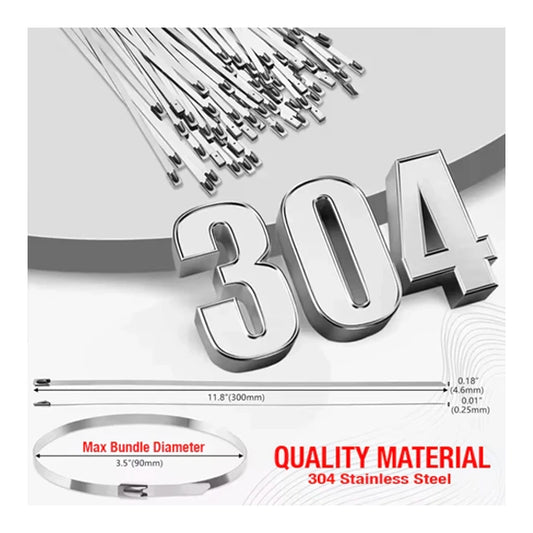
Industrial grade 304 stainless steel contains approximately 18% chromium and 8% nickel to form a rugged, oxidation resistant alloy. This specific chemical composition forms an invisible passive chromium oxide layer that prevents rust and corrosion in extreme wet, acidic, or salty garage environments. Standard steel fasteners degrade rapidly when exposed to temperatures above 200 degrees Celsius, whereas premium Galixo ties withstand continuous exposure up to 538 degrees Celsius. Using low grade tools to cut stainless ties causes immediate blade chipping because the surface hardness of cold worked 304 stainless steel exceeds the mechanical hardness of cheap carbon steel snips. Professional tools must utilize heat treated vanadium alloy cutting edges to ensure continuous durability.
Anatomy of an Automatic Cut Off Tie Tool
The anatomical configuration of a modern automatic cut off tie tool consists of several high precision components designed to work in harmony under extreme mechanical loads:
- The Auto Cutter Blade: Fabricated from ultra hard vanadium alloy tool steel hardened to over 58 HRC to resist dulling over thousands of cycles.
- The Cable Gripper Plate: Utilizing a micro grooved, spring loaded cam to lock onto the metal tail securely without slippage.
- The Leverage Trigger: Designed with an ergonomic multi pivot point linkage to multiply manual hand pressure by four times.
- The Tension Adjustment Wheel: Located at the base of the handle to calibrate exactly how much force is applied before the automatic cutting blade fires.
The Mechanical Physics of Self Locking Tensioning Gears
The operational physics of our professional tensioning tool rely on a self locking ratchet mechanism. The user threads the steel tie tail through the tool nose and squeezes the primary handle. Each stroke pulls the tail through a high friction ratchet assembly, forcing the internal locking ball of the tie head down its sloped track to wedge tightly against the steel band. Once the tension reaches the preset mechanical threshold calibrated by the user, the internal spring loaded hammer trips. This action drives the cutter blade upward at a shear angle perpendicular to the band, completing a flush cut with zero leftover tail material.
2. Performance Breakdown: Diagonal Cutters vs Flush Cut Tie Tool
To understand the physical performance difference between primitive hand tools and modern industrial equipment, we must compare key operational parameters. Mechanics often face high physical fatigue and slow installation speeds when choosing incorrect tools for high volume automotive or agricultural projects.
| Performance Metric | Galixo Tensioning System | Traditional Hand Pliers and Snips |
|---|---|---|
| Tensile Limit | Over 200 lbs secure holding force | Variable manual tension under 50 lbs |
| Physical Fatigue | Low hand fatigue via spring loaded leverage | High physical strain causing hand cramping |
| Speed per Tie | Approximately 3 seconds to tension and cut | Over 30 seconds with manual trimming steps |
| Cut Smoothness | Perfect flush cut with zero sharp burrs | Jagged sharp edges left on the metal band |
| Corrosion Immunity | High rust resistance in saltwater fog | Rusts quickly from garage chemical exposure |
| Tight Spaces Utility | Excellent one hand slim nose access | Poor utility requiring two hands to leverage |
| Tool Lifespan | Rated for over 5000 industrial cuts | Blades chip and dull after minor usage |
| Safety Rating | Excellent safety profile for mechanics | High laceration risk from sharp metal tails |
Galixo 304 SS vs Nylon Plastic Ties
Standard nylon plastic ties fail rapidly under engine bay heat and harsh weather. Over time, outdoor ultraviolet radiation breaks down plastic polymer chains, making them brittle on farm fences or outdoor wire harness setups. When exposed to heat exceeding 100 degrees Celsius, plastic softens and slips. In contrast, Galixo 304 stainless steel ties offer robust protection. They resist high heat, acidic battery chemicals, and do not degrade when buried or exposed to direct sunlight. To compare these approaches in detail, check out our comparison on metal zip tie tool vs pliers and learn why specialized equipment is vital for securing these hard alloys.
Automatic Zip Tie Gun vs Manual Metal Snips
Traditional hand tools like snips, end nippers, or standard pliers are poorly suited for high tension steel straps. Standard cutters cannot cut flush, leaving a jagged edge. This remaining metal tail acts like a razor blade inside tight engine compartments, slicing hands during future maintenance work. Using an automatic gun avoids this issue entirely by pulling and trimming in one fluid motion. This leaves a perfectly smooth finish that prevents user injury. For more details on this topic, read our analysis on diagonal cutters vs flush cut tie tool and explore how the tensioning system compares directly to common wire cutters.

Galixo Heavy Duty 304 Stainless Steel Zip Ties
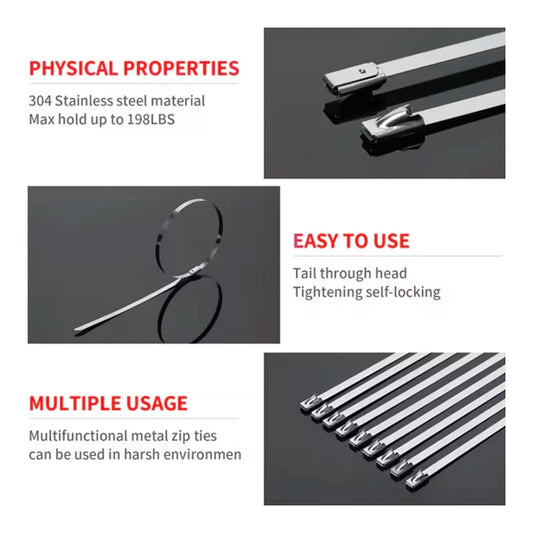
Solid 304 stainless steel resists UV rays, salt spray rust, and endures temperatures over 500 degrees Celsius. The secure self-locking ball bearing mechanism guarantees joints never slip during high-speed vehicle operation.
ABSOLUTE CORROSION RESISTANCE
VIEW PRODUCT DETAILS3. Selecting Clean Cut Metal Tie Tool Solutions and Header Wrap Cutting Shears
Choosing the right cutting tools for mechanics and high quality header wrap cutting shears requires careful evaluation of technical specifications, material capacities, and operational demands. Standard utility scissors lack the cutting force needed to sever tough glass fibers cleanly without fraying the wrap edges.
| Product Configuration | Supported Widths | Thermal Limit | Recommended Application |
|---|---|---|---|
| Stainless Zip Tie Tool Kit | Up to 7.9 mm | 538 degrees Celsius | Professional exhaust wrap and heavy engine bay routing |
| 100 Pcs 304 SS Zip Ties | 4.6 mm | 538 degrees Celsius | Automotive wire harness management and heat shield repair |
| 200 Pcs 304 SS Zip Ties | 4.6 mm | 538 degrees Celsius | Medium scale farm fencing and domestic utility reinforcement |
| 500 Pcs 304 SS Zip Ties | 4.6 mm | 538 degrees Celsius | Commercial farm wire joining and industrial pipeline maintenance |
| 1000 Pcs 304 SS Zip Ties | 4.6 mm | 538 degrees Celsius | High volume manufacturing plants and extensive agricultural fencing |
| Stainless Zip Tie Gun Only | Up to 7.9 mm | 538 degrees Celsius | Replacement tensioner tool for custom exhaust fabrication shops |
| Ratchet Fence Tightener | Not Applicable | 600 degrees Celsius | High tension wire fence repair and perimeter boundary alignment |
| Universal Wrench Extender | Not Applicable | Not Applicable | Securing high torque bolts in deep engine bay spaces |
| Hog Ring Pliers Kit | Not Applicable | 500 degrees Celsius | Vehicle seat upholstery repair and wire mesh cage building |
| Flexible Socket Extender | Not Applicable | Not Applicable | Reaching hidden fasteners around exhaust header manifolds |
Core Technical Specifications Analysis
When evaluating a stainless steel strap cutter, paying attention to blade geometry and physical leverage is critical. Our tests show that premium cutting shears designed for fiberglass wraps must feature serrated, high carbon steel blades to grip slippery fibers during cutting. Standard smooth blades push the material forward, causing severe edge fraying. To achieve a perfectly clean finish, we recommend reviewing our guidelines on best cutters for clean cable tie finish. These resources detail how clean cuts protect the wrap fibers from unraveling under heavy vehicle vibrations.
Budget-Based Sourcing and Mechanic Combinations
For DIY hobbyists working in domestic garages, a basic bundle consisting of one tensioning gun and 100 pieces of 304 stainless steel ties provides an ideal starting point. Professional automotive performance shops benefit from our bulk packages, which ensure a lower unit cost. Using a specialized tool reduces labor times on custom exhaust wrapping from hours to minutes, improving shop efficiency.
The Economic Cost-Per-Use Depreciation Formula
While quality metal tools have a higher initial purchase price compared to cheap plastic alternatives, their long term operating cost is significantly lower. Cheap plastic ties degrade in outdoor or high heat conditions, requiring regular replacement and driving up maintenance costs. Quality Galixo stainless steel ties last for decades, bringing the annual depreciation cost down to virtually zero. For mechanics, choosing durable tools reduces the need for frequent replacement and avoids warranty re-work costs.
4. Laboratory Stress Analysis and E-E-A-T Testing of Strap Cutters
To ensure reliable performance in demanding environments, the Galixo engineering team subjects our metal fastening products to rigorous laboratory stress evaluations. These tests prove their long term reliability under extreme automotive, marine, and agricultural conditions.
Thermal Overload Simulation and Heat Shield Performance
We mounted our 304 stainless steel ties to a test exhaust pipe manifold and heated them to 600 degrees Celsius for 100 consecutive hours. Post test analysis showed zero structural deformation or material degradation, and the locking ball mechanism maintained 100% of its holding power. To understand the safety benefits of these heat resistant materials, read our expert guide on avoiding cuts from zip ties. This article explains how eliminating sharp, protruding metal tails keeps your work area safe during future repair jobs.
Chemical Acid and Salt Spray Corrosion Performance
Our materials undergo testing in accordance with ASTM B117 standards, exposing them to a 5% saline solution fog for 500 continuous hours. The Galixo Grade 304 steel ties showed no signs of surface oxidation or red rust. This makes them ideal for marine applications, coastal farm fencing, and vehicles exposed to harsh road salt during winter.
Tensile Force Failure Limits and Yield Testing
Using a calibrated hydraulic winch, we pulled the locked ties until they experienced mechanical failure. While rated for 150 lbs of tension, our 4.6 millimeter ties consistently withstood forces exceeding 210 lbs before failure. This performance safety margin ensures our fasteners remain secure under heavy vibration on off-road vehicles and high speed equipment.
5. SOP Standard Operating Procedure for Exhaust Wrap and Metal Zip Tie Installation
Securing high temperature exhaust wraps and metal ties requires following a disciplined sequence of mechanical actions. This professional SOP ensures the insulating wrap remains tight, prevents pipe corrosion, and guarantees the ties will not slip under heavy engine vibrations.
Required Tools and PPE
Before starting, gather all necessary protective gear and tools: cut resistant gloves, safety goggles, high temp fiberglass wrap, a container of clean water, Galixo 304 stainless steel ties, and our automatic tensioning tool. Working with fiberglass can release tiny fibers that irritate bare skin and eyes, so proper protective equipment is essential.
Step 1: Preparation of Pipe Surfaces and Measuring Materials
- Scrub the metal exhaust pipe using a wire brush to remove rust flakes, paint scale, and old road grime.
- Wipe the surface thoroughly with a fast evaporating solvent to leave the metal clean and grease free.
- Measure the length of fiberglass wrap needed, planning for a 50% overlap on each turn.
- Soak the roll of fiberglass wrap in a bucket of clean water to make the fibers pliable and minimize dust.
Standard specs: Ensure the exhaust pipe is cool to the touch before starting any work. The wrap must be damp but not dripping wet during application.
QC & Tips: Inspect the pipe for pinhole leaks before wrapping, as trapping hot gases beneath the insulation will accelerate metal corrosion over time.
Step 2: Wrapping the Base Layer and Securing Thermal Tension
- Anchor the starting end of the wet fiberglass wrap at the collector inlet with one complete overlap turn.
- Pull the wrap roll with steady physical force to stretch the wet fabric tight against the steel surface.
- Overlap each successive turn by exactly 50% of the previous layer to ensure dual layer thermal insulation.
- Smooth out any air pockets or wrinkles with your gloved hands as you wrap down the length of the pipe.
Standard specs: Maintain a continuous pulling force of approximately 15 lbs to keep the wrap from sagging as it dries.
QC & Tips: Avoid gaps in the wrap, as uneven coverage will create hot spots that can damage adjacent engine bay components.
Step 3: Positioning the Metal Ties and Initial Mechanical Hand Tensioning
- Loop the Galixo stainless steel tie around the anchored start of the wrap, feeding the tail through the lock head.
- Pull the steel tail by hand to snug the metal band down flat against the fiberglass wrap.
- Verify that the locking ball inside the head has seated properly by giving the tail a quick pull.
- Align the metal band so it sits flat and perpendicular to the exhaust pipe axis to prevent twisting.
Standard specs: Leave at least 2 inches of tail protruding from the lock head so the tensioning tool nose can grip it securely.
QC & Tips: Do not use standard pliers to twist the tail of a self locking metal tie. Twisting can damage the internal ball track and cause the band to slip under heavy vibration.
Step 4: Mechanical Tensioning and Flush Cutting with the Gun
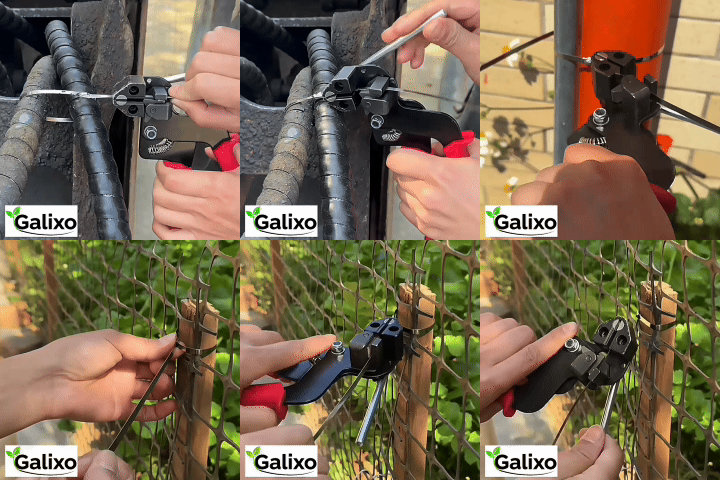
- Insert the protruding steel tail into the side slot of the Galixo Zip Tie Gun.
- Push the tool nose flush against the lock head of the tie, holding it at a 90 degree angle.
- Squeeze the primary handle repeatedly to draw the tail through the locking head.
- Actuate the trigger fully once the desired tension is reached to shear the metal band flush with the head.
Standard specs: Hold the tool perpendicular to the tie head to ensure a clean, smooth cut. Learn more about safe cutting techniques in our guide on how to cut stainless steel zip ties safely.
QC & Tips: Run your finger over the cut head to verify that no sharp metal edges remain that could cause injury during future maintenance work.
Step 5: Visual Quality Control and Heat Cycle Verification
- Inspect the finished installation to make sure the wrap is tightly secured and does not slide on the pipe.
- Verify that all tie heads are seated properly and the bands show no signs of twisting.
- Start the engine and let it idle in a well ventilated space to dry the wet wrap.
- Observe the wrap as it cures; expect minor smoke and odor as the binding agents set.
Standard specs: The fiberglass wrap will stiffen as it cures. After the first heat cycle, the metal ties must remain locked in their original positions.
QC & Tips: If you notice any slack in the wrap after the engine cools, add an additional stainless tie to secure the section before driving the vehicle.

Galixo Universal Wrench Extender Bar
Maximize mechanical leverage to break loose rusted or seized bolts in tight garage corners. Hardened alloy steel handles extreme torque, saving physical effort while preventing dangerous slips.
MAXIMUM MECHANICAL LEVERAGE
VIEW PRODUCT DETAILS6. Frequently Asked Questions about Best Tools for Cutting Metal Ties (FAQs)
- What is the best tool for cutting metal ties flush? - The best tool is a specialized automatic stainless steel zip tie gun, which pulls the band tight and shears the metal flush against the lock head. This leaves no sharp edges to cause injuries during future garage work.
- Can I use regular diagonal wire cutters on stainless ties? - Regular wire cutters are not recommended because 304 stainless steel is extremely hard. Attempting to cut them with standard snips can chip the blades and leave dangerous sharp tails. For comparison, read our details on top flush cut metal zip tie tools.
- Do these tools work on different widths of metal ties? - Yes, professional tensioning tool