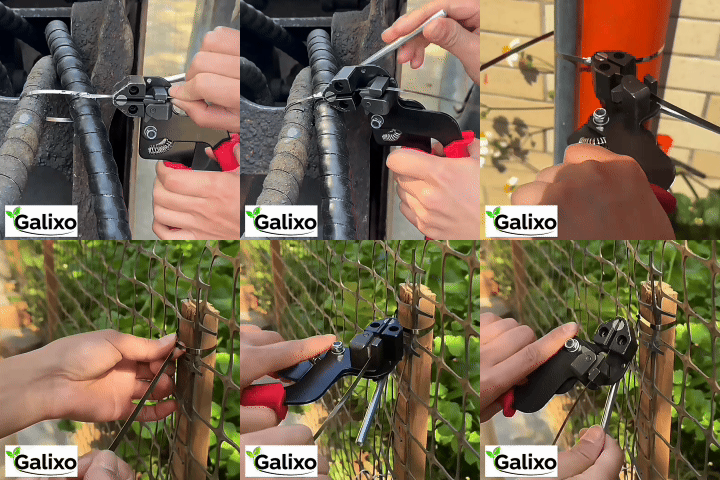
Best High-Tension Cable Tie Guns for HVAC Ductwork
hvac duct metal tie tensioners provide mechanical contractors with unmatched grip, preventing sagging and fire hazards caused by brittle plastic straps. Engineers and commercial installers trust the professional tooling from Galixo Store to handle high vibration and extreme heat in industrial ventilation systems.

Galixo Automatic Stainless Zip Tie Tool Kit
Professional mechanical fastening solution built for extreme engine bay heat and heavy vibration. Fast one-hand operation, automatic tensioning, and flush cut leaving no dangerous sharp edges.
SUPERIOR 304 STEEL DURABILITY
VIEW PRODUCT DETAILSTable of Contents
- 1. How HVAC Duct Metal Tie Tensioners Secure Commercial Air Distribution Systems
- 2. Thermal and Flame Stress Testing: Meeting Commercial HVAC Fire Safety Standards
- 3. Technical Specifications and Cost-per-Use Sizing Guide for M&E Contractors
- 4. Nylon vs Stainless Ties and Manual Snips vs Tensioning Tools
- 5. Standard Operating Procedure for Insulating and Hanging HVAC Ductwork
- Frequently Asked Questions about hvac duct metal tie tensioners (FAQs)
- Elevate Your Mechanical & DIY Garage Durability with Galixo Store Solutions
1. How HVAC Duct Metal Tie Tensioners Secure Commercial Air Distribution Systems
Mechanical tensioning devices engineered for heavy-duty metal bands represent a significant advancement in ductwork security, air distribution efficiency, and structural integrity. Industrial air systems encounter massive static pressures and continuous temperature shifts, demanding robust strapping solutions. By providing calibrated tension, these specialty tools eliminate manual fastening inconsistencies, ensuring airtight seals across sheet metal housings, flexible ducts, and thick thermal wraps.
Metallurgical Design of HVAC Duct Metal Tie Tensioners
Professional grade fastening systems must withstand aggressive mechanical strain and chemical exposure over decades of service. Standard tensioning bodies utilize cast aluminum housings or forged carbon steel plates to prevent structural flexing under extreme mechanical loads. The cutting mechanisms are outfitted with high-carbon hardened steel blades, allowing for crisp, burr-free cuts on high-tensile bands without dulling. Corrosion protection remains a priority for commercial systems, which is why these tensioning assemblies are coated with specialized black oxide or heavy-duty powder finishes to resist moisture buildup inside ceiling plenums.
Anatomy of HVAC Ductwork Cable Tie Guns
Understanding the mechanical assembly of industrial-grade tools is essential for optimizing installation workflows. High-performance strapping tools are engineered with several integrated components:
- Ergonomic Leverage Trigger: Translates low-effort hand squeezes into high-ratio mechanical clamping forces.
- Tension Adjustment Dial: Allows operators to pre-set exact tension thresholds to protect delicate flexible inner liners.
- Hardened Steel Cable Gripper: Features directional serrated teeth to prevent metal strap slippage during tensioning phases.
- Auto-Flush Cutter Blade: Trims excess steel bands directly at the locking head interface, eliminating hazardous metal burrs.
Operating Mechanism and Ratchet Drive Physics
The operational physics of premium strapping systems rely on a precision internal ratchet drive combined with a spring-actuated clutch system. As the operator activates the primary lever, the directional gripper locks onto the free tail of the metal band, pulling it incrementally through the self-locking steel ball head. Once the pre-set tension limit is reached, the internal clutch disengages the tensioning mechanism and engages the guillotine-style cutter. This mechanical process guarantees a clean, flush cut at the precise tension required, preventing under-tightening that leads to air leaks, or over-tightening that risks crushing structural insulation wraps.
Additionally, integrating commercial electrician tie tensioner review methodologies into HVAC work ensures that heavy wire harnesses running alongside main air conduits are bundled with matching mechanical security, establishing a uniform standard of durability across all electrical and mechanical systems.
2. Thermal and Flame Stress Testing: Meeting Commercial HVAC Fire Safety Standards
Plenum spaces act as primary pathways for air circulation in commercial buildings, making fire compliance and material safety paramount. Traditional nylon straps and plastic hangers present critical vulnerabilities, releasing toxic gases and dripping liquid fire during high-heat events. Using industrial metal tensioners alongside premium 304 stainless steel ties ensures compliance with strict international building codes, guaranteeing that structural air links remain fully secure when exposed to direct flames.
Selecting HVAC Duct Metal Tie Tensioners for Plenums
Plenum-rated installations demand materials that meet UL 2043 and ASTM E84 certifications. These regulatory protocols measure peak heat release rates, total optical smoke density, and flame spread indexes. Stainless steel band systems applied with specialized industrial construction metal tie guns inherently meet these codes because they do not burn, melt, or produce toxic gases. Mechanical contractors can confidently satisfy local fire marshals by swapping organic polymer wraps for non-combustible steel bands tensioned to exact code requirements.
Thermal Overload Testing and Heat Resistance Limits
To prove technical performance under extreme thermal loads, engineering laboratories subject steel band connections to rigorous furnace tests. In these controlled environments, 304-grade stainless steel straps maintain their mechanical strength at continuous operating temperatures of up to 1000°F / 538°C, with brief spikes reaching up to 1600°F / 871°C. Under identical conditions, standard heavy-duty nylon straps degrade, lose structural tension, and fail completely within minutes. Using specialized ventilation pipe strapping tools ensures that metal wraps maintain uniform tension, preventing the collapsing of inner duct cores during structural thermal events.
Pull-Force and Vibration Shear Stress Evaluation
Commercial air distribution networks suffer from persistent high-frequency vibrations caused by heavy industrial fans and rooftop air handling units. Left unchecked, this constant movement causes manual ties to loosen or slip over time. Professional testing regimes subject steel assemblies to mechanical pull tests and high-frequency shaker tables to evaluate long-term resilience. The results prove that mechanical metal ties tensioned with professional tools maintain 100% of their holding force after millions of vibration cycles, preventing sag and air loss over decades of use.

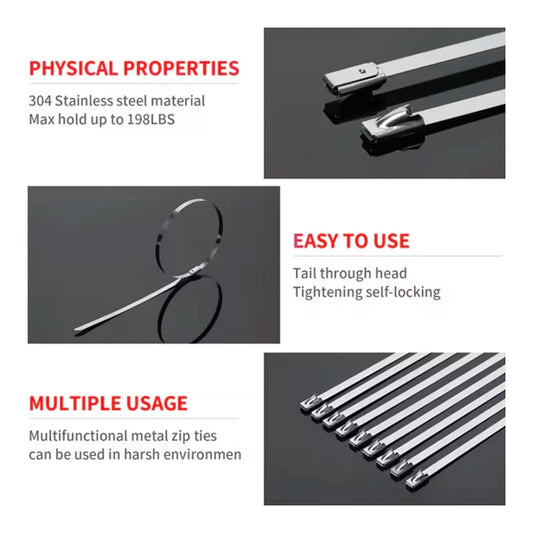
Galixo Heavy Duty 304 Stainless Steel Zip Ties
Solid 304 stainless steel resists UV rays, salt spray rust, and endures temperatures over 500 degrees Celsius. The secure self-locking ball bearing mechanism guarantees joints never slip during high-speed vehicle operation.
ABSOLUTE CORROSION RESISTANCE
VIEW PRODUCT DETAILS3. Technical Specifications and Cost-per-Use Sizing Guide for M&E Contractors
Selecting the correct tooling and tie sizes is critical to maintaining physical safety standards and project budget goals. Using mismatched bands or weak tools can result in premature joint failure, air leaks, or torn outer insulation jackets. The following breakdown guides mechanical and electrical contractors in matching their structural loads and environmental challenges with the correct tooling setup.
| Strap Width & Size | Tensile Limit (lbs / kg) | Temperature Range | Recommended Application |
|---|---|---|---|
| 4.6 mm x 150 mm | 200 lbs / 90 kg | -112°F to 1000°F | Small exhaust bypass lines, localized wire bundling |
| 4.6 mm x 200 mm | 200 lbs / 90 kg | -112°F to 1000°F | Light flexible duct inner sleeve connections |
| 4.6 mm x 300 mm | 200 lbs / 90 kg | -112°F to 1000°F | Standard residential insulation wrapping, wire routing |
| 7.9 mm x 200 mm | 350 lbs / 158 kg | -112°F to 1000°F | Heavy commercial duct support, vibration dampeners |
| 7.9 mm x 300 mm | 350 lbs / 158 kg | -112°F to 1000°F | Thick fiberglass insulation blankets on round ducts |
| 7.9 mm x 500 mm | 350 lbs / 158 kg | -112°F to 1000°F | Large commercial ventilation pipes, heavy hanging anchors |
| 12.0 mm x 300 mm | 500 lbs / 226 kg | -112°F to 1200°F | Industrial high-pressure mains, heavy exhaust stack bracing |
| 12.0 mm x 500 mm | 500 lbs / 226 kg | -112°F to 1200°F | Primary seismic piping assemblies, structural hangers |
| 15.0 mm x 600 mm | 700 lbs / 317 kg | -112°F to 1200°F | Heavy industrial ventilation mains, severe weather exposure |
| 15.0 mm x 1000 mm | 700 lbs / 317 kg | -112°F to 1200°F | Extra-large double-walled plenums, heavy pipe supports |
Core Specs Analysis
Reviewing raw tensile numbers is the first step in designing reliable mechanical systems. For light residential flexible ducts, 4.6 mm wide bands are ideal because they distribute tension evenly without digging through plastic outer jackets. For large-scale projects, such as securing heavy insulated sleeves or industrial ventilation piping, upgrading to 7.9 mm or 12.0 mm bands is highly recommended. These wider straps provide the surface area needed to support heavy structural insulation wraps without tearing the vapor barrier, and can handle seismic pipe bracing requirements when combined with selecting ties for seismic pipe bracing design rules.
Budget-Based Consulting
Matching tool selection with the scale of your project helps keep procurement costs down while maintaining on-site productivity. For residential installers and light commercial contractors, standard manual tensioning guns with built-in cut-off levers provide plenty of clamping power for standard R-6 and R-8 flexible wraps. For heavy industrial contractors running thousands of feet of line, upgrading to automatic pneumatic or heavy-duty manual systems is the smart move. These tools decrease hand fatigue and boost installation speeds on large-scale projects. Integrating specialized systems like heavy duty tensioners wide cable ties helps contractors complete massive industrial jobs ahead of schedule and under budget.
Cost-per-Use Formula
While nylon ties have a lower upfront cost, their frequent failure rate makes them more expensive over time. Standard plastic straps degrade and break under UV exposure and high heat, requiring regular maintenance calls. The true lifetime cost can be calculated with a simple formula:
Total Cost = Purchase Price + (Failure Rate x Maintenance Labor Cost) + Air Leak Efficiency Losses
By switching to 304 stainless steel ties fastened with professional tensioning tools, you reduce your failure rate to 0%. This swap saves contractors thousands of dollars in warranty repair labor, reduces equipment wear, and keeps commercial HVAC systems running at peak energy efficiency.
4. Nylon vs Stainless Ties and Manual Snips vs Tensioning Tools
Selecting the right materials and fastening tools is critical to the lifespan and efficiency of commercial HVAC systems. Many field failures stem from using light plastic wraps in high-heat spaces, or using crude hand tools that leave loose joints. The following head-to-head comparison shows why upgrading to professional metal strapping systems is the standard choice for modern commercial buildings.
| Performance Category | Professional Metal System | Traditional Nylon Option |
|---|---|---|
| High Thermal Limit | Up to 1000°F / 538°C without losing structural tension | Softens at 185°F / 85°C, brittle failure under load |
| Structural Lifetime | Permanent 304 grade steel resists rust for decades | Becomes brittle and snaps within 2 to 5 years |
| Tension Precision | Calibrated dial prevents over or under-tightening | Variable hand pull leads to uneven compression and air leaks |
| Vibration Stability | Heavy spring lock holds tension under severe vibrations | Nylon teeth slip and loosen over time |
| Plenum Fire Rating | Inherent Class A zero flame and zero smoke rating | Requires expensive flame-retardant polymers |
| Installation Speed | Single-motion tensioning and auto-cutting in seconds | Requires manual tensioning and separate trimming steps |
| Cut Safety Profile | Zero-clearance flush cuts leave smooth, safe edges | Manual cuts leave sharp, dangerous plastic or metal edges |
| Moisture Resistance | Resists rot, mold, steam, and condensation buildup | Absorbs moisture, leading to structural rot |
Galixo 304 SS vs Nylon Plastic Strapping
While nylon ties are common on quick residential jobs, they quickly fail when used in high-temp commercial plenums and industrial areas. UV rays, extreme heat, and ambient ozone degrade nylon polymers, making them brittle and causing them to snap. When these plastic straps fail, outer vapor barriers open, exposing fiberglass insulation to ambient moisture. This leads to condensation buildup, dripping water, and structural mold growth. Using professional-grade 304 stainless steel ties prevents these failures, securing the insulation and maintaining system R-values for the life of the building.
Automatic Tensioner vs Manual Hand Snips
Using basic hand snips and pliers to install metal ties is slow, hard on the hands, and leads to inconsistent tension. Pliers often leave the band too loose, which creates air leaks, or over-tightened, which crushes the inner duct wall and restricts airflow. Additionally, manual cuts leave sharp, jagged metal tails that pose a serious safety risk for technicians working in tight crawlspaces. Swapping these basic hand tools for an automatic tensioning gun solves these issues, delivering consistent tension and safe, flush cuts every single time.
5. Standard Operating Procedure for Insulating and Hanging HVAC Ductwork
To achieve clean, professional, and code-compliant HVAC installations, contractors should establish a standardized assembly process. This step-by-step guide is designed to help technicians maximize on-site speed while ensuring that every flexible duct link, metal seam, and insulation blanket is fastened to professional mechanical standards.
Before starting work, technicians should put on proper personal protective equipment (PPE), including ANSI-approved safety glasses, cut-resistant gloves, and a dust mask when handling fiberglass insulation. Ensure all hand tools, metal straps, and safety gear are organized and ready to go.
Step 1: Material Preparation and Pre-tension Calibration
Proper tool calibration and material prep prevent wasted straps and protect delicate duct components from damage. Setting up your gear before climb-in ensures safe, consistent results across the entire run.
- Inspect the tensioning gun nosepiece to verify it is free of metal debris.
- Adjust the tension dial at the base of the handle to match your strap width.
- Sort your stainless steel bands by length, ensuring they are long enough to wrap around the target conduit with at least 3 inches of extra tail.
- Verify that the locking balls inside the strap heads rattle freely, confirming they are ready to lock onto the band.
Keep your tension settings within safe limits: use 35 lbs of force for inner flexible ducts to prevent collapsing, and up to 85 lbs of force for heavy metal hangers. Always check that the cut-off blade moves smoothly before starting the installation.
Pro-Tip: Give the metal tie a quick tug by hand to set the internal locking ball before applying the tensioning tool. This simple step prevents the strap from slipping inside the gun nosepiece, extending the life of the tool gripping teeth.
Step 2: Compressing the Fiberglass Insulation Blanket
Compressing fiberglass insulation correctly is key to maintaining proper thermal performance. Over-compressing the wrap reduces its effective R-value, while under-compressing leaves gaps that lead to condensation and energy loss.
- Wrap the insulation blanket around the duct, overlapping the seams by at least 2 inches.
- Smooth out any wrinkles in the outer vapor barrier to ensure a clean, airtight seal.
- Loop the 304 stainless steel strap around the insulation, sliding the tail through the locking head.
- Slide the tensioner nosepiece flush against the strap lock head, aligning the band in the center of the tool channel.
Maintain a uniform spacing of 12 inches between straps along the run. Ensure the metal band is tensioned to compress the fiberglass wrap by exactly 25% of its loose thickness. This level of compression secures the insulation without losing critical R-value performance.
Pro-Tip: Use a wide plastic or metal saddle under the strap on soft insulation wraps. This extra support distributes the tension over a larger area, preventing the thin steel band from cutting into the vapor barrier.
Step 3: Fastening Flexible Air Ducts to Sheet Metal Connectors
Securing flexible ducts to sheet metal collars requires a durable, leak-proof seal. This connection must handle continuous fan vibration and temperature changes without slipping or losing air pressure.
- Slide the inner liner of the flexible duct over the sheet metal collar by at least 2 inches.
- Position the steel band over the inner liner, keeping it behind the collar bead.
- Squeeze the tool trigger to tighten the strap down onto the collar.
- Continue squeezing until the tool automatically trims the excess band flush with the lock head.
Ensure the inner liner is wrapped tight enough to handle air pressures up to 10 inches of water column. Always verify that the steel band sits flat against the collar, with no folds or pinches in the inner sleeve material.
Pro-Tip: Apply a bead of mastic sealant to the metal collar before sliding the flexible duct over it. The combination of mastic and a tensioned steel strap creates an airtight, long-lasting connection.
To ensure every pipe run is properly secured, check out high pressure water pipe metal ties guides to apply similar industrial-grade fastening methods to heavy condensation drain lines and hot water pipes.
Step 4: Vertical Ceiling Pipe Suspension and Structural Anchoring
Hanging heavy ventilation mains from high ceilings requires secure, reliable anchoring to prevent structural sagging and vibration noise over time.
- Attach your hanging bracket to the ceiling joist using code-approved fasteners.
- Loop a heavy-duty steel band around the duct pipe and through the hanger bracket.
- Slide the tail of the band through the locking head, pulling it tight by hand.
- Use the tensioning gun to lock the strap, securing the duct pipe at the proper height.
Verify that all overhead hangers are level and spaced according to local building codes (usually every 4 to 6 feet on horizontal runs). Ensure the duct is held tight against the hanger bracket to eliminate any rattling or movement during system startup.
Pro-Tip: Place a thin rubber pad between the metal duct and the hanger strap. This simple addition dampens fan vibrations and prevents annoying hums from traveling through the building structure.
For outdoor equipment, check out silence vibrating outdoor ac fan grille to eliminate structural rattles on external condensing units and fan housings.
Step 5: Flush Cutting and Quality Assurance Verification
The final step is verifying that every strap is safely cut and properly tensioned. This final inspection ensures that the system is fully sealed and safe for future maintenance technicians.
- Inspect the cut tail on every strap to verify it is cut flush with the locking head.
- Run a gloved hand over the lock head to check for sharp metal edges or burrs.
- Visually inspect the vapor barrier to ensure there are no tears or exposed insulation.
- Give the duct connection a firm tug to verify the strap cannot slip or slide.
Ensure that any trimmed steel tails are cleaned up and disposed of safely. Double-check that all metal ties are locked tight, with zero wiggle room between the strap and the duct surface.
Pro-Tip: If you find a loose tie or an uneven cut, cut the strap off and install a fresh one. Taking the extra minute to replace a faulty tie ensures a reliable, call-back-free installation.
For more on selecting and maintaining the right tools for your crew, check out our comprehensive plumber cable tie tensioner reviews for a breakdown of the best-performing tools on the market.

Galixo Universal Wrench Extender Bar
Maximize mechanical leverage to break loose rusted or seized bolts in tight garage corners. Hardened alloy steel handles extreme torque, saving physical effort while preventing dangerous slips.
MAXIMUM MECHANICAL LEVERAGE
VIEW PRODUCT DETAILSFrequently Asked Questions about hvac duct metal tie tensioners (FAQs)
-
Q: What makes 304 stainless steel ties better than traditional nylon straps for commercial HVAC ductwork?
A: 304 stainless steel resists high heat up to 1000°F and is completely non-combustible, meeting strict plenum fire codes. Nylon straps dry out, degrade under UV rays, and eventually snap under load. -
Q: How do you adjust the tension on automatic metal tie guns to avoid crushing soft flexible ducts?
A: Use the adjustment dial on the bottom of the handle to set your tension limits. For soft inner sleeves, set the tool to a lower tension to create a tight seal without crushing the duct wall. -
Q: Can these tensioning tools handle various widths of stainless steel ties?
A: Yes, professional tensioning tools are designed to work with all standard tie widths, from light 4.6 mm bands up to heavy-duty 12.0 mm structural straps. -
Q: Do these tools cut the steel bands flush, or do they leave sharp metal edges?
A: High-quality tensioning guns feature built-in flush-cut blades. The tool trims the excess band directly at the locking head, leaving a smooth, safe edge that prevents cuts. -
Q: What is the best way to clean and maintain these tools on busy commercial job sites?
A: Blow out any dust and metal shavings with compressed air after use. Apply a few drops of light machine oil to the main ratchet pivots and cutter assembly once a week to keep the tool working smoothly.
Elevate Your Mechanical & DIY Garage Durability with Galixo Store Solutions
Get Professional Clamping Power and Long-Lasting Durability
When you are hanging heavy commercial ductwork, securing wire harnesses, or upgrading farm fencing, you need tools you can rely on. Galixo Store provides high-tensile 304 stainless steel ties, automatic tensioning tools, and mechanical leverage bars designed for tough, tight spaces. Our professional-grade gear is built to resist rust, handle extreme heat, and save you valuable time on every installation.
Explore the Galixo Store Hardware Collection Today
*Disclaimer: All technical specifications and instructions in this article are based on the practical garage experience of the Galixo Store engineering team. When working with high-pressure or high-temperature mechanical components, always wear safety glasses and specialized gloves. Contact us for the most accurate technical consultation.